
| Company | Oct 25 | Nov 25 | Dec 25 | Jan 26 | Feb 26 | Mar 26 | Apr 26 | May 26 | Jun 26 | Jul 26 | Aug 26 | Sep 26 | 12-Mo |
|---|---|---|---|---|---|---|---|---|---|---|---|---|---|
| JOBY | +7% | -17% | -9% | -20% | -5% | -18% | +11% | +29% | -25% | -20% | -4% | -12% | -63% |
| AVAV | +17% | -24% | -13% | +15% | -9% | -27% | +7% | +6% | -20% | -10% | -1% | -4% | -55% |
| KTOS | -1% | -16% | -0% | +36% | -16% | -18% | -11% | +2% | -22% | -7% | +9% | -16% | -53% |
| ACHR | +17% | -31% | -3% | -4% | -1% | -27% | +11% | +19% | -31% | -2% | +25% | -14% | -48% |
| EH | -1% | -23% | -8% | -3% | -4% | -21% | +1% | +4% | -36% | -22% | -12% | -6% | -77% |
| UBER | -2% | -9% | -7% | -2% | -6% | -5% | +4% | -6% | +3% | -2% | +8% | -9% | -30% |
Source: Yahoo Finance monthly adjusted close.
Quick Thesis
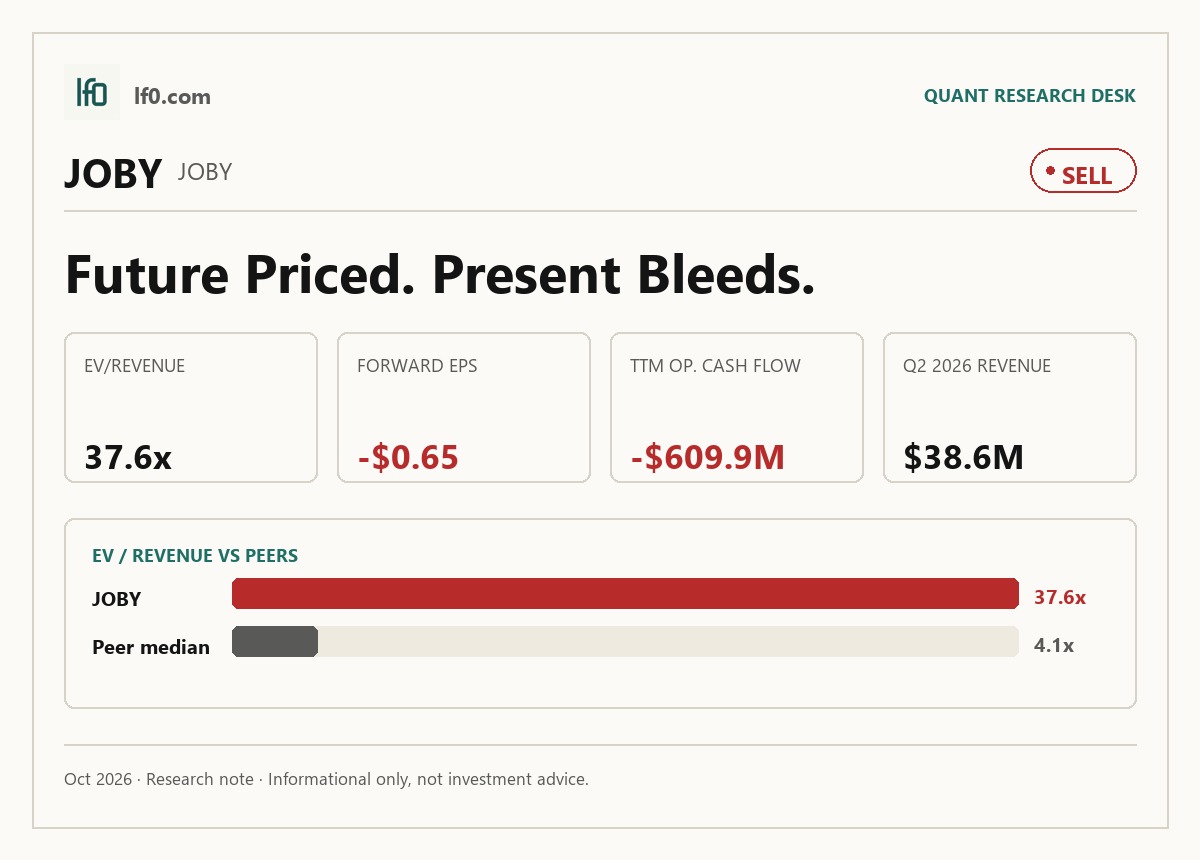
- Rated sell — valuation already discounts commercialization before earnings or cash flow.
- Strongest financial point: $2.3B cash gives runway, not profitability.
- Biggest financial risk: -$609.9M TTM operating cash flow keeps burning that runway.
- Valuation is rich at 37.6x EV/Revenue and 51.0x price/sales.
- I would raise my rating toward hold if quarterly revenue stays above $35M and EBITDA loss narrows.
Executive Summary
Rating: SELL | JOBY
We’ll begin tracking this call’s performance since publication once sufficient adjusted-close data is available.
I would put my rating as a sell because Joby Aviation is still valued for a commercial launch that has not yet translated into operating leverage. Revenue reached $38.6M in Q2 2026, but EBITDA was still -$249M and free cash flow remained deeply negative, so the stock is already discounting a scale-up that the income statement has not yet earned.
The key strength is the balance sheet. Joby ended the period with $2.3B of cash, which gives it time to finish certification and build production without immediate financing stress. The key risk is the -$609.9M TTM operating cash flow, because that burn rate keeps consuming the cushion and leaves the equity dependent on external capital until commercialization starts.
I would raise my rating toward hold if revenue can stay above $35M per quarter for two or more quarters, meaning the Q2 2026 step-up was not a one-off, and if EBITDA loss narrows materially from the current TTM level. That would tell me the market is finally seeing a real operating platform rather than a funded development program.
Company Profile
Joby Aviation designs, manufactures, and plans to operate a piloted all-electric vertical takeoff and landing aircraft for urban routes. The aircraft is targeted to carry one pilot and up to four passengers at speeds of up to 200 mph and a range of up to 100 miles. Joby expects revenue from owned and operated air taxi service, affiliate-operated service, and direct aircraft sales, including defense and other specialized markets.
The company was incorporated in Delaware in 2016 and went public in 2021 through a merger with Reinvent Technology Partners, a special purpose acquisition company. It acquired Blade Urban Air Mobility in August 2025 to add charter brokerage, customer access, and airport relationships. Joby operates in San Carlos and Marina, California, and is building a high-rate production site in Dayton, Ohio, where it bought a 130,000 square feet facility in Marina, California.
Economic Moat
Business Model
The most defensible element is the vertically integrated control of aircraft design, manufacturing, operations, and software, because I do not think a well-funded competitor can rebuild that stack, the FAA type-certification path, and the operating data loop within 3 years. Joby has spent more than a decade designing and testing its piloted eVTOL aircraft, and that long build has produced over 330 issued or allowed patents and over 250 pending patent applications as of January 31, 2026.
I think the real barrier is not the airframe alone but the combination of the aircraft, Elevate OS, the Part 135 air carrier certificate, the Part 145 repair station certificate, and the Part 141 flight school certificate, because those pieces let Joby learn from operations and feed that learning back into design and maintenance faster than a new entrant could. Secondary support comes from the noise profile of 10 times faster than driving, the use of more than 5,000 heliport and airport infrastructure facilities already in existence in the U.S., and the Toyota relationship, which includes nearly $650 million of investment as of December 31, 2025 and a 2023 long-term supply agreement for key powertrain and actuation components.
I also see the Dubai Road and Transport Authority agreement, the August 2025 Blade acquisition, and the 2025 memorandum of understanding with Abdul Latif Jameel as evidence that Joby is building route access and customer access before commercial launch, not after it. That matters because the moat is not just certification; it is the ability to pair certified aircraft with a usable operating network.
Business & Operating Risks
The biggest disclosed risk is certification slippage, because commercialization still depends on Type Certification, Production Certification, and an air carrier certificate under Part 119 with Part 135 operations specifications. The 2026 10-K says a future government shutdown, an FAA reauthorization failure, or reduced FAA staffing could delay the rulemaking and certification process.
That is not abstract for Joby. The company has already received its Part 135 Air Carrier Certificate, but the remaining approvals are still outstanding, so any delay pushes out revenue timing and keeps the business in pre-commercial cash burn longer; the financial data already shows that risk through continued losses of $929.8M in 2025 and another capital raise cycle. The filing also warns that the FAA or other regulators may disagree with the view that the service can fit into the National Airspace System without changes, and that any new rules for high-volume flights could raise costs or delay launch.
A second risk is market adoption and pricing. According to their SEC filings, the market for urban air mobility has not been established with precision, and customers may be reluctant to adopt the service or pay projected prices. That risk is already showing up in the financials as a business with only an early revenue base to absorb fixed costs, so the issue is not just hypothetical demand uncertainty.
A third risk is execution across manufacturing, supply chain, and safety. The 10-K says the company has not yet constructed a high-volume production facility, is still finalizing design and supplier selection, and may not be able to engage suppliers for remaining components in a timely manner, at acceptable prices, or at all. The filing also highlights the February 2022 prototype accident and says any similar event closer to launch could cause redesign, certification delay, or postponement of commercial service.
The disclosed risks do not break the moat itself, but they do threaten the timing and monetization of the certification-and-network advantage that is supposed to make the moat valuable.
Management Discussion & Analysis
Management is signaling a capital-intensive push to commercial launch, not a pause for balance-sheet repair. It raised $575.9M in net proceeds from the October 2025 underwritten offering, $249.9M from the Toyota Motor Corporation investment, and $670.4M from the February 2026 0.75% Convertible Senior Notes due 2032, while still saying it will use a mix of equity and debt until operating cash flow can fund the business.
That financing stack pushes runway out beyond the first passenger launch, but it also tells me the model is still being funded externally rather than self-financing, so dilution and future leverage remain part of the equity case. The Blade acquisition for approximately $92.4M is the clearest strategic move in the filing because it buys immediate market access, airport relationships, and infrastructure across New York City and Southern Europe, which should shorten the path to revenue but does not remove certification and utilization risk.
Management is also leaning on operating milestones, including the August 2025 public-airport flight in FAA-controlled airspace and the target to carry first passengers in 2026, yet the filing still frames the global urban air mobility market as undeveloped and admits there is no guarantee of future demand. In my view, the company is trying to answer the certification and adoption risks with capital, infrastructure, and operating proof points, but the cash burn means the response is still incomplete.
Management’s track record is mixed, with more slippage on timing than on strategic direction. In 2024’s 10-K, management targeted commercial passenger operations in 2025, while the 2025 filing shifted to first passengers in 2026, so the launch timetable slipped by at least one year even as certification progress continued. The repeated need for equity raises in 2024, 2025, and February 2026 shows that the capital intensity has remained higher than the narrative implied.
Recent Events
The most significant development I see here is the March 6, 2026 acquisition of a 728,000 square foot property in Vandalia, Ohio for $61.5M, funded with a $30.8M senior secured loan. That adds physical capacity and a long-dated financing structure, which supports Joby’s manufacturing buildout rather than leaving the company dependent on a purely cash-funded expansion.
The March 2, 2026 dismissal of Deloitte and appointment of PricewaterhouseCoopers LLP as auditor is a governance change, but the filing says there were no disagreements or reportable events. I read that as a clean auditor transition, so it does not weaken the thesis on its own, although it does add a small execution check for a pre-commercial company.
The June 2, 2026 annual meeting also reinforced continuity: all three Class II directors were elected and shareholders approved both PwC’s 2026 appointment and executive pay. The overall signal from recent 8-Ks is modestly constructive, because Joby is still adding infrastructure while avoiding any obvious governance or financing red flags.
Financial Analysis
Growth
JOBY — Financial Growth (Quarterly, USD Mil)
| Metric | 2025-06-30 | 2025-09-30 | 2025-12-31 | 2026-03-31 | 2026-06-30 |
|---|---|---|---|---|---|
| REVENUE (USD Mil) | 0 | 22.6 | 30.8 | 24.2 | 38.6 |
| EBITDA (USD Mil) | -158.1 | -171.5 | -195.7 | -222.6 | -249 |
| NET INCOME (USD Mil) | -324.7 | -401.2 | -121.5 | -110 | -245.4 |
| DILUTED EPS | -0.4 | -0.5 | -0.1 | -0.1 | -0.2 |
Source: Yahoo Finance — Quarterly Financial Statements
Revenue is still early and volatile, but the latest quarter was the strongest in the set: $38.6M in Q2 2026 versus $15M in Q2 2025, up 157% year over year, after $24.2M in Q1 2026 and $30.8M in Q4 2025. The step-up looks more like an early commercialization inflection than a smooth run rate, and the filing gives no clear explanation for the quarter-to-quarter swing.
EBITDA and earnings are not yet keeping pace with revenue because EBITDA was still -$249M in Q2 2026 and net income was -$245.4M, both worse than Q1 2026. That gap tells me the business is still in the investment phase, so revenue growth alone does not yet change the thesis.
Profitability
JOBY — Profitability (TTM)
| Metric | TTM |
|---|---|
| Operating Margin (TTM) | -675.2% |
| Net Margin (TTM) | 0.0% |
| Return on Assets (TTM) | -27.5% |
| Return on Equity (TTM) | -65.9% |
| Gross Margin (TTM) | 34.3% |
| EBITDA Margin (TTM) | -721.2% |
Source: Yahoo Finance — Trailing Twelve Months (TTM)
TTM gross margin was 34.3%, but TTM operating margin was -675.2% and TTM EBITDA margin was -721.2%, so the business is still far from operating leverage. The gap between gross profit and the deeply negative operating and EBITDA lines shows that research, certification, manufacturing setup, and corporate overhead are still overwhelming revenue.
TTM net margin was 0.0%, while TTM return on assets was -27.5% and TTM return on equity was -65.9%, confirming that capital is not yet earning a return and that equity value is being consumed by development spending. The ROE and ROA gap is wide, so leverage is amplifying weak returns rather than creating durable capital efficiency.
I would want to see operating margin move materially closer to positive territory and net margin stop lagging gross margin, because that would show fixed costs are finally being absorbed. Until then, profitability remains the clearest evidence that the company is still pre-scale.
Valuation
JOBY — Valuation Multiples
| Metric | Value |
|---|---|
| Current Share Price (USD) | 5.9 |
| Market Cap (USD Mil) | 5,928 |
| Enterprise Value (USD Mil) | 4,369 |
| Trailing P/E | — |
| Forward P/E | -9.2 |
| Price/Sales (TTM) | 51 |
| Price/Book (mrq) | 3.3 |
| EV/Revenue | 37.6 |
| EV/EBITDA | -5.2 |
| Beta (5Y Monthly) | 2.68 |
| FCF Yield % (TTM) | -7.4% |
| Forward EPS (USD) | -0.6 |
| Analyst Target Price – Low (USD) | 6 |
| Analyst Target Price – Mean (USD) | 10.7 |
| Analyst Target Price – High (USD) | 18 |
| # Analyst Opinions | 9 |
Source: Yahoo Finance
Joby trades on sales and asset value, not earnings, because trailing earnings are negative and forward earnings are still negative. The primary anchor is EV/Revenue at 37.6x, with price/sales at 51.0x and a current share price of $5.95. That combination implies the market is pricing in a very large commercial ramp from the 2026 passenger-launch target, plus eventual operating leverage that turns today’s loss-making platform into a high-margin transportation network.
The other multiples reinforce that read. Forward P/E is -9.2x and EV/EBITDA is -5.2x, so those earnings-based ratios are not useful cheapness signals yet because EBITDA and net income remain negative. Price/book is 3.3x, which is rich for a company with $1.79 book value per share and $2.29 cash per share, so the stock is already paying for more than the balance sheet.
On the analysis here, I would put fair value in a wide range of roughly $6-$18 per share, which is consistent with the analyst target range and shows how much of the valuation still depends on execution. That sits inside the current analyst consensus of $6.0 low, $10.7 mean, and $18.0 high across 9 opinions, so the market is not wildly out of line with Wall Street, but the spread also tells me conviction is still low. Forward EPS of -$0.65 is only slightly worse than the company’s own -$0.6 estimate in the peer table, which means the earnings path is still negative and the stock is being priced more on timing than on near-term profit.
FCF yield is -7.4%, and that is the clearest cash-burn signal here. With 9 analyst opinions, the target range around a $10.7 mean shows the market is still split on how quickly commercialization arrives. I think the valuation is rich relative to the current cash burn and the still-negative earnings base, even if the balance sheet gives the company time to execute.
Leverage
JOBY — Leverage & Coverage (Quarterly)
| Metric | Value |
|---|---|
| Total Debt/Equity % (mrq) | 42.3 |
| Current Ratio (mrq) | 18 |
| Total Debt (mrq, USD Mil) | 747.7 |
| Operating Cash Flow (TTM, USD Mil) | -609.9 |
| Levered Free Cash Flow (TTM, USD Mil) | -436.4 |
| Net Debt/EBITDA (TTM) | 1.8 |
| FCF Margin % (TTM) | -375.3% |
Source: Yahoo Finance — Quarterly Financial Statements
Joby’s leverage is modest on a debt basis but weak on cash generation. Total debt/equity was 42.3%, current ratio was 18.0, and total debt was $747.7M. The liquidity cushion is large, so near-term refinancing pressure is limited.
The more important issue is that operating cash flow was -$609.9M TTM and levered free cash flow was -$436.4M. FCF margin was -375.3%, so EBITDA is not converting into cash yet; the business is still funding development and operating losses rather than self-financing. I view that as a runway problem, not a debt problem, which is why the cash balance matters more than the leverage ratio.
Insider Activity
The insider transaction record I see here is dominated by sales, led by several large dispositions from the CEO, CFO, and a director. The pattern is concentrated rather than broad buying, which weakens the near-term alignment signal even though the longer-period summary still shows insiders as a meaningful ownership block.
That does not by itself change the thesis, but it does matter because a pre-commercial company depends heavily on management credibility. When insiders are selling into a period of heavy cash burn, I want to see especially clear operating progress before treating that as a positive signal.
Comparable Analysis
LF0 has published standalone analyses of these peers: AeroVironment (AVAV) (rated Sell); Archer Aviation (ACHR) (rated Sell); Uber Technologies (UBER) (rated Hold).
Growth
| Company | Revenue TTM (USD Mil) | Revenue Growth YoY % | Diluted EPS TTM |
|---|---|---|---|
| JOBY | 116.3 | 257,493.3% | -1 |
| AVAV | 2,002.7 | 5.7% | -4.1 |
| KTOS | 1,522.5 | 30.5% | 0.2 |
| ACHR | 6.9 | — | -1.1 |
| EH | 382.1 | -47.1% | -0.7 |
| UBER | 55,227 | 12.2% | 4.6 |
Source: Yahoo Finance
Joby’s revenue was $116.3M TTM, but the reported 257,493.3% year-over-year growth is a base-effect artifact from a near-zero starting point, so it does not justify a premium on its own. Against AVAV’s 5.7% and UBER’s 12.2% revenue growth, Joby is still the most speculative name in the group, which means the market is paying for future certification and scale rather than current operating traction.
Valuation
| Company | Current Share Price (USD) | Trailing P/E | Forward P/E | EV/Revenue | EV/EBITDA | Price/Sales (TTM) | Price/Book (mrq) | Market Cap (USD Mil) | Enterprise Value (USD Mil) | Beta (5Y Monthly) | FCF Yield % (TTM) | Forward EPS | Analyst Target Price – Low | Analyst Target Price – Mean | Analyst Target Price – High | # Analyst Opinions |
|---|---|---|---|---|---|---|---|---|---|---|---|---|---|---|---|---|
| JOBY | 5.9 | — | -9.2 | 37.6 | -5.2 | 51 | 3.3 | 5,928 | 4,369 | 2.68 | -7.4% | -0.6 | 6 | 10.7 | 18 | 9 |
| AVAV | 140.8 | — | 31.6 | 3.7 | 33.8 | 3.6 | 1.6 | 7,157 | 7,401 | 1.41 | -0.4% | 4.5 | 148.6 | 219.3 | 315 | 19 |
| KTOS | 43.1 | 253.4 | 39.1 | 4.5 | 78.6 | 5.3 | 2.4 | 8,076 | 6,841 | 1.11 | -1.5% | 1.1 | 60 | 102.2 | 150 | 21 |
| ACHR | 4.9 | — | -6.1 | 341.1 | -2.6 | 545.7 | 2 | 3,765 | 2,354 | 3.23 | -10.0% | -0.8 | 4.5 | 10.6 | 18 | 9 |
| EH | 4.1 | — | 29.7 | 0 | 0 | 0.8 | 2.3 | 314 | -11 | 1.17 | — | 0.1 | 3.9 | 10 | 20.5 | 10 |
| UBER | 68.1 | 14.9 | 15.4 | 2.7 | 20 | 2.5 | 5.1 | 139,119 | 149,542 | 1.16 | 5.2% | 4.4 | 70 | 100.8 | 150 | 46 |
Source: Yahoo Finance
Joby trades at 37.6x EV/Revenue and 51.0x price/sales, versus AVAV at 3.7x and 3.6x, KTOS at 4.5x and 5.3x, ACHR at 341.1x and 545.7x, EH at 0.0x and 0.8x, and UBER at 2.7x and 2.5x. The only cleaner cash-flow anchor is Joby’s -7.4% FCF yield, which is better than ACHR’s -10.0% but far worse than UBER’s 5.2%.
On forward EPS, Joby is -$0.65 versus AVAV at $4.5, KTOS at $1.1, ACHR at -$0.8, EH at $0.1, and UBER at $4.4, so the stock is pricing a commercialization path that is not yet visible in earnings. Using peer EV/Revenue on Joby’s $116.3M revenue gives an illustrative EV range of roughly $0.3B to $39.7B, or about $0 to $37.9 per share after netting cash and debt and dividing by 996.3M shares; that wide range shows how much of the valuation is still option value, not fundamentals. The market is clearly paying for a future operating platform, but the current margin profile does not yet support a premium on a like-for-like basis.
Profitability
| Company | Operating Margin (TTM) | Net Margin (TTM) | Return on Assets (TTM) | Return on Equity (TTM) | Gross Margin (TTM) | EBITDA Margin (TTM) |
|---|---|---|---|---|---|---|
| JOBY | -675.2% | 0.0% | -27.5% | -65.9% | 34.3% | -721.2% |
| AVAV | -2.3% | -10.1% | -0.1% | -4.6% | 26.5% | 10.9% |
| KTOS | -0.2% | 2.0% | 0.4% | 1.1% | 23.0% | 5.7% |
| ACHR | -5,514.0% | 0.0% | -28.1% | -44.5% | 14.5% | -13,127.5% |
| EH | -169.1% | -91.3% | -13.3% | -36.5% | 61.5% | -95.1% |
| UBER | 13.3% | 17.3% | 6.9% | 37.2% | 40.8% | 13.5% |
Source: Yahoo Finance
Joby’s gross margin is 34.3%, which is better than AVAV’s 26.5%, KTOS’s 23.0%, ACHR’s 14.5%, and close to UBER’s 40.8%, but the operating margin is -675.2% and EBITDA margin is -721.2%, far worse than AVAV’s -2.3% and UBER’s 13.3%. The problem is not cost of revenue alone; it is that R&D and launch costs still overwhelm gross profit.
That gap is why Joby’s returns are so weak. ROE of -65.9% and ROA of -27.5% are much worse than AVAV’s -4.6% and -0.1%, KTOS’s 1.1% and 0.4%, and UBER’s 37.2% and 6.9%, which tells me capital efficiency is not yet in the same league. The profitability gap also explains why the valuation multiple is hard to defend today: the market is paying for a margin profile that has not arrived.
Leverage
| Company | Total Debt/Equity % (mrq) | Current Ratio (mrq) | Total Debt (mrq, USD Mil) | Operating Cash Flow TTM (USD Mil) | Free Cash Flow TTM (USD Mil) | Net Debt/EBITDA (TTM) | FCF Margin % (TTM) |
|---|---|---|---|---|---|---|---|
| JOBY | 42.3 | 18 | 747.7 | -609.9 | -436.4 | 1.8 | -375.3% |
| AVAV | 19.4 | 4.3 | 850.8 | 58.8 | -25.9 | 1.2 | -1.3% |
| KTOS | 5.7 | 5.5 | 193.6 | -39.6 | -118.3 | -14.3 | -7.8% |
| ACHR | 6.6 | 10.2 | 125.6 | -540.4 | -376.4 | 1.6 | -5,455.6% |
| EH | 63.9 | 1.8 | 578.1 | — | — | 0.9 | — |
| UBER | 51.9 | 0.8 | 14,731 | 10,424 | 7,244.8 | 1.2 | 13.1% |
Source: Yahoo Finance
Joby’s debt/equity is 42.3%, above AVAV’s 19.4% and UBER’s 51.9%, but its $2.3B cash and 18.0 current ratio leave it much more liquid than AVAV’s 4.3 or UBER’s 0.8. Net debt/EBITDA of 1.8x is manageable versus AVAV’s 1.2x and UBER’s 1.2x, but the negative FCF margin of -375.3% is the real issue because it shows the cash pile is funding development rather than creating self-sustaining financing capacity.
That also helps explain why Joby can look safer on liquidity than on valuation. A large cash balance buys time, but it does not justify a premium multiple unless the company turns that runway into operating leverage.
Conclusion
I would put my rating as a sell because Joby still needs certification, utilization, and manufacturing execution to line up at the same time, and the financials do not yet show that the commercial ramp is taking hold. The balance sheet buys time, but it does not change the fact that the stock is already pricing in a commercial outcome that the numbers have not yet earned.
The bull case is straightforward: if quarterly revenue can hold above $35M for two or more quarters and EBITDA loss narrows materially from the current TTM level, I would move the rating toward hold because that would show the Q2 2026 step-up was not a one-off. If first passenger service in 2026 turns into repeatable bookings and operating cash burn moves meaningfully lower, the market could start to treat the business as a real operating platform rather than a funded development program.
The bear case is that certification slips again and the commercial ramp stays uneven, which would keep losses wide while cash burn continues. If operating cash flow stays near the current -$609.9M TTM pace, the $2.3B cash balance gets consumed quickly, and a slower launch would push the equity back toward a financing overhang rather than a rerating. In that scenario, the 37.6x EV/Revenue multiple would look even harder to defend because it would be sitting on top of a business that is still not converting revenue into cash.
Weighing both sides, I lean to the bear case because the company still needs certification, utilization, and manufacturing execution to line up at the same time, and that is a lot to ask at this stage. The balance sheet buys time, but it does not change the fact that the stock is already pricing in a commercial outcome that the financials have not yet earned.
What to Watch Next
- Quarterly revenue above $35M — would support the view that Q2 2026 was not a one-off.
- EBITDA loss narrowing from -$249M — would show operating leverage is starting to emerge.
- Operating cash flow moving materially above -$609.9M TTM — would reduce runway pressure.
- First passenger service in 2026 turning into repeatable bookings — would strengthen the commercialization case.
- Certification progress without new FAA delays — would keep the launch timetable intact.
What’s your take? I rated Joby Aviation (JOBY) SELL above — but the goal here is to get this right, not just to publish an opinion. What would you add to this analysis, or which risk or catalyst do you think I’m under- or over-weighting? Tell me in the comments.
Sources
- SEC 10-K Annual Report — filed 2026-02-27
- SEC 8-K Filing (2026-06-04)
- SEC 8-K Filing (2026-05-05)
- SEC 8-K Filing (2026-04-22)
- SEC 8-K Filing (2026-03-11)
- SEC 8-K Filing (2026-03-06)
- SEC 8-K Filing (2026-02-25)
- SEC Form 4 Insider Transaction (2026-06-08)
- SEC Form 4 Insider Transaction (2026-06-03)
- SEC Form 4 Insider Transaction (2026-06-03)
- SEC 10-K Annual Report — FY2026
- SEC 10-K Annual Report — FY2025
- SEC 10-K Annual Report — FY2024
- SEC 10-K Annual Report — FY2023
- SEC 10-K Annual Report — FY2022
Data sourced from Yahoo Finance and SEC EDGAR. Not investment advice.
Leave a Comment