| Company | Oct 25 | Nov 25 | Dec 25 | Jan 26 | Feb 26 | Mar 26 | Apr 26 | May 26 | Jun 26 | Jul 26 | Aug 26 | Sep 26 | 12-Mo |
|---|---|---|---|---|---|---|---|---|---|---|---|---|---|
| AVAV | +17% | -24% | -13% | +15% | -9% | -27% | +7% | +6% | -20% | -10% | -1% | -4% | -55% |
| KTOS | -1% | -16% | -0% | +36% | -16% | -18% | -11% | +2% | -22% | -7% | +9% | -16% | -53% |
| RKLB | +31% | -33% | +66% | +15% | -14% | -7% | +28% | +74% | -29% | -36% | -2% | +9% | +45% |
| LUNR | +13% | -20% | +71% | +17% | -13% | +13% | +37% | +73% | -51% | -42% | +24% | -7% | +35% |
| RDW | -12% | -30% | +38% | +55% | -23% | -6% | +8% | +167% | -50% | -30% | +24% | -2% | +16% |
| PL | +4% | -12% | +66% | +27% | -3% | +16% | +32% | +38% | -35% | -38% | -3% | -17% | +26% |
Source: Yahoo Finance monthly adjusted close.
Quick Thesis
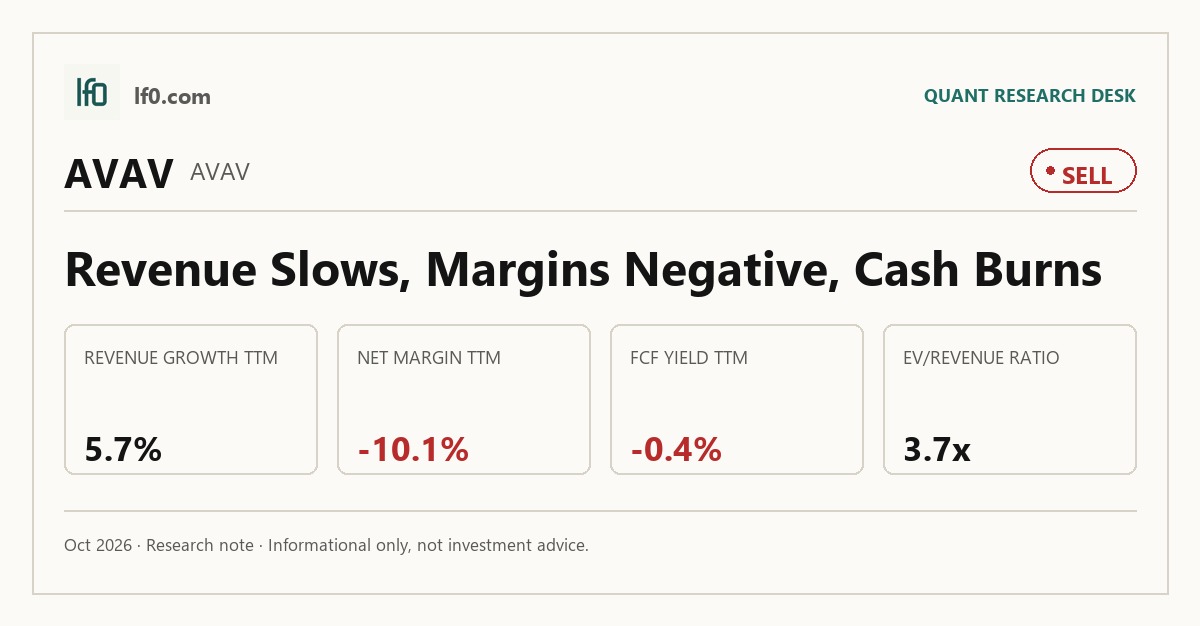
- Rated sell — valuation still assumes margin repair that the latest numbers do not show.
- Best strength: $580.2M cash and a 4.3x current ratio.
- Main risk: -$25.9M levered free cash flow and -0.4% FCF yield.
- Valuation is rich at 33.7x EV/EBITDA and 3.68x EV/revenue.
- I would turn more constructive only if operating margin turns positive and stays there.
Executive Summary
Rating: SELL | AVAV
We’ll begin tracking this call’s performance since publication once sufficient adjusted-close data is available.
I would put my rating as a sell because AeroVironment’s defense demand base is real, but the stock already discounts a much cleaner earnings path than the latest cash-flow and margin data support. Revenue was $480M in Q3 2026 and $642M in Q2 2026, yet levered free cash flow was still -$25.9M TTM and operating margin was -2.3% TTM, so growth is not yet converting into shareholder value.
The key strength is the installed-platform moat: customers buy hardware, training, spares, support, and upgrades tied to systems already embedded with defense users, and I feel that relationship is hard to replicate quickly. The key risk is execution, not demand; the business is still absorbing R&D and program costs faster than it is turning revenue into cash.
I would raise my rating more towards a buy if operating margin turns positive and stays there for two consecutive quarters, because that would show the company is finally absorbing overhead across a larger revenue base. I would also want to see quarterly revenue hold above $500M without another large earnings swing, which would tell me the Q2 2026 spike was not just timing noise.
Company Profile
AeroVironment designs, develops, produces, delivers, and supports uncrewed aircraft systems, uncrewed ground vehicles, and loitering munitions systems for the U.S. Department of Defense, other federal agencies, allied governments, and select commercial customers. Revenue comes mainly from product sales, support services, customer-funded research and development, and long-term government contracts, with 88% of fiscal 2024 revenue from fixed-price contracts and 11% from cost-reimbursable contracts.
Founded in 1971 and reincorporated in Delaware in 2006, the company has expanded through internal development and acquisitions, including Tomahawk Robotics, whose Kinesis control software is being integrated into small uncrewed aircraft systems. It is headquartered in Arlington, Virginia, with major facilities in Simi Valley, Petaluma, Erie, and Stuttgart, and it listed on Nasdaq under AVAV.
Economic Moat
Business Model
The moat is built on an installed base of uncrewed systems and loitering munitions already embedded with U.S. and allied users, because those customers buy not just hardware but training, spares, support, and upgrades tied to specific platforms and control systems. In my view, that customer intimacy, field experience, and integration depth are hard to copy quickly, especially when the systems are already operating in contested environments and are supported by a global business development team, depot network, and training teams.
AeroVironment also has a secondary moat in intellectual property, with 316 U.S. patents and 79 pending U.S. patent applications as of April 30, 2024, plus trade secrets and proprietary software. I think the more durable advantage is still the procurement footprint: long-term government contracts, follow-on orders, sustainment work, and IDIQ tasking tend to favor incumbents already inside the customer workflow.
Business & Operating Risks
The biggest disclosed risk is dependence on U.S. government demand, because sales to the U.S. government and its agencies were approximately 76.0% of revenue in fiscal 2024 and the DoD alone was approximately 28.0%. According to the risk factors in their SEC 10-K, a decline in government budgets, changes in spending priorities, or delays in contract awards could cut future revenue, and that is a real issue for a business tied to annual appropriations and contract definitization.
Competitive pressure is also meaningful. The filing names larger defense primes and specialist drone rivals across SUAS, MUAS, LMS, UGVs, and HAPS UAS, which matters because AeroVironment may have to accept lower payments or lose subcontracting opportunities when larger firms bundle broader contracts. Supply chain risk is equally concrete: some components are sole source, lead times have been stretched by shortages, and rising costs for components, shipping, warehousing, and inventory have already been experienced.
Contract and compliance exposure adds another layer. The company is subject to the Federal Acquisition Regulation, the Truth in Negotiations Act, the False Claims Act, export controls, FAA rules, security clearances, and the DoD’s CMMC program, and failure could lead to fines, suspension, debarment, or loss of export privileges. The disclosed risks do not break the moat, but they do test it by making execution, compliance, and supply continuity part of the competitive edge rather than a backdrop.
Management Discussion & Analysis
Management is still pushing capital into growth rather than into balance-sheet repair, and that tells me the company is prioritizing capability expansion over de-risking the capital structure. AeroVironment closed the Tomahawk acquisition for $134.4M, paid $109.8M in stock and $24.2M from cash on hand net of cash acquired, and then prepaid $8M of term-loan principal, so the funding mix is still acquisition-led rather than deleveraging-led.
The operating message is that demand remains strong in loitering munitions and uncrewed systems, but the economics are uneven. LMS revenue rose $192.6M in fiscal 2024 to $448.0M, which supports management’s growth narrative, yet MW revenue was flat at $76.1M and the segment adjusted loss widened, so the broader autonomy bet is still a cash drag. That split matters for the moat: the core defense platforms are compounding, but the newer software and robotics layer has not yet proven that it can earn its keep.
Management also says existing cash, operating cash flow, and credit facilities should cover the next twelve months, but cash from operations was only $58.82M in fiscal 2024 against $23M of capital spending. I read that as a sign that the company can fund itself near term, though not yet on a clean free-cash-flow basis.
Recent Events
The most important development was the BlueHalo merger agreement announced on 2024-11-18. AeroVironment agreed to issue 18.5 million shares, or about 39.5% of the pro forma company, which should broaden the defense-tech platform but also raises dilution and integration risk.
A credit amendment on 2024-10-04 added a $200M revolving facility due 2029 and drew $15M, which gives the company more flexibility for acquisitions and working capital. The lease extension at 900 Innovators Way in Simi Valley through May 2030 also signals a longer product cycle, not a short-term retrenchment.
The cleanest positive came on 2024-12-16, when the GAO denied the protest against the Army’s $990M sole-source Switchblade award. In my view, that removes a material overhang and confirms the company’s position in loitering munitions. The recent filings therefore strengthen the moat thesis, but they also show that AeroVironment is leaning harder into scale and integration risk at the same time.
Financial Analysis
Growth
AVAV — Financial Growth (Quarterly, USD Mil)
| Metric | 2025-07-31 | 2025-10-31 | 2026-01-31 | 2026-04-30 | 2026-07-31 |
|---|---|---|---|---|---|
| REVENUE (USD Mil) | 454.7 | 472.5 | 408 | 641.6 | 480.5 |
| EBIT (USD Mil) | -69.3 | -30.2 | -27.7 | -172.8 | -10.9 |
| EBITDA (USD Mil) | 21 | 27.8 | 26.9 | -110.7 | 45.2 |
| NET INCOME (USD Mil) | -67.4 | -17.1 | -243.8 | -24.1 | -5.1 |
| DILUTED EPS | -1.4 | -0.3 | -4.9 | 1.2 | -0.1 |
Source: Yahoo Finance — Quarterly Financial Statements
Revenue was $454.7M in Q3 2025, $472.5M in Q4 2025, $408M in Q1 2026, $641.6M in Q2 2026, and $480.5M in Q3 2026. The pattern is choppy, and the Q2 2026 spike looks more like program timing than a clean step-up in run rate.
EBITDA moved from $21M to $27.8M and $26.9M before swinging to -$110.7M in Q2 2026 and rebounding to $45.2M in Q3 2026, so earnings are far more volatile than revenue. That volatility matters because a defense contractor with lumpy quarterly results can still be investable, but only if the underlying contract cadence is translating into steadier margin conversion over time.
Profitability
AVAV — Profitability (TTM)
| Metric | TTM |
|---|---|
| Operating Margin (TTM) | -2.3% |
| Net Margin (TTM) | -10.1% |
| Return on Assets (TTM) | -0.1% |
| Return on Equity (TTM) | -4.6% |
| Gross Margin (TTM) | 26.5% |
| EBITDA Margin (TTM) | 10.9% |
Source: Yahoo Finance — Trailing Twelve Months (TTM)
TTM gross margin was 26.5%, EBITDA margin was 10.9%, operating margin was -2.3%, and net margin was -10.1%. The spread from gross margin to operating margin is wide, which tells me the core product layer is profitable but overhead, R&D, and program costs still absorb too much before earnings reach the bottom line.
Return on assets was -0.132% TTM and return on equity was -4.6% TTM, so the asset base and shareholder capital are still earning below zero on a GAAP basis. I would watch for operating margin turning positive first, because that would show the business is finally absorbing fixed costs across a larger revenue base.
Valuation
AVAV — Valuation Multiples
| Metric | Value |
|---|---|
| Current Share Price (USD) | 140.3 |
| Market Cap (USD Mil) | 7,131 |
| Enterprise Value (USD Mil) | 7,375 |
| Forward P/E | 31.5 |
| Price/Sales (TTM) | 3.6 |
| Price/Book (mrq) | 1.6 |
| EV/Revenue | 3.7 |
| EV/EBITDA | 33.7 |
| Beta (5Y Monthly) | 1.41 |
| FCF Yield % (TTM) | -0.4% |
| Forward EPS (USD) | 4.5 |
| Analyst Target Price – Low (USD) | 148.6 |
| Analyst Target Price – Mean (USD) | 219.3 |
| Analyst Target Price – High (USD) | 315 |
| # Analyst Opinions | 19 |
Source: Yahoo Finance
AVAV trades at 3.68x EV/revenue and 3.56x price/sales on a current share price of $140, while forward P/E is 31.5x on forward EPS of $4.46. That is not a cheap setup for a business with -2.3% TTM operating margin and -0.4% TTM FCF yield, so the market is clearly paying for margin repair that has not yet shown up in the cash flow.
On my read, fair value sits in a broad $150–$220 range. That range is above the current price but below the $219 analyst mean and well below the $315 high, which tells me I am more cautious than consensus because I weight cash conversion and quarterly volatility more heavily than the target-price set appears to. The company’s 19 analyst opinions are real coverage, so I do not think the consensus is thin; I just think the market is giving too much credit to a profit step-up that still needs to be proven.
I would also frame the earnings path as a $4.0–$5.0 forward EPS band, with $4.5 already embedded in the data. That is not expensive versus the current share price if margins keep improving, but on a like-for-like basis it still looks richer than peers with stronger near-term growth or cleaner cash conversion.
Leverage
AVAV — Leverage & Coverage (Quarterly)
| Metric | Value |
|---|---|
| Total Debt/Equity % (mrq) | 19.4 |
| Current Ratio (mrq) | 4.3 |
| Total Debt (mrq, USD Mil) | 850.8 |
| Levered Free Cash Flow (TTM, USD Mil) | -25.9 |
| Net Debt/EBITDA (TTM) | 1.2 |
| FCF Margin % (TTM) | -1.3% |
Source: Yahoo Finance — Quarterly Financial Statements
Total debt was $850.8M against a current ratio of 4.3x and total debt/equity of 19.4%, so the balance sheet has room to absorb a downturn without immediate liquidity stress. Cash generation is mixed: operating cash flow was $58.8M TTM, but levered free cash flow was -$25.9M TTM and FCF margin was -1.3% TTM, which means EBITDA is not yet converting cleanly into cash after capex and financing costs.
Net debt/EBITDA was 1.2x TTM, a moderate leverage load rather than a stretched one. Total cash was $580.2M, which gives near-term flexibility, but the negative free cash flow means that cushion can erode if working capital stays heavy or if a refinancing date arrives before cash conversion improves.
Insider Activity
The insider record here is one-sided: 13 open-market sales and 0 open-market purchases in the 2024-12-31 to 2026-05-15 window. Selling was concentrated, with PAGE STEPHEN F accounting for most of the activity while the CFO and Chief Accounting Officer added smaller sales, so alignment looks weak rather than broad-based.
Comparable Analysis
LF0 has published standalone analyses of these peers: Redwire (RDW) (rated Sell); Planet Labs (PL) (rated Sell).
Growth
| Company | Revenue TTM (USD Mil) | Revenue Growth YoY % | EBITDA TTM (USD Mil) | Diluted EPS TTM |
|---|---|---|---|---|
| AVAV | 2,002.7 | 5.7% | 218.8 | -4 |
| KTOS | 1,522.5 | 30.5% | 87 | 0.2 |
| RKLB | 769.1 | 62.0% | -150.5 | -0.3 |
| LUNR | 490.1 | 309.8% | -74.4 | -0.9 |
| RDW | 426.3 | 89.6% | -121.3 | -1.2 |
| PL | 378.3 | 58.1% | -48.4 | -1.1 |
Source: Yahoo Finance
AVAV’s revenue growth of 5.7% TTM trails KTOS at 30.5%, RKLB at 62.0%, LUNR at 309.8%, RDW at 89.6%, and PL at 58.1%, so it is being valued against a much slower top-line profile than the faster-growing space names. That said, AVAV’s TTM diluted EPS of -$4.0 is still better than the deeper losses at RKLB, LUNR, RDW, and PL, which means the growth gap is not just about speed; it is also about how much cash the companies burn to get there.
Valuation
| Company | Current Share Price (USD) | Forward P/E | EV/Revenue | EV/EBITDA | Price/Sales (TTM) | Price/Book (mrq) | Market Cap (USD Mil) | Enterprise Value (USD Mil) | Beta (5Y Monthly) | FCF Yield % (TTM) | Forward EPS | Analyst Target Price – Low | Analyst Target Price – Mean | Analyst Target Price – High | # Analyst Opinions |
|---|---|---|---|---|---|---|---|---|---|---|---|---|---|---|---|
| AVAV | 140.3 | 31.5 | 3.7 | 33.7 | 3.6 | 1.6 | 7,131 | 7,375 | 1.41 | -0.4% | 4.5 | 148.6 | 219.3 | 315 | 19 |
| KTOS | 42.8 | 38.9 | 4.5 | 78.1 | 5.3 | 2.3 | 8,030 | 6,794 | 1.11 | -1.5% | 1.1 | 60 | 102.2 | 150 | 21 |
| RKLB | 70.5 | 1,546.5 | 52 | -265.7 | 58.6 | 12.1 | 45,053 | 39,991 | 2.61 | -0.6% | 0 | 64 | 109.2 | 150 | 20 |
| LUNR | 14.1 | -90.6 | 7.7 | -50.4 | 4.6 | -8.2 | 2,268 | 3,750 | 1.85 | -3.5% | -0.2 | 13 | 29.5 | 43 | 8 |
| RDW | 10.6 | -31.1 | 5.1 | -17.9 | 6.2 | 1.6 | 2,642 | 2,165 | 3.09 | -1.0% | -0.3 | 8 | 14.7 | 20 | 8 |
| PL | 16.1 | -12,912 | 14.6 | -113.8 | 15.5 | 13 | 5,873 | 5,506 | 2.11 | 0.9% | 0 | 22 | 33.4 | 50 | 10 |
Source: Yahoo Finance
AVAV’s EV/revenue of 3.68x and price/sales of 3.56x sit below KTOS at 4.5x and 5.3x, far below RKLB at 52.0x and 58.6x, but above LUNR at 7.7x and 4.6x and well below PL at 14.6x and 15.5x. On a growth-adjusted basis, that looks reasonable only if AVAV can turn its current revenue base into cleaner earnings, because the market is not paying a growth premium for it the way it is for RKLB.
Using the peer EV/revenue range of 4.5x to 14.6x on AVAV’s $2B revenue implies EV of about $8.9B to $29.1B. After netting debt and cash, that still leaves a wide implied equity range, but I think the lower end is the more relevant anchor because AVAV’s cash conversion is still negative and its leverage is not low enough to justify a premium multiple on its own.
Profitability
| Company | Operating Margin (TTM) | Net Margin (TTM) | Return on Assets (TTM) | Return on Equity (TTM) | Gross Margin (TTM) | EBITDA Margin (TTM) |
|---|---|---|---|---|---|---|
| AVAV | -2.3% | -10.1% | -0.1% | -4.6% | 26.5% | 10.9% |
| KTOS | -0.2% | 2.0% | 0.4% | 1.1% | 23.0% | 5.7% |
| RKLB | -24.6% | -21.5% | -4.6% | -7.9% | 37.3% | -19.6% |
| LUNR | -18.1% | -26.6% | -5.5% | -30.8% | 16.4% | -15.2% |
| RDW | -18.9% | -57.3% | -6.1% | -18.2% | 22.7% | -28.4% |
| PL | -12.0% | -95.1% | -5.0% | -72.0% | 55.5% | -12.8% |
Source: Yahoo Finance
AVAV’s gross margin of 26.5% is above KTOS at 23.0%, RDW at 22.7%, and LUNR at 16.4%, but its operating margin of -2.3% and EBITDA margin of 10.9% lag KTOS at -0.2% and 5.7%. That pattern points to a scale and opex issue rather than a cost-of-revenue problem: AVAV can make a decent gross profit, but it is still spending too much below the gross line to turn that into durable operating profit.
Leverage
| Company | Total Debt/Equity % (mrq) | Current Ratio (mrq) | Total Debt (mrq, USD Mil) | Operating Cash Flow TTM (USD Mil) | Free Cash Flow TTM (USD Mil) | Net Debt/EBITDA (TTM) | FCF Margin % (TTM) |
|---|---|---|---|---|---|---|---|
| AVAV | 19.4 | 4.3 | 850.8 | 58.8 | -25.9 | 1.2 | -1.3% |
| KTOS | 5.7 | 5.5 | 193.6 | -39.6 | -118.3 | -14.3 | -7.8% |
| RKLB | 3.8 | 5.5 | 133.7 | -222.5 | -252 | 14.4 | -32.8% |
| LUNR | 52.8 | 1.7 | 481.4 | -126.3 | -80 | -1.5 | -16.3% |
| RDW | 5.5 | 3.9 | 90.3 | -76.2 | -26 | 3.8 | -6.1% |
| PL | 88.4 | 2.8 | 498.6 | 117.6 | 51.8 | 7.6 | 13.7% |
Source: Yahoo Finance
AVAV’s debt/equity of 19.4% is higher than KTOS at 5.7% and RKLB at 3.8%, but its net debt/EBITDA of 1.2x is far safer than RKLB at 14.4x and RDW at 3.8x. The current ratio of 4.3x also stands out as a liquidity cushion, yet the -1.3% FCF margin shows that balance-sheet strength is a support, not a source of upside.
Conclusion
The tension in this name is simple: the moat is real, but the cash conversion is not yet good enough to justify paying ahead of it. AVAV has a defense demand base, a sticky installed platform, and a balance sheet that can absorb volatility, yet the latest numbers still show -2.3% operating margin TTM and -$25.9M of levered free cash flow TTM, so the business is growing without proving that growth can reliably turn into cash.
I would raise my rating more towards a buy if operating margin turns positive and stays there for two consecutive quarters, because that would show the company is finally absorbing R&D and overhead across a larger revenue base. On the current TTM revenue run rate of about $2B, a move to a positive $106M operating margin would add roughly $106M of annual operating profit, which would materially improve free cash flow and narrow the gap between reported growth and shareholder value creation. I would also want to see quarterly revenue hold above $500M without another large earnings swing, because that would tell me the Q2 2026 spike was not just timing noise.
I would move from sell to hold if revenue slips back below $420M in a quarter while levered free cash flow stays negative, because that would show the company is still dependent on lumpy contract timing rather than a steadier demand base. I would turn more cautious if the BlueHalo integration adds another quarter of EBITDA volatility or if net debt/EBITDA moves materially above 1.5x, since the current 1.2x level is manageable but not forgiving when cash generation is this thin.
Weighing both sides, I think the bull case needs one more clean quarter of margin conversion before it can outrun the bear case. The installed base, backlog, and government demand are real, but until the company shows that higher revenue can produce positive operating margin and free cash flow, I would rather wait than pay ahead of proof.
What to Watch Next
- Operating margin turning positive for two straight quarters — would support a move toward buy.
- Quarterly revenue holding above $500M — would suggest the Q2 2026 spike was not just timing noise.
- Levered free cash flow staying negative — would keep the sell case intact.
- Net debt/EBITDA moving above 1.5x — would make the balance sheet less forgiving.
- BlueHalo integration volatility — another weak quarter would argue for more caution.
What’s your take? I rated AeroVironment (AVAV) SELL above — but the goal here is to get this right, not just to publish an opinion. What would you add to this analysis, or which risk or catalyst do you think I’m under- or over-weighting? Tell me in the comments.
Sources
- SEC 10-K Annual Report — filed 2024-06-27
- SEC 8-K Filing (2024-12-16)
- SEC 8-K Filing (2024-12-04)
- SEC 8-K Filing (2024-11-19)
- SEC 8-K Filing (2024-10-18)
- SEC 8-K Filing (2024-10-08)
- SEC 8-K Filing (2024-10-03)
- SEC Form 4 Insider Transaction (2026-05-18)
- SEC Form 4 Insider Transaction (2026-04-21)
- SEC Form 4 Insider Transaction (2026-04-20)
Data sourced from Yahoo Finance and SEC EDGAR. Not investment advice.
Leave a Comment