
Executive Summary
Rating: HOLD | LASR
Measured from adjusted close on 2026-06-29 to 2026-09-25. Sell ratings are correct when the stock falls; Hold is tracked as a +/-10% range. Daily-close data, not intraday. Calls are tracked for 182 days from publication, then frozen as a final record.
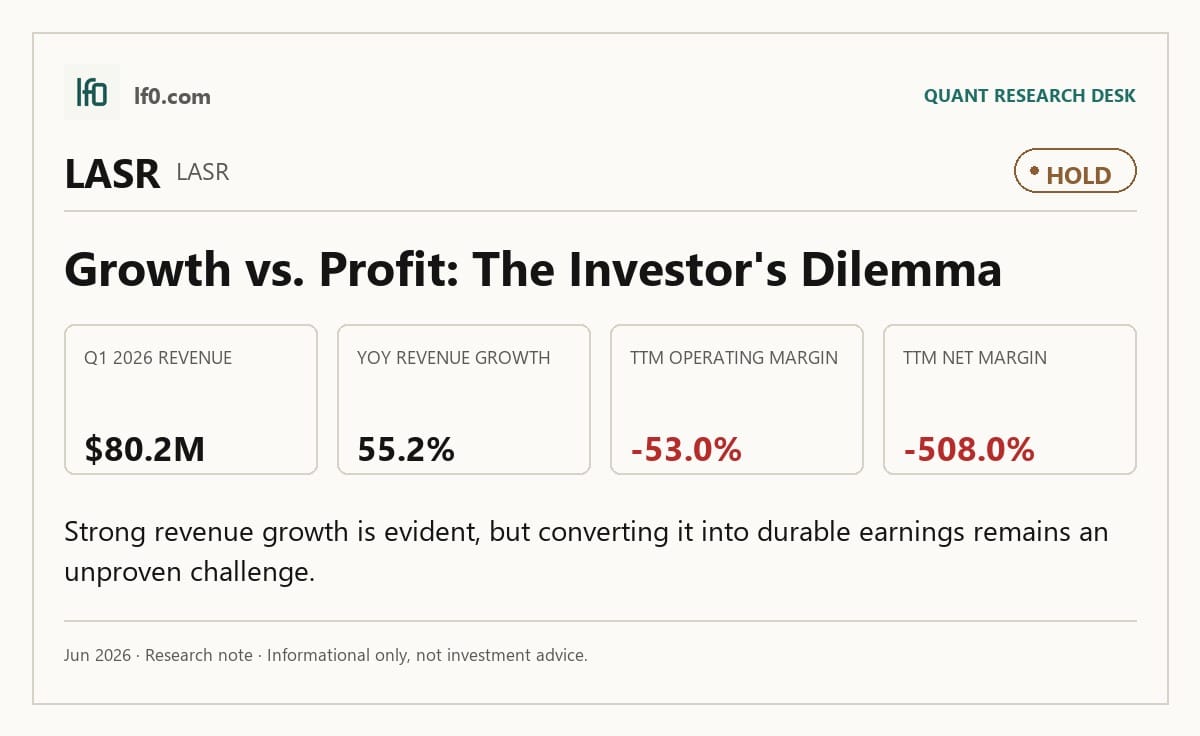
I would put my rating as a Hold because nLIGHT is growing quickly, but the market is already discounting a cleaner earnings path than the company has yet delivered. Revenue reached $80.2M in Q1 2026, up 55.2% year over year, yet EBITDA was only $4.37M and TTM operating margin was still -0.529%, so I think the stock is priced for margin expansion that has not fully shown up. I would raise my rating more towards a Buy if nLIGHT can keep EBITDA positive for several quarters while gross margin holds near 39.2%, because that would tell me the defense mix is turning into durable cash earnings rather than a one-quarter lift.
Company Profile
nLIGHT designs and manufactures high-power semiconductor lasers, fiber lasers, fiber amplifiers, and beam-combining systems for aerospace and defense, industrial, and microfabrication uses. It sells to more than 300 customers worldwide, and the top ten customers accounted for about 75% of 2025 revenue. The company also performs funded advanced development work for government-directed energy and laser-sensing programs. It is listed on Nasdaq under LASR and operates manufacturing sites in Washington, Oregon, Colorado, and Finland.
Economic Moat
Business Model
The clearest structural edge is nLIGHT’s patented multiplexed single-chip architecture, which lets it combine and package multiple semiconductor laser chips into what it describes as highly brilliant semiconductor lasers. In my view, that is hard to replicate quickly because it rests on accumulated chip design, packaging know-how, and vertically integrated manufacturing rather than on one patent alone. I also see a secondary moat in programmable, field-serviceable fiber lasers, since one system can replace several less flexible units and improve uptime for customers.
Business & Operating Risks
Competition and pricing pressure are the most material risks for this investment thesis. According to their SEC filings, nLIGHT competes with larger semiconductor and fiber-laser rivals that have substantially greater manufacturing, financial, and R&D resources, and some receive government subsidies. That can force price cuts, which would hit revenue and gross margin first. Government demand and contract execution are also a real concern: aerospace and defense revenue depends on U.S. defense budgets, and many awards face lengthy evaluation periods, bid protests, and possible termination for convenience or default. The filing also notes unsettled incurred cost claims, so delayed or disputed billings could pressure cash flow. Product obsolescence, Average Selling Price (ASP) erosion, manufacturing dependence on third parties, and cybersecurity are worth watching too.
Management Discussion & Analysis
Management is signaling a defense-led mix shift rather than a broad balance-sheet repair. Aerospace and Defense revenue reached $175.3M in FY2025, or 67.0% of sales, and management tied that to higher unit sales of directed-energy laser products and progress on existing development contracts. The company also drew $20M on its $40M revolving line of credit, a secured revolving credit facility maturing in September 2027, to fund working capital and general corporate purposes. I read that as liquidity support, not de-risking. Capital spending was $8.5M in FY2025, while restructuring costs of $2.3M included headcount cuts in China, Austria, Germany, and Finland plus write-downs of idle capacity. That tells me management is cutting underused assets rather than funding a broad expansion. Gross margin in Laser Products improved to 39.2% in FY2025 from 22.8% in FY2024, helped by mix, higher volume, duty reclaim, and better yields. That is the right direction, but it still needs to translate into sustained EBITDA if the moat is going to compound.
Recent Events
The February 3, 2026 equity offering raised about $166.5M before the underwriters’ option and came with a 60-day lock-up. In my view, that strengthens liquidity but also shows management is still leaning on external capital. The January 13, 2026 preliminary fourth-quarter release and the May 7, 2026 first-quarter results were routine earnings updates, and I do not see a new product, contract, or acquisition in them that would materially widen the moat. The June 5, 2026 annual meeting was more mixed: shareholders elected Geoffrey Moore to the board, ratified KPMG LLP, and rejected named executive officer compensation. That vote against pay is a clear governance warning and suggests investors want better operating execution.
Financial Analysis
Growth
LASR — Financial Growth (Quarterly, USD Mil)
| Metric | 2025-03-31 | 2025-06-30 | 2025-09-30 | 2025-12-31 | 2026-03-31 |
|---|---|---|---|---|---|
| REVENUE (USD Mil) | 51.7 | 61.7 | 66.7 | 81.2 | 80.2 |
| EBIT (USD Mil) | -7.9 | -3.2 | -6.3 | -4.3 | 1 |
| EBITDA (USD Mil) | -4.2 | 0.2 | -3 | -0.4 | 4.4 |
| NET INCOME (USD Mil) | -8.1 | -3.6 | -6.9 | -4.9 | 0.6 |
| DILUTED EPS | -0.2 | -0.1 | -0.1 | -0.1 | 0 |
Source: Yahoo Finance — Quarterly Financial Statements
Revenue rose from $51.7M in Q1 2025 to $80.2M in Q1 2026, up 55.2% year over year. EBITDA improved from $-4.24M to $4.37M over the same span, while net income moved to $0.645M from a loss of $-8.09M. I view that as real operating leverage, not just top-line noise, because the business is finally showing that higher volume can push it toward profitability. The key question is whether that growth can stay above the current run-rate without slipping back into loss-making quarters.
Profitability
LASR — Profitability (TTM)
| Metric | TTM |
|---|---|
| Operating Margin (TTM) | -0.5% |
| Net Margin (TTM) | -5.1% |
| Return on Assets (TTM) | -2.3% |
| Return on Equity (TTM) | -4.6% |
| Gross Margin (TTM) | 31.3% |
| EBITDA Margin (TTM) | -0.4% |
Source: Yahoo Finance — Trailing Twelve Months (TTM)
TTM gross margin was 31.3%, operating margin was -0.529%, EBITDA margin was -0.37%, net margin was -5.08%, ROA was -2.33%, and ROE was -4.59%. Gross margin tells me the product still clears manufacturing cost, but the small negative operating and EBITDA margins show overhead and scale costs are still absorbing most of the gross profit. The negative ROA and ROE confirm that capital is not earning a return yet, which is why I would focus more on margin trajectory than on the current bottom line. The latest quarter’s move to positive net income is encouraging, but the TTM profile still says the turnaround is early.
Valuation
LASR — Valuation Multiples
| Metric | Value |
|---|---|
| Market Cap (USD Mil) | 3,533 |
| Enterprise Value (USD Mil) | 3,165 |
| Forward P/E | 92.7 |
| Price/Sales (TTM) | 12.2 |
| Price/Book (mrq) | 8.2 |
| EV/Revenue | 10.9 |
| Beta (5Y Monthly) | 2.29 |
| FCF Yield % (TTM) | 0.7% |
| Forward EPS (USD) | 0.7 |
| Analyst Target Price – Low (USD) | 80 |
| Analyst Target Price – Mean (USD) | 86.4 |
| Analyst Target Price – High (USD) | 100 |
| # Analyst Opinions | 7 |
Source: Yahoo Finance
nLIGHT trades at 10.9x EV/revenue, 12.2x price/sales, 92.7x forward P/E, and 8.23x price/book, with a 0.7% FCF yield and a 2.29 beta. That is a full valuation for a company with a still-negative TTM operating margin, so the market is clearly paying ahead of earnings. On the analysis here, I would put fair value in a range of about $80–$100 per share, which is broadly in line with the analyst target range of $80 to $100 from seven estimates and above the $86.4 mean. I think that range is justified only if the company keeps converting revenue growth into positive EBITDA and better cash generation; otherwise, the multiple looks too rich for the current earnings base. Forward EPS is 0.676, and that is thin relative to the share price, so the stock is still being priced more on expected operating leverage than on current profit power.
Leverage
LASR — Leverage & Coverage (Quarterly)
| Metric | Value |
|---|---|
| Total Debt/Equity % (mrq) | 8.3 |
| Current Ratio (mrq) | 7.1 |
| FCF Margin % (TTM) | 8.3% |
Source: Yahoo Finance — Quarterly Financial Statements
Total debt was $35.58M, total debt/equity was 8.29%, and the current ratio was 7.075x. Total cash was $332.6M, so the balance sheet is in net cash, not net debt. Operating cash flow was $31.03M TTM and levered free cash flow was $24.21M TTM, which means the company is still generating cash even while earnings remain uneven. FCF margin was 8.35%, a useful sign that the business can fund itself through the current growth phase. I would watch EBITDA more than debt from here, because the real risk is not near-term liquidity; it is whether earnings stay positive enough to keep cash conversion intact.
Insider Activity
The insider record is decisively net selling. I see 74 open-market sales versus 1 open-market purchase, with about $44.2M of sales against just $10,400 of buying. The selling is broad and includes senior management, so I do not treat it as noise. In my view, that weakens alignment with outside shareholders over this filing window.
Comparable Analysis
Growth
| Company | Revenue TTM (USD Mil) | Revenue Growth YoY % | EBITDA TTM (USD Mil) | Diluted EPS TTM |
|---|---|---|---|---|
| LASR | 289.8 | 55.2% | -1.1 | -0.3 |
| LITE | 2,488.4 | 90.1% | 508.8 | 5.7 |
| IPGP | 1,041.5 | 16.6% | 91.8 | 0.7 |
| COHR | 6,602.1 | 20.5% | 1,313.7 | 2.1 |
| NVMI | 902.5 | 10.3% | 283.9 | 8 |
| ONTO | 1,030.6 | 9.5% | 266.9 | 2.1 |
Source: Yahoo Finance
LASR’s revenue growth was 55.2% TTM, ahead of ONTO at 9.5%, NVMI at 10.3%, IPGP at 16.6%, and COHR at 20.5%, but below LITE at 90.1%. That puts LASR near the top of the group on growth, yet its diluted EPS TTM of -0.3 shows the market is still paying for a revenue ramp that has not fully reached the bottom line.
Valuation
| Company | Forward P/E | EV/Revenue | EV/EBITDA | Price/Sales (TTM) | Price/Book (mrq) | Beta (5Y Monthly) | FCF Yield % (TTM) | Forward EPS | Analyst Target Price – Low | Analyst Target Price – Mean | Analyst Target Price – High | # Analyst Opinions |
|---|---|---|---|---|---|---|---|---|---|---|---|---|
| LASR | 92.7 | 10.9 | -2,985.7 | 12.2 | 8.2 | 2.29 | 0.7% | 0.7 | 80 | 86.4 | 100 | 7 |
| LITE | 45 | 23.6 | 115.4 | 25.5 | 19.7 | 1.48 | 0.1% | 18.1 | 600 | 1,111.3 | 1,400 | 25 |
| IPGP | 45.5 | 3.6 | 40.9 | 4.3 | 2.1 | 0.95 | 0.0% | 2.3 | 92.5 | 130.5 | 160 | 7 |
| COHR | 45.4 | 11.5 | 57.7 | 11 | 6.8 | 2.05 | -0.3% | 8.2 | 230 | 384.5 | 465 | 22 |
| NVMI | 39.3 | 16.9 | 53.7 | 17.9 | 12.3 | 1.75 | 0.8% | 12.9 | 494 | 597.6 | 640 | 8 |
| ONTO | 34.1 | 15 | 57.9 | 16.3 | 8 | 1.62 | 1.2% | 9.9 | 330 | 363.6 | 450 | 10 |
Source: Yahoo Finance
LASR’s 10.9x EV/revenue and 12.2x price/sales are below LITE’s 23.6x and 25.5x, but above IPGP’s 3.6x and 4.3x. Its 0.7% FCF yield is also low versus NVMI at 0.8% and ONTO at 1.2%, which tells me the market is not giving LASR a discount for its weaker profitability. A peer EV/revenue range of 3.6x to 23.6x on LASR’s $289.8M revenue implies a wide enterprise value band, but I would anchor closer to the middle because the company still needs several quarters of positive EBITDA to justify a premium multiple. That is why the valuation looks more like a recovery bet than a clean comp to the higher-quality names.
Profitability
| Company | Operating Margin (TTM) | Net Margin (TTM) | Return on Assets (TTM) | Return on Equity (TTM) | Gross Margin (TTM) | EBITDA Margin (TTM) |
|---|---|---|---|---|---|---|
| LASR | -0.5% | -5.1% | -2.3% | -4.6% | 31.3% | -0.4% |
| LITE | 21.8% | 17.7% | 2.9% | 22.8% | 40.8% | 20.4% |
| IPGP | 2.1% | 2.8% | 0.6% | 1.4% | 37.6% | 8.8% |
| COHR | 13.6% | 7.1% | 3.1% | 4.7% | 37.0% | 19.9% |
| NVMI | 30.1% | 29.2% | 8.4% | 22.3% | 57.3% | 31.4% |
| ONTO | 16.8% | 10.3% | 5.4% | 5.3% | 54.2% | 25.9% |
Source: Yahoo Finance
LASR’s gross margin of 31.3%, operating margin of -0.529%, EBITDA margin of -0.37%, net margin of -5.08%, ROA of -2.33%, and ROE of -4.59% trail every profitable peer here. NVMI stands out at 57.3% gross margin and 30.1% operating margin, while ONTO posts 54.2% gross margin and 16.8% operating margin. The gap is not just at the bottom line; LASR’s gross margin is also below the peer set, which tells me the issue is still product mix and cost structure, not only overhead.
Leverage
| Company | Total Debt/Equity % (mrq) | Current Ratio (mrq) | Operating Cash Flow TTM (USD Mil) | Free Cash Flow TTM (USD Mil) | Net Debt/EBITDA (TTM) | FCF Margin % (TTM) |
|---|---|---|---|---|---|---|
| LASR | 8.3 | 7.1 | 31 | 24.2 | 280.2 | 8.3% |
| LITE | 111.4 | 1.1 | 452.4 | 93.3 | 0.3 | 3.8% |
| IPGP | 0.8 | 5.8 | 56.4 | 0.6 | -8.7 | 0.1% |
| COHR | 31.1 | 3 | 140.3 | -197.6 | 0.8 | -3.0% |
| NVMI | 57.7 | 1.6 | 217.1 | 122.4 | -1.1 | 13.6% |
| ONTO | — | 6.2 | 262.7 | 197.2 | -2.5 | 19.1% |
Source: Yahoo Finance
LASR’s debt/equity of 8.3% is low versus LITE at 111.4%, COHR at 31.1%, and NVMI at 57.7%, while its current ratio of 7.1x is stronger than most peers. The more important comparison is cash generation: LASR’s 8.3% FCF margin and $24.2M of FCF TTM are healthy for a small-cap hardware name, though still well below ONTO’s 19.1% and NVMI’s 13.6%. That combination matters because the company’s valuation premium only works if the balance sheet stays flexible while EBITDA turns consistently positive.
Conclusion
I would put my rating as a Hold because the growth inflection is visible, but the earnings conversion is not yet strong enough to justify paying ahead of it. Revenue reached $80.2M in Q1 2026 and gross margin improved to 39.2% in FY2025, which tells me the business is gaining traction. What keeps me at Hold is that TTM operating margin is still -0.529% and net margin is -5.08%, so the company has not yet proven to me that the current sales run-rate can support durable profitability.
I would raise my rating more towards a Buy if EBITDA stays positive for several quarters and gross margin holds near the high-30% range, because that would show the defense-led mix is turning into a self-funding earnings base. I would also want Aerospace and Defense revenue to remain above $175.3M, or about 67.0% of FY2025 sales, since that would confirm the core demand engine is still intact. On the other side, I would move from Hold to Sell if EBITDA slips back negative after the latest $4.37M quarter or if customer concentration near 75% of 2025 revenue starts to show up in weaker order flow. In that case, the current 10.9x EV/revenue would look too rich for a business still dependent on external capital and still working through pricing pressure.
Weighing both sides, I lean to Hold rather than Buy because the revenue ramp is real, but the company still needs several quarters of positive EBITDA to prove the improvement is durable. The next proof point I want is not another revenue beat; it is sustained cash earnings with gross margin staying near the high-30% range, because that would show the moat is finally translating into shareholder value.
What’s your take? I rated nLIGHT (LASR) HOLD above — but the goal here is to get this right, not just to publish an opinion. What would you add to this analysis, or which risk or catalyst do you think I’m under- or over-weighting? Tell me in the comments.
Data sourced from Yahoo Finance. Not investment advice.
Leave a Comment