Executive Summary
Rating: SELL | AEHR
Measured from adjusted close on 2026-06-18 to 2026-09-16. Sell ratings are correct when the stock falls; Hold is tracked as a +/-10% range. Daily-close data, not intraday. Calls are tracked for 182 days from publication, then frozen as a final record.
This Aehr Test Systems stock analysis evaluates AEHR’s investment case, currently rated SELL. Aehr Test Systems is a high-beta semiconductor test equipment name with a valuation that already discounts a sharp earnings recovery, but the current fundamentals do not yet support that setup. TTM revenue was $45.3M, TTM operating margin was -41.0%, and EV/revenue was 72.3x, while forward P/E was 771.1x. The key strength is liquidity: current ratio was 11.0x and total debt was 7.2% of equity. The key risk is execution, as revenue fell 43.7% year over year in the latest quarter and TTM operating cash flow remained negative at -$7.4M.
Investment Rating
Rating: SELL
AEHR screens as expensive relative to both its own earnings power and its peer set. The stock trades at 80.4x price/sales, 72.3x EV/revenue, and 771.1x forward P/E, while TTM EBITDA was -$11.9M and TTM diluted EPS was -$0.4. The balance sheet is not the issue; the issue is that the business is still loss-making and cash flow negative on a trailing basis.
Company Profile
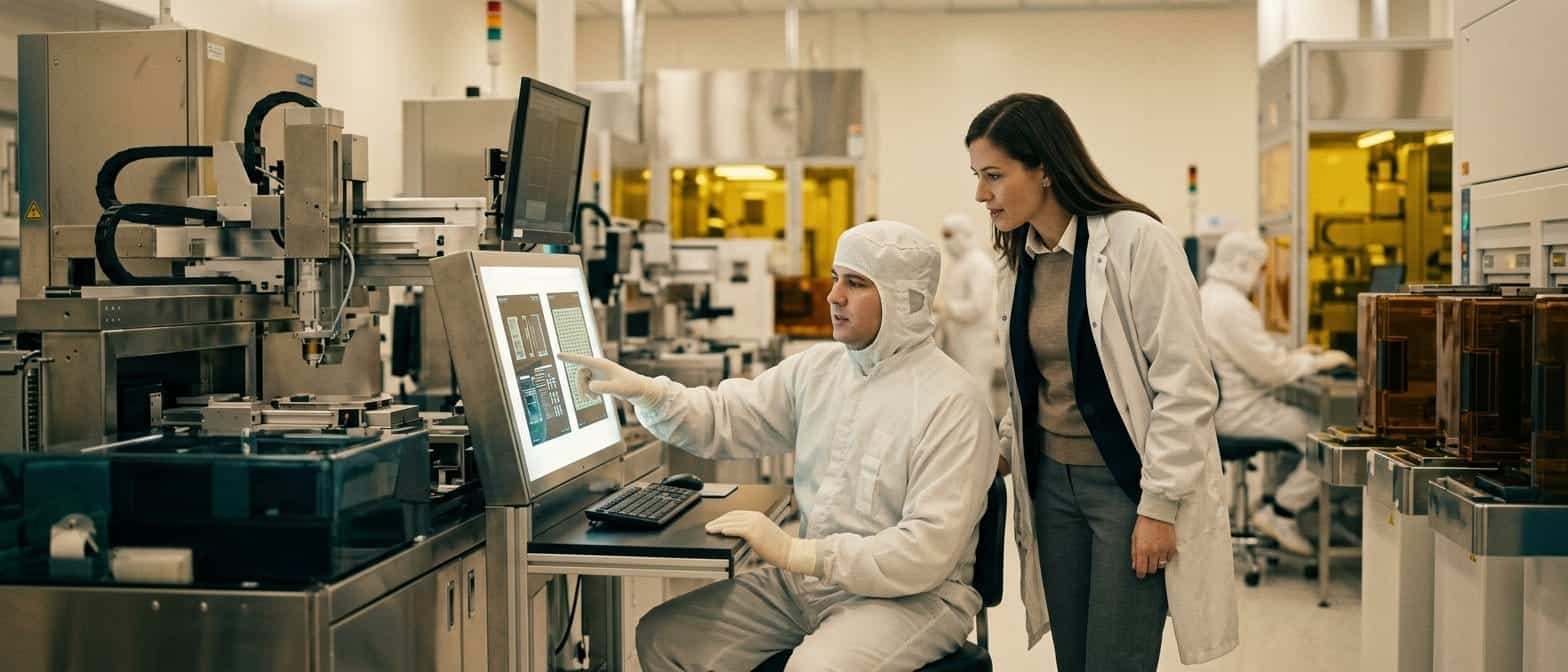
Aehr Test Systems designs, manufactures, markets, and sells semiconductor test and burn-in systems used to screen wafers, singulated die, and packaged parts for reliability. Its revenue is concentrated in the FOX P, FOX XP, FOX NP, FOX CP, WaferPak, and DiePak product lines. The company operates in one segment and serves customers through sales and service operations in the United States, Germany, the Philippines, and Taiwan, with dedicated resources in China and South Korea.
Economic Moat
Aehr’s moat is based on application-specific test architecture rather than broad scale. Its WaferPak Contactor and FOX XP/NP platforms are designed for full-wafer, single-touchdown burn-in, which reduces clean-room footprint and supports known-good-die workflows in SiC, GaN, photonics, and AI-related devices. The installed base also matters because it creates switching friction and recurring demand for custom WaferPak and DiePak consumables.
Business Model
The company monetizes a specialized test-and-burn-in workflow that is difficult to replicate quickly because it is tied to customer qualification, device-specific hardware, and process integration. Revenue is therefore driven by system placements, consumables, and field support rather than a broad catalog of commoditized equipment. That structure can support repeat business, but only if customers continue to qualify the platform into production.
Risk Factors
Customer concentration is the most material risk. Two customers accounted for 67.0% and 17.0% of fiscal 2024 net sales, and the five largest customers represented 93.0% of revenue. That is a high-severity risk because a single order deferral can materially move quarterly results.
Qualification risk is also high severity. Aehr notes that customers must complete lengthy qualification and correlation testing before production use, and initial purchases are often limited to engineering studies. If those programs do not convert, future revenue can remain lumpy.
Technology obsolescence is another high-severity risk. The company faces the possibility that improved yields, lower burn-in requirements, or cheaper conventional test systems could reduce demand for its products. Supply-chain dependence is medium severity because several critical parts are sourced from only one or a limited number of suppliers, which can delay shipments and raise costs.
Management Discussion & Analysis
Management appears to be prioritizing product development and customer qualification over near-term margin recovery. The latest quarter showed continued revenue pressure, but the company is still investing in the FOX-P family and related test platforms. The tone suggests a focus on expanding the addressable application set rather than defending near-term profitability.
Recent Earnings
The latest quarter showed modest sequential stabilization after a steep decline, with revenue at $10.3M versus $9.9M in the prior quarter, but the year-over-year comparison remains weak at -43.7%. EBITDA was -$3.4M and net income was -$3.2M, indicating that lower revenue is still flowing through to negative operating leverage. The Q1 2026 swing in EBITDA has no clear driver identified; investors should seek further disclosure.
Financial Analysis
Growth
AEHR — Financial Growth (Quarterly, USD Mil)
| Metric | 2025-02-28 | 2025-05-31 | 2025-08-31 | 2025-11-30 | 2026-02-28 |
|---|---|---|---|---|---|
| REVENUE (USD Mil) | 18.307 | 14.089 | 10.969 | 9.884 | 10.313 |
| EBIT (USD Mil) | -1.119 | -2.340 | -3.847 | -4.861 | -4.229 |
| EBITDA (USD Mil) | -0.210 | -1.320 | -2.925 | -3.990 | -3.369 |
| NET INCOME (USD Mil) | -0.643 | -2.899 | -2.084 | -3.230 | -3.203 |
| DILUTED EPS | -0.020 | -0.100 | -0.070 | -0.110 | -0.100 |
Source: Yahoo Finance — Quarterly Financial Statements
Revenue declined from $18.3M in the year-ago quarter to $10.3M in the latest quarter, a 43.7% drop year over year. Over the same period, EBITDA moved from -$0.2M to -$3.4M and net income moved from -$0.6M to -$3.2M, showing that the business has not yet regained operating scale. The key point is not just the revenue decline, but that losses widened as volume fell.
Profitability
AEHR — Profitability (TTM)
| Metric | TTM |
|---|---|
| Operating Margin (TTM) | -41.0% |
| Net Margin (TTM) | -25.2% |
| Return on Assets (TTM) | -6.1% |
| Return on Equity (TTM) | -8.7% |
Source: Yahoo Finance — Trailing Twelve Months (TTM)
TTM operating margin was -41.0%, TTM net margin was -25.2%, TTM return on assets was -6.1%, and TTM return on equity was -8.7%. Those figures indicate that the company is still well below breakeven on a trailing basis. Profitability is therefore a function of both revenue recovery and operating discipline, not just top-line growth.
Valuation
AEHR — Valuation Multiples
| Metric | Value |
|---|---|
| Market Cap (USD Mil) | 3,638.198 |
| Enterprise Value (USD Mil) | 3,270.359 |
| Trailing P/E | — |
| Forward P/E | 771.133 |
| Price/Sales (TTM) | 80.393 |
| Price/Book (mrq) | 25.796 |
| EV/Revenue | 72.265 |
| EV/EBITDA | -274.175 |
| Beta (5Y Monthly) | 3.183 |
Source: Yahoo Finance
AEHR trades at 80.4x price/sales, 72.3x EV/revenue, 25.8x price/book, and 771.1x forward P/E. EV/EBITDA was -274.2x because EBITDA remains negative. Relative to the company’s current revenue base and margin profile, the valuation implies a substantial improvement in earnings power that is not yet visible in the trailing numbers.
Leverage
AEHR — Leverage & Coverage (Quarterly)
| Metric | Value |
|---|---|
| Total Debt/Equity % (mrq) | 722.3% |
| Current Ratio (mrq) | 10.970 |
| Total Debt (mrq, USD Mil) | 10.025 |
| Operating Cash Flow (TTM, USD Mil) | -7.444 |
| Levered Free Cash Flow (TTM, USD Mil) | -7.452 |
Source: Yahoo Finance — Quarterly Financial Statements
Leverage is modest, with total debt/equity at 7.2% and total debt at $10.0M. The current ratio was 11.0x, which gives the company substantial near-term liquidity. The offset is cash burn: operating cash flow was -$7.4M and levered free cash flow was -$7.5M on a TTM basis.
Comparable Analysis
On growth, AEHR’s TTM revenue was $45.3M and revenue growth was -43.7%, versus AMAT at 29,024.0M and 11.4%, KLAC at 13,096.7M and 11.5%, ONTO at 1,030.6M and 9.5%, FORM at 839.8M and 32.0%, and ACLS at 845.4M and 3.3%. AEHR is the clear laggard on both scale and growth.
On profitability, AEHR’s TTM operating margin was -41.0% and net margin was -25.2%, versus positive margins across the peer group. KLAC and AMAT are the strongest profit generators, while ONTO, FORM, and ACLS also remain profitable on a trailing basis.
On leverage, AEHR’s total debt/equity was 7.2% and current ratio was 11.0x, which is more liquid than most peers. However, the company’s TTM operating cash flow and free cash flow were both negative, unlike AMAT, KLAC, ONTO, and ACLS, which are generating positive cash flow.
On valuation, AEHR’s 72.3x EV/revenue and 80.4x price/sales are well above AMAT at 15.5x and 17.1x, KLAC at 23.8x and 25.9x, ONTO at 14.6x and 16.4x, FORM at 12.7x and 13.8x, and ACLS at 6.1x and 6.8x. The multiple gap is difficult to justify given AEHR’s negative margins and negative cash flow.
Growth
| Company | Revenue TTM (USD Mil) | Revenue Growth YoY % | EBITDA TTM (USD Mil) | Diluted EPS TTM |
|---|---|---|---|---|
| AEHR | 45.260 | -43.7% | -11.930 | -0.380 |
| AMAT | 29,024.000 | 11.4% | 9,275.000 | 10.630 |
| KLAC | 13,096.660 | 11.5% | 5,850.220 | 3.540 |
| ONTO | 1,030.600 | 9.5% | 266.920 | 2.150 |
| FORM | 839.780 | 32.0% | 137.390 | 0.870 |
| ACLS | 845.440 | 3.3% | 108.150 | 3.220 |
Valuation
| Company | Trailing P/E | Forward P/E | EV/Revenue | EV/EBITDA | Price/Sales (TTM) | Price/Book (mrq) | Market Cap (USD Mil) | Enterprise Value (USD Mil) | Beta (5Y Monthly) |
|---|---|---|---|---|---|---|---|---|---|
| AEHR | — | 771.133 | 72.265 | -274.175 | 80.393 | 25.796 | 3,638.200 | 3,270.360 | 3.183 |
| AMAT | 58.866 | 38.483 | 15.511 | 48.537 | 17.116 | 20.779 | 496,820.130 | 450,178.580 | 1.672 |
| KLAC | 73.412 | 51.479 | 23.762 | 53.196 | 25.921 | 58.256 | 339,474.810 | 311,205.720 | 1.504 |
| ONTO | 157.933 | 34.518 | 14.625 | 56.468 | 16.389 | 8.034 | 16,890.680 | 15,072.270 | 1.625 |
| FORM | 170.483 | 53.137 | 12.695 | 77.594 | 13.768 | 10.920 | 11,562.250 | 10,660.990 | 1.265 |
| ACLS | 57.882 | 40.203 | 6.079 | 47.519 | 6.775 | 5.483 | 5,728.180 | 5,139.040 | 1.918 |
Profitability
| Company | Operating Margin (TTM) | Net Margin (TTM) | Return on Assets (TTM) | Return on Equity (TTM) |
|---|---|---|---|---|
| AEHR | -41.0% | -25.2% | -6.1% | -8.7% |
| AMAT | 31.9% | 29.3% | 14.9% | 39.7% |
| KLAC | 41.2% | 35.7% | 21.3% | 95.0% |
| ONTO | 16.8% | 10.3% | 5.4% | 5.3% |
| FORM | 17.7% | 8.1% | 5.2% | 6.8% |
| ACLS | 4.0% | 11.9% | 4.5% | 9.7% |
Leverage
| Company | Total Debt/Equity % (mrq) | Current Ratio (mrq) | Total Debt (mrq, USD Mil) | Operating Cash Flow TTM (USD Mil) | Free Cash Flow TTM (USD Mil) |
|---|---|---|---|---|---|
| AEHR | 722.3% | 10.970 | 10.030 | -7.440 | -7.450 |
| AMAT | 3,039.9% | 2.508 | 7,268.000 | 7,993.000 | 3,040.380 |
| KLAC | 10,540.0% | 3.026 | 6,145.360 | 4,401.640 | 2,890.190 |
| ONTO | — | 6.154 | 0.000 | 262.660 | 197.240 |
| FORM | 301.2% | 4.548 | 31.890 | 136.820 | -0.570 |
| ACLS | 674.9% | 4.589 | 70.500 | 96.650 | 49.110 |
Returns
| Company | Return on Equity (TTM) | Return on Assets (TTM) |
|---|---|---|
| AEHR | -8.7% | -6.1% |
| AMAT | 39.7% | 14.9% |
| KLAC | 95.0% | 21.3% |
| ONTO | 5.3% | 5.4% |
| FORM | 6.8% | 5.2% |
| ACLS | 9.7% | 4.5% |
Source: Yahoo Finance
Conclusion
AEHR has a differentiated product set and a strong liquidity position, but the investment case is still dominated by weak trailing fundamentals. Revenue is down sharply year over year, margins remain deeply negative, and cash flow is still burning. The stock’s valuation leaves little room for execution error, so the risk-reward remains unfavorable until the company shows sustained improvement in revenue, EBITDA, and cash generation.
Data sourced from Yahoo Finance. Not investment advice.
Leave a Comment