
| Company | Oct 25 | Nov 25 | Dec 25 | Jan 26 | Feb 26 | Mar 26 | Apr 26 | May 26 | Jun 26 | Jul 26 | Aug 26 | Sep 26 | 12-Mo |
|---|---|---|---|---|---|---|---|---|---|---|---|---|---|
| SOUN | +10% | -32% | -17% | -15% | +2% | -20% | +16% | +13% | -28% | -5% | +17% | -16% | -63% |
| AI | +1% | -18% | -7% | -18% | -28% | +6% | +5% | +22% | -16% | +1% | +18% | +2% | -37% |
| PLTR | +10% | -16% | +6% | -18% | -6% | +7% | -5% | +13% | -25% | +5% | +51% | +0% | +3% |
| PATH | +19% | -13% | +18% | -23% | -15% | +3% | -7% | +14% | -7% | +17% | +46% | -31% | -4% |
| S | +1% | -9% | -7% | -7% | -6% | -2% | +10% | +17% | +3% | +12% | +16% | +8% | +35% |
| TWLO | +35% | -4% | +10% | -15% | +0% | +4% | +18% | +29% | +8% | -4% | +19% | +24% | +192% |
Source: Yahoo Finance monthly adjusted close.
Quick Thesis
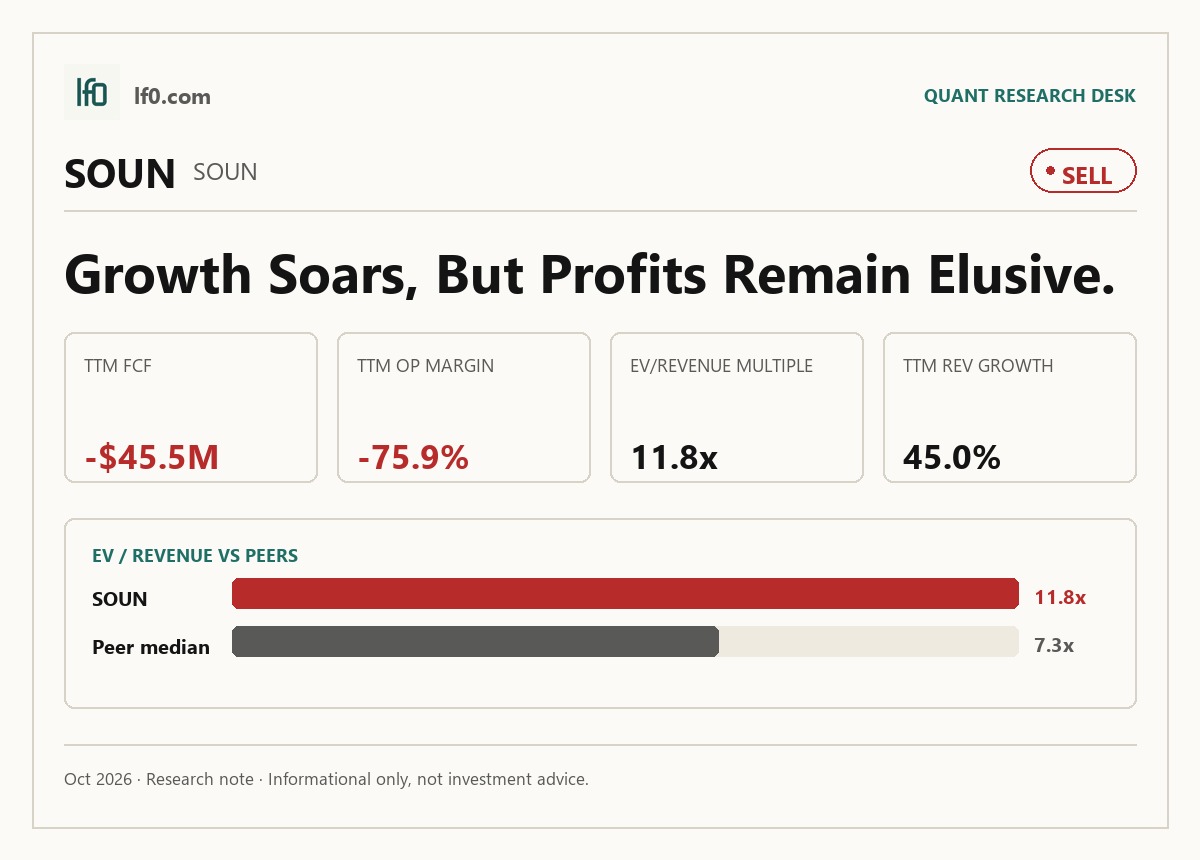
- Rated sell — revenue growth has not yet translated into self-funding economics.
- Strongest point: TTM gross margin is 42.3%, so the core product is not the problem.
- Biggest risk: TTM operating margin is -75.9% and levered free cash flow is -$45.5M.
- Valuation looks rich at 11.8x EV/revenue versus peers with better cash generation.
- I would turn more constructive only if operating margin moves toward positive and cash burn narrows.
Performance Since Our Last Call
I would put my rating as a sell because the prior call has held up: since the 2026-06-14 sell call, the stock has returned -20.3% and the verdict so far is correct so far. That performance is consistent with the fresh numbers here, because revenue is still growing while cash burn and negative margins remain the dominant facts. The latest filing does not show the kind of operating leverage that would have invalidated the prior thesis. I still see the same setup: growth is real, but it is not yet self-funding.
Executive Summary
Rating: SELL | SOUN
Measured from adjusted close on 2026-06-15 to 2026-10-30. Sell ratings are correct when the stock falls; Hold is tracked as a +/-10% range. Daily-close data, not intraday. Calls are tracked for 182 days from publication, then frozen as a final record.
Same call, re-affirmed: we have tracked this SELL since 2026-06-15, and the entry price above is that day’s close, not today’s price. This article re-affirms the call on 2026-10-05; the tracking window runs 182 days from then.
I would put my rating as a sell because SoundHound AI is still priced for a cleaner monetization path than the current numbers justify. Revenue reached $61.9M in Q2 2026, but TTM operating margin was -75.9% and TTM levered free cash flow was -$45.5M, so scale is not yet converting into earnings or cash.
The key question is whether the company can turn that top-line momentum into operating leverage before dilution and cash burn do more damage. I would become more constructive if revenue growth stays above 40% for two more quarters and operating margin moves toward a positive level, because that would show the acquisition stack and enterprise AI mix are finally improving unit economics. If cash burn also narrows materially, I would start to view the current valuation as a bridge to profitability rather than a claim on distant optionality.
Company Profile
SoundHound AI builds conversational AI software that lets businesses add voice interfaces to products and services. Revenue comes mainly from royalties on voice-enabled products, subscriptions for services such as customer support and ordering, and monetization fees tied to leads and transactions. The company serves automotive, television, Internet of Things, and restaurant customers across 25 languages, and it has broadened from voice recognition into enterprise agentic AI through Amelia.
Economic Moat
Business Model
SoundHound’s Speech-to-Meaning engine is the hardest part of the model to copy quickly, because it converts speech and meaning in one step rather than the usual speech-to-text-then-meaning sequence. In my view, that is the clearest defensible edge in the 10-K: it supports faster responses, better handling of noisy or accented speech, and more natural follow-up queries, which is what a buyer of voice AI would pay for. Houndify adds a second layer of stickiness by giving developers access to more than 100 content domains while letting customers keep their own brand and data control instead of handing the experience to a third-party assistant. The platform is already embedded at scale, with millions of products and billions of interactions each year, so this is a commercial base rather than a demo-only product.
The business has moved from a narrow voice platform into a broader agentic AI platform over the last five years. In 2023, the company was still centered on Speech-to-Meaning and Deep Meaning Understanding, with customers such as Hyundai, Mercedes-Benz, Pandora, Snap, VIZIO, Square, Toast, Oracle, KIA, and Stellantis, and Houndify had surpassed 1 billion annual queries in 2021. By 2025, SoundHound had added Amelia and launched Amelia 7, extending the product from voice response into enterprise task execution and multi-agent orchestration. Today, the 2026 filing shows that same base expanded into Smart Answering, Smart Ordering, Dynamic Interaction, SoundHound Chat AI, and agentic workflows for vehicles and customer service, while the company says it has grown from a single-language capability to 25 languages. I think the moat is broader than it was five years ago because the product set is wider, the language footprint is larger, and the Amelia integration made the platform more useful for enterprise workflows, not just voice queries.
Business & Operating Risks
The biggest disclosed risk is customer concentration. The filing says SoundHound’s operating results could be materially harmed if it loses any of its largest customers, and the current numbers show how exposed the revenue base still is: one customer was 14.0% of total revenue in FY2024, two customers were 62.0% in FY2023, and unbilled receivables from five customers were 83.0% of the FY2025 balance. Those are different measures, but they all point in the same direction — the business still depends on a small number of relationships, which makes revenue and working capital lumpy.
The master service agreements are also short dated, with automatic one-year renewals and customer termination rights on six months to one year notice, so a lost design win can roll off faster than investors may assume. The second major risk is the dependence on AI-powered output and the new regulatory burden around it: the filing warns that generative AI can produce hallucinatory or biased output, that the European Union’s Artificial Intelligence Act becomes fully applicable on August 2, 2026, and that compliance could require additional costs and changes to operations and processes. I view that as material because the company is still burning cash, so added compliance or product-validation cost lands on a business that has not yet proven durable cash generation. The filing also discloses material weaknesses in internal control as of December 31, 2025, including weak oversight, weak controls over non-routine and complex transactions, and segregation-of-duties gaps, which makes reporting risk concrete rather than hypothetical. Acquisition integration risk has also increased after SYNQ3, Amelia, and Interactions, because those deals may not be accretive and could create goodwill impairment, amortization, and integration costs.
Taken together, these risks do not break the moat itself, but they do threaten the path from product advantage to durable economics. The customer concentration and cash burn are the most direct pressure points on the structural edge described above.
Management Discussion & Analysis
Management is clearly trying to answer those risks with acquisition-led scale and financing flexibility, but the execution burden is still high. The Interactions acquisition was presented as a way to strengthen Agentic AI and expand customer service penetration, yet the numbers show that the move added scale faster than it improved unit economics. Revenue rose to $168.9M in 2025 from $84.7M in 2024, but cost of revenues also climbed to $97.4M from $43.3M and gross margin fell to 42.0% from 49.0%, so I read the deal as growth first, margin later.
The company also sold $201.5M of stock under its at-the-market program, which funded liquidity and acquisitions but also tells me dilution remains part of the financing model. Management’s claim that sales and marketing, research and development, and general and administrative expenses will grow below revenue is not yet supported by 2025 results, because those lines rose 112.0%, 39.0%, and 54.0%, respectively, versus 99.0% revenue growth. The one clear balance-sheet positive is that no interest expense was incurred in 2025 after the repayment of the Amelia debt in December 2024 and the term loan in June 2024, but that benefit sits beside recurring operating cash outflows of $98.2M, so the company is still relying on cash, operating improvement, and the remaining ATM capacity to fund the next phase.
Management’s credibility is mixed rather than cleanly strong. Prior filings expected gross margin to improve as Amelia scaled, yet 2025 gross margin fell to 42.0% from 49.0%, so the directional call was too optimistic. The same pattern shows up in earnings quality: revenue growth held, but the company still posted a $14M net loss and $98.2M of operating cash outflow in 2025. Leadership continuity is a positive, with no CEO or CFO change disclosed across the history I reviewed, but the financial path has been more volatile than the language suggested. The company is responding to the risks, but it has not yet shown me that the response is enough to offset them.
Recent Events
The most significant development is the April 21, 2026 merger agreement to acquire LivePerson, which would fold LivePerson in as an indirect wholly owned subsidiary and pay stock consideration tied to a $42.8M aggregate amount, subject to cash and note adjustments. In my view, that is a strategic expansion into conversational AI scale, but it also raises execution risk because the deal still needs stockholder approval, foreign direct investment clearances, Nasdaq listing approval, and an effective Form S-4 before closing.
The May 11, 2026 equity distribution agreement is the other material signal. SoundHound secured the ability to sell up to $300M of Class A stock through a group of agents, which strengthens financing flexibility for the LivePerson deal and future growth, but it also tells me dilution risk is now part of the capital plan rather than a remote possibility.
I also view the March 18, 2026 CFO transition as a governance test. Nitesh Sharan’s departure and James Hom’s interim appointment keep continuity in place, but the company is still searching for a permanent finance chief, so the merger and financing work will be judged against a less stable finance bench. The May 27, 2026 bylaw change, which removed a ratification defense in derivative suits, modestly weakens litigation protection. Overall, recent 8-Ks strengthen the growth narrative but also raise financing, integration, and governance risk.
Financial Analysis
Growth
SOUN — Financial Growth (Quarterly, USD Mil)
| Metric | 2025-06-30 | 2025-09-30 | 2025-12-31 | 2026-03-31 | 2026-06-30 |
|---|---|---|---|---|---|
| REVENUE (USD Mil) | 42.7 | 42 | 55.1 | 44.2 | 61.9 |
| EBIT (USD Mil) | -73.3 | -108.7 | 42.4 | -24.2 | -40.6 |
| EBITDA (USD Mil) | -64.8 | -99.4 | 53.2 | -13.3 | -28.7 |
| NET INCOME (USD Mil) | -74.7 | -109.3 | 40.1 | -25 | -42.8 |
| DILUTED EPS | -0.2 | -0.3 | 0 | -0.1 | -0.1 |
Source: Yahoo Finance — Quarterly Financial Statements
Revenue accelerated to $61.9M in Q2 2026 from $44.2M in Q1 2026, after $55.1M in Q4 2025 and $42M in Q3 2025, so the top line is still expanding but in an uneven pattern. The cleanest YoY read is Q2 2026 revenue of $61.9M versus $43.7M in Q2 2025, up 41.8%, which supports a growth lens but not a straight-line one because Q1 2026 was only up 0.7% YoY. EBITDA is not keeping pace: EBITDA was -$28.7M in Q2 2026 versus -$13.3M in Q1 2026 and $53.2M in Q4 2025, so profitability is more volatile than revenue. That is a bear signal for durability.
Profitability
SOUN — Profitability (TTM)
| Metric | TTM |
|---|---|
| Operating Margin (TTM) | -75.9% |
| Net Margin (TTM) | -67.5% |
| Return on Assets (TTM) | -19.5% |
| Return on Equity (TTM) | -32.2% |
| Gross Margin (TTM) | 42.3% |
| EBITDA Margin (TTM) | -76.1% |
Source: Yahoo Finance — Trailing Twelve Months (TTM)
TTM gross margin was 42.3%, but TTM operating margin was -75.9% and TTM EBITDA margin was -76.1%, which means SoundHound is still far from operating leverage even though the core product layer is not loss-making. The gap between gross margin and EBITDA margin is about 118.4 percentage points, so sales and R&D spending are still absorbing far more than the company earns from delivering the service. TTM net margin was -67.5%, TTM ROA was -19.5%, and TTM ROE was -32.2%, which tells me the business is still in an investment-heavy stage where accounting returns are deeply negative rather than merely thin. The ROE gap versus ROA also suggests losses are not being masked by leverage; the capital base is simply not earning an adequate return yet. I would want to see operating margin move toward a positive level and net margin narrow materially before I call the economics durable.
Valuation
SOUN — Valuation Multiples
| Metric | Value |
|---|---|
| Current Share Price (USD) | 5.9 |
| Market Cap (USD Mil) | 2,622 |
| Enterprise Value (USD Mil) | 2,396 |
| Trailing P/E | — |
| Forward P/E | -59.1 |
| Price/Sales (TTM) | 12.9 |
| Price/Book (mrq) | 5.2 |
| EV/Revenue | 11.8 |
| EV/EBITDA | -15.5 |
| Beta (5Y Monthly) | 2.86 |
| FCF Yield % (TTM) | -1.7% |
| Forward EPS (USD) | -0.1 |
| Analyst Target Price – Low (USD) | 6 |
| Analyst Target Price – Mean (USD) | 12.6 |
| Analyst Target Price – High (USD) | 17 |
| # Analyst Opinions | 7 |
Source: Yahoo Finance
SoundHound AI trades at 11.8x enterprise value to revenue and 12.9x price to sales on a current share price of $5.91, so the market is paying for a business that still needs a clear path to durable monetization rather than current earnings power. With trailing earnings still negative, the trailing price to earnings multiple is not usable, and the forward price to earnings multiple is -59.1x because forward earnings remain below zero, which means earnings-based valuation is not yet a useful cheap-or-expensive signal. The same issue shows up in enterprise value to EBITDA at -15.5x, since EBITDA is still negative and the multiple is mechanically distorted by losses.
The stock also screens expensive on balance sheet and cash flow measures: price to book is 5.2x against book value per share of $1.125, while free cash flow yield is -1.7% and levered free cash flow is -$45.5M TTM, or about -$0.11 per share against a $5.91 stock price. Beta is 2.86, short interest is 40.5% of float, and the 52-week range is $5.65 to $22.17, which tells me the market is still treating this as a high-volatility, heavily shorted name. On the analysis here, I would put fair value in a range of roughly $1.2-$3.4 per share using peer EV/revenue, and that sits well below the current price. Analyst coverage is not thin — there are 7 opinions with a $6 low, $12.6 mean, and $17 high — but my range is still below the consensus mean because I weight the negative cash flow and leverage profile more heavily than the market appears to. I also think the implied earnings path is too optimistic: forward EPS is -$0.1 for SoundHound, versus 0.9 for PATH, 0.5 for S, 6.8 for TWLO, and 2.3 for PLTR, so the company is still priced ahead of its peer set on a like-for-like earnings basis. That is why I see the stock as rich rather than merely full.
Leverage
SOUN — Leverage & Coverage (Quarterly)
| Metric | Value |
|---|---|
| Total Debt/Equity % (mrq) | 1.1 |
| Current Ratio (mrq) | 3.9 |
| Total Debt (mrq, USD Mil) | 5.4 |
| Operating Cash Flow (TTM, USD Mil) | -114.5 |
| Levered Free Cash Flow (TTM, USD Mil) | -45.5 |
| Net Debt/EBITDA (TTM) | 1.3 |
| FCF Margin % (TTM) | -22.4% |
Source: Yahoo Finance — Quarterly Financial Statements
SoundHound AI’s leverage profile is weak because the balance sheet is not the problem, but cash burn is. Total Debt/Equity was 1.1x mrq, Current Ratio was 3.9x mrq, and Total Debt was $5.4M mrq, so near-term solvency is not the issue. The strain comes from cash generation: Operating Cash Flow was -$114.5M TTM, Levered Free Cash Flow was -$45.5M TTM, and FCF Margin was -22.4% TTM, which means reported activity is still consuming cash rather than funding the business. Net Debt/EBITDA was 1.3x TTM, but with EBITDA still negative in the latest periods, that ratio is not a sign of balance-sheet strength so much as a reminder that earnings power has not yet converted into cash. Total Cash was 202.8M mrq, which gives room to absorb losses for now, but in my opinion this is medium refinancing risk because the cash cushion is real while ongoing negative cash flow steadily erodes it.
Insider Activity
The insider transaction record I see here is one-sided: 20 open-market sales and 0 open-market purchases in the 2025-03-20 to 2026-05-22 window. The selling is broad, not just one holder, because the CEO, CFO, and several operating leaders all sold, with the largest cluster on 2026-03-20. That points to weak insider alignment with shareholders.
Comparable Analysis
LF0 has published standalone analyses of these peers: UiPath (PATH) (rated Hold).
Growth
| Company | Revenue TTM (USD Mil) | Revenue Growth YoY % | EBITDA TTM (USD Mil) | Diluted EPS TTM |
|---|---|---|---|---|
| SOUN | 203.2 | 45.0% | -154.6 | -0.6 |
| AI | 232.4 | -25.5% | -447.1 | -3.1 |
| PLTR | 6,155.9 | 92.8% | 2,662.6 | 1.2 |
| PATH | 1,720.9 | 13.4% | 184.6 | 0.7 |
| S | 1,098.7 | 20.6% | -237.8 | -1 |
| TWLO | 5,572.3 | 22.0% | 499.8 | 7.2 |
Source: Yahoo Finance
SoundHound’s 45.0% TTM revenue growth is solid, but it is still below PLTR’s 92.8% and only modestly ahead of TWLO’s 22.0%, while PATH at 13.4% and S at 20.6% are growing from more mature bases. The key point is that SOUN’s growth is coming off a much smaller base and has not yet translated into earnings power, so the headline rate deserves less credit than it would at a profitable peer.
Valuation
| Company | Current Share Price (USD) | Trailing P/E | Forward P/E | EV/Revenue | EV/EBITDA | Price/Sales (TTM) | Price/Book (mrq) | Market Cap (USD Mil) | Enterprise Value (USD Mil) | Beta (5Y Monthly) | FCF Yield % (TTM) | Forward EPS | Analyst Target Price – Low | Analyst Target Price – Mean | Analyst Target Price – High | # Analyst Opinions |
|---|---|---|---|---|---|---|---|---|---|---|---|---|---|---|---|---|
| SOUN | 5.9 | — | -59.1 | 11.8 | -15.5 | 12.9 | 5.2 | 2,622 | 2,396 | 2.86 | -1.7% | -0.1 | 6 | 12.6 | 17 | 7 |
| AI | 11.2 | — | -23.6 | 5.1 | -2.6 | 7.8 | 2.6 | 1,806 | 1,179 | 2.10 | 0.9% | -0.5 | 6 | 8.3 | 12 | 10 |
| PLTR | 188.5 | 162.5 | 80.4 | 72.2 | 166.9 | 73.6 | 46.3 | 452,868 | 444,490 | 1.60 | 0.5% | 2.3 | 80 | 195.6 | 255 | 26 |
| PATH | 12.9 | 19.3 | 14 | 3.3 | 30.5 | 3.9 | 3.5 | 6,731 | 5,633 | 1.01 | 7.0% | 0.9 | 10 | 15.5 | 23 | 17 |
| S | 25.3 | — | 54.7 | 7.3 | -33.9 | 8 | 6 | 8,797 | 8,067 | 0.71 | 3.4% | 0.5 | 17.5 | 24.5 | 29 | 30 |
| TWLO | 291.8 | 40.4 | 43 | 7.8 | 87.3 | 8 | 5 | 44,819 | 43,649 | 1.36 | 2.1% | 6.8 | 165 | 263 | 330 | 28 |
Source: Yahoo Finance
SOUN trades at 11.8x EV/revenue and 12.9x price/sales with a negative 1.7% FCF yield, versus AI at 5.1x EV/revenue and 7.8x P/S with 0.9% FCF yield, PATH at 3.3x and 3.9x with 7.0% FCF yield, S at 7.3x and 8.0x with 3.4% FCF yield, and TWLO at 7.8x and 8.0x with 2.1% FCF yield. Using peer EV/revenue of 3.3x to 7.8x on SOUN’s $203.2M revenue implies an illustrative enterprise value of about $0.7B to $1.6B, or roughly $1.2 to $3.4 per share after netting $202.8M of cash and $5.4M of debt; that sits well below the $5.91 share price, so the stock is pricing in a much stronger re-rating than peers have earned. I think that premium is harder to defend because SOUN’s growth is not yet paired with the positive FCF that PATH and TWLO already show.
Profitability
| Company | Operating Margin (TTM) | Net Margin (TTM) | Return on Assets (TTM) | Return on Equity (TTM) | Gross Margin (TTM) | EBITDA Margin (TTM) |
|---|---|---|---|---|---|---|
| SOUN | -75.9% | -67.5% | -19.5% | -32.2% | 42.3% | -76.1% |
| AI | -186.3% | -192.1% | -31.2% | -59.8% | 29.1% | -192.4% |
| PLTR | 47.1% | 49.0% | 17.3% | 38.1% | 84.8% | 43.2% |
| PATH | 8.9% | 21.0% | 3.7% | 20.0% | 82.6% | 10.7% |
| S | -22.7% | -31.0% | -7.6% | -23.0% | 72.5% | -21.6% |
| TWLO | 7.8% | 20.6% | 2.1% | 13.5% | 48.6% | 9.0% |
Source: Yahoo Finance
SOUN’s gross margin of 42.3% is below TWLO’s 48.6% and PATH’s 82.6%, but the real issue is operating leverage: SOUN’s operating margin is -75.9% and EBITDA margin is -76.1%, far worse than AI’s -186.3% and -192.4% but also far from the positive 8.9% and 10.7% at PATH or 7.8% and 9.0% at TWLO. The gross-margin gap is not the main problem here; the much wider operating-margin gap says the business is still spending far more on sales and development than its revenue base can absorb. That is why the market is paying for potential, not demonstrated profitability.
Leverage
| Company | Total Debt/Equity % (mrq) | Current Ratio (mrq) | Total Debt (mrq, USD Mil) | Operating Cash Flow TTM (USD Mil) | Free Cash Flow TTM (USD Mil) | Net Debt/EBITDA (TTM) | FCF Margin % (TTM) |
|---|---|---|---|---|---|---|---|
| SOUN | 1.1 | 3.9 | 5.4 | -114.5 | -45.5 | 1.3 | -22.4% |
| AI | 8.6 | 6.2 | 59.5 | -154.6 | 15.9 | 1.3 | 6.8% |
| PLTR | 2.1 | 7.2 | 211.4 | 3,400.3 | 2,159.1 | -3.5 | 35.1% |
| PATH | 4.1 | 2.4 | 79.8 | 373.2 | 474.3 | -6.5 | 27.6% |
| S | — | 1.4 | 0 | 57.3 | 296.9 | 2.8 | 27.0% |
| TWLO | 11.9 | 4.6 | 1,065.5 | 1,060.7 | 954.7 | -3.2 | 17.1% |
Source: Yahoo Finance
SOUN’s debt/equity is only 1.1x and net debt/EBITDA is 1.3x, which is cleaner than AI’s 8.6x debt/equity and 1.3x net debt/EBITDA, and far better than TWLO’s 11.9x debt/equity even though TWLO has negative 3.2x net debt/EBITDA because of its cash position. The problem is cash generation: SOUN’s free cash flow margin is -22.4%, while PATH is 27.6%, TWLO is 17.1%, and AI is 6.8%; that means SOUN is funding growth with cash burn, not self-financing it. The balance sheet can carry the company for now, but it does not change the fact that the operating model is still consuming capital.
Conclusion
I would put my rating as a sell because the company still has to prove that revenue scale can outrun a -76.1% EBITDA margin and a -22.4% FCF margin. The product is real, but until the next few quarters show a clear step-down in cash burn, I would stay cautious rather than pay ahead of the evidence.
I would raise my rating more towards a hold if revenue growth stays above 40% for two more quarters and operating margin improves toward a positive level, because that would show the acquisition stack and enterprise AI mix are finally creating operating leverage. If the company can also narrow TTM free cash flow burn from -$45.5M to roughly -$20M, meaning the cash drain is cut by more than half, I would start to view the current valuation as a bridge to profitability rather than a claim on distant optionality.
I would move from sell to strong sell if revenue growth falls below 25% for two consecutive quarters or if TTM free cash flow burn widens beyond $60M, because that would tell me the market is paying 11.8x EV/revenue for a business whose growth is slowing while losses are still expanding. A second negative trigger would be another round of insider selling from senior leadership, since the 20 sales and 0 purchases in the latest window already leave me with little confidence that management sees near-term upside from here.
Weighing both sides, I think the bear case is more likely to show up first because the company still has to prove that revenue scale can outrun a negative EBITDA margin and a negative FCF margin. The product is real, but until the next few quarters show a clear step-down in cash burn, I would stay cautious rather than pay ahead of the evidence.
What to Watch Next
- Revenue growth above 40% for two more quarters — would support moving the rating toward hold.
- Operating margin moving toward positive territory — would show operating leverage is finally arriving.
- TTM free cash flow burn narrowing toward -$20M — would reduce dilution and financing pressure.
- Revenue growth below 25% for two straight quarters — would push the case toward strong sell.
- TTM free cash flow burn widening beyond $60M — would confirm the cash drain is getting worse.
What’s your take? I rated SoundHound AI (SOUN) SELL above — but the goal here is to get this right, not just to publish an opinion. What would you add to this analysis, or which risk or catalyst do you think I’m under- or over-weighting? Tell me in the comments.
Sources
- SEC 10-K Annual Report — filed 2026-03-02
- SEC 8-K Filing (2026-05-27)
- SEC 8-K Filing (2026-05-07)
- SEC 8-K Filing (2026-04-21)
- SEC 8-K Filing (2026-03-18)
- SEC 8-K Filing (2026-02-26)
- SEC Form 4 Insider Transaction (2026-05-27)
- SEC Form 4 Insider Transaction (2026-05-27)
- SEC Form 4 Insider Transaction (2026-05-27)
- SEC 10-K Annual Report — FY2026
- SEC 10-K Annual Report — FY2025
- SEC 10-K Annual Report — FY2024
- SEC 10-K Annual Report — FY2023
- SEC 10-K Annual Report — FY2022
Data sourced from Yahoo Finance and SEC EDGAR. Not investment advice.
Leave a Comment