
| Company | Sep 25 | Oct 25 | Nov 25 | Dec 25 | Jan 26 | Feb 26 | Mar 26 | Apr 26 | May 26 | Jun 26 | Jul 26 | Aug 26 | 12-Mo |
|---|---|---|---|---|---|---|---|---|---|---|---|---|---|
| COIN | +11% | +2% | -21% | -17% | -14% | -10% | -1% | +8% | +1% | -23% | +0% | +29% | -38% |
| HOOD | +38% | +3% | -12% | -12% | -12% | -24% | -9% | +5% | +29% | +6% | -14% | +21% | +1% |
| PYPL | -4% | +3% | -9% | -7% | -10% | -12% | -2% | +11% | -11% | -3% | +32% | -8% | -24% |
| IBKR | +11% | +2% | -8% | -1% | +16% | -5% | -6% | +19% | +9% | +0% | +1% | +11% | +57% |
| ETOR | -7% | -10% | +13% | -16% | -16% | +4% | -2% | +18% | +18% | -6% | -10% | -10% | -28% |
| FUTU | -6% | +14% | -15% | -3% | -1% | -8% | -8% | +15% | -33% | -10% | +12% | +16% | -33% |
Source: Yahoo Finance monthly adjusted close.
Quick Thesis
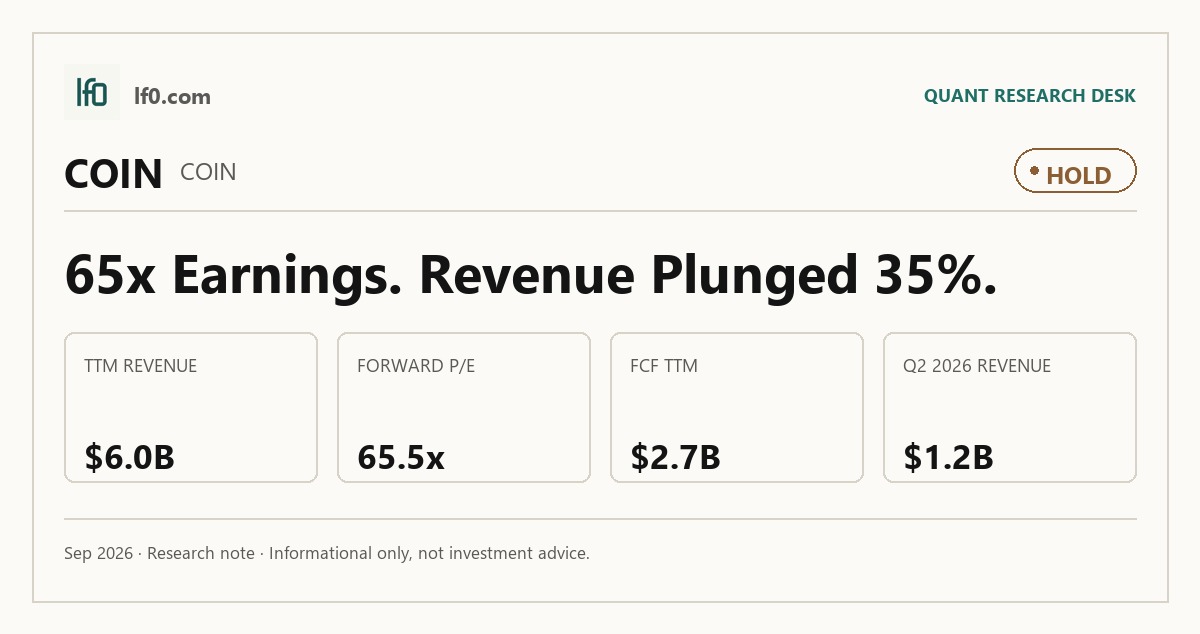
- Rated Hold because Coinbase is cash-rich, but revenue and earnings are still decelerating.
- Strongest support: $2.7B of levered free cash flow TTM and $8.8B of cash.
- Biggest risk: Q2 2026 revenue fell to $1.2B and net income was negative $359.5M.
- Valuation is rich at 7.9x EV/Revenue and 65.5x forward P/E.
- I would get more constructive if quarterly revenue re-accelerates above $1.5B and operating margin turns positive.
Executive Summary
Rating: HOLD | COIN
Measured from adjusted close on 2026-09-30 to 2026-09-30. Sell ratings are correct when the stock falls; Hold is tracked as a +/-10% range. Daily-close data, not intraday. Calls are tracked for 182 days from publication, then frozen as a final record.
I would put my rating as a Hold because Coinbase has real cash-generation capacity, but the latest revenue and earnings trend still points the wrong way. The company produced $2.7B of levered free cash flow TTM and held $8.8B of cash against $6.7B of debt, yet Q2 2026 revenue fell to $1.2B and net income was negative $359.5M, so the stock is still priced for a stronger crypto rebound than the business has delivered. In my view, the key question is not whether Coinbase can survive volatility; it is whether the platform can turn that volatility into sustained earnings growth. I would raise my rating more towards a Buy if quarterly revenue re-accelerates above $1.5B and operating margin turns positive, because that would show the business is converting volume into durable profit rather than just gross profit.
Company Profile
Coinbase Global, Inc. was founded in 2012 and became the holding company in 2014; it converted to a Texas corporation in December 2025 and trades on Nasdaq under COIN. It runs a crypto and financial-services platform that earns most of its revenue from transaction fees on consumer trading, Coinbase Prime institutional brokerage, and exchange activity, with subscription and services revenue coming from stablecoins, custody, staking, Coinbase One, and custodial interest. In December 2025, it broadened the platform with the Everything Exchange, which added stocks, commodity futures, perpetual futures, and prediction markets, while Base, a decentralized Ethereum layer-2 network, and the Base App, a self-custodial wallet, extend the onchain side of the franchise. The company had 4,951 employees and describes itself as remote-first, so it does not operate around a single headquarters in the usual sense.
Economic Moat
Business Model
I think Coinbase’s most durable advantage is trust, and that trust is reinforced by regulation, custody controls, and operating history rather than by software alone. The platform spans money transmission, a BitLicense, a New York State trust company, a SEC-registered broker-dealer, a futures commission merchant, and overseas licenses, which makes the compliance stack hard to replicate quickly. Customer assets are kept separate under UCC Article 8, no more than 2% of assets under custody sit in hot wallets, and multiple human approvers are required to decrypt private keys, so institutions and consumers are buying a safety layer as much as a trading venue. Base and the Circle Agreement add secondary moat elements, but I see them as extensions of the same trust franchise rather than separate sources of power.
Business & Operating Risks
The biggest disclosed risk is still dependence on crypto trading activity, especially Bitcoin and Ethereum, which drove about 45.0% of total trading volume in 2025 and 46.0% in 2024. That concentration means a drop in either asset’s price or liquidity would hit transaction fees quickly, and the quarterly results later in this article show how fast that can flow through to earnings. Regulatory risk is the other major issue: Coinbase is not registered or licensed with the SEC as a broker-dealer, national securities exchange, or ATS for the products it offers, so a security classification challenge could force delistings, suspensions, or penalties. I do not think these risks break the moat itself, but they do threaten the monetization layer that sits on top of it.
Management Discussion & Analysis
Management is responding to those risks by widening the product set and pushing harder on scale, but it is not yet proving to me that the earnings base is stable enough to call the risk contained. The company completed the Deribit acquisition in August 2025, launched U.S. perpetual-style futures, and expanded into the Everything Exchange, while USDC revenue reached $1.3B in 2025; that is a real attempt to reduce dependence on spot trading, even if the latest earnings still look volatile. Sales and marketing rose to $1.1B in 2025 from $654.4M in 2024, and technology and development increased to $1.7B from $1.5B, so management is still spending to build the platform rather than harvesting it. The risk is that the spending has not yet translated into cleaner earnings, which keeps the moat from showing up as durable profit.
Recent Events
The May 5, 2026 restructuring plan is the clearest recent signal that management is trying to protect the cost base, not just grow the top line. Coinbase said it will cut about 700 jobs, or 14% of the global workforce, and expects $50M to $60M of severance and related costs; that should help margins if trading activity stays soft, but it also shows the company is still adjusting to a more volatile demand backdrop. The April 7, 2026 board update, in which Paul Clement will not stand for re-election and the board will shrink to 9 directors after the annual meeting, looks like governance housekeeping rather than a strategic reset. Taken together, the recent events support the moat thesis on discipline, but they do not yet prove that the business has moved beyond its dependence on crypto cycles.
Financial Analysis
Growth
COIN — Financial Growth (Quarterly, USD Mil)
| Metric | 2025-06-30 | 2025-09-30 | 2025-12-31 | 2026-03-31 | 2026-06-30 |
|---|---|---|---|---|---|
| REVENUE (USD Mil) | 1,497.2 | 1,868.7 | 1,781.1 | 1,413 | 1,220.1 |
| EBIT (USD Mil) | 1,844.3 | 523.9 | -863.7 | -442.1 | -372.9 |
| EBITDA (USD Mil) | 1,878.2 | 574 | -792.6 | -374.1 | -308.5 |
| NET INCOME (USD Mil) | 1,428.9 | 432.6 | -666.7 | -394.1 | -359.5 |
| DILUTED EPS | 5.1 | 1.5 | -2.5 | -1.5 | -1.4 |
Source: Yahoo Finance — Quarterly Financial Statements
Revenue is still large, but the trend has weakened sharply. Coinbase posted $1.5B in Q2 2025, $1.9B in Q3 2025, $1.8B in Q4 2025, $1.4B in Q1 2026, and $1.2B in Q2 2026, so the latest quarter was down 35.0% year over year from Q2 2025 and 34.7% sequentially from Q1 2026. EBITDA moved from $1.9B in Q2 2025 to negative $308.5M in Q2 2026, and net income fell from $1.4B to negative $359.5M over the same span. That is the core tension in the stock: the platform still has scale, but the current run rate does not yet support the valuation the market is assigning.
Profitability
COIN — Profitability (TTM)
| Metric | TTM |
|---|---|
| Operating Margin (TTM) | -13.9% |
| Net Margin (TTM) | -16.3% |
| Return on Assets (TTM) | 1.1% |
| Return on Equity (TTM) | -7.8% |
| Gross Margin (TTM) | 85.8% |
| EBITDA Margin (TTM) | 11.6% |
Source: Yahoo Finance — Trailing Twelve Months (TTM)
TTM operating margin was -13.9%, TTM net margin was -16.3%, TTM gross margin was 85.8%, TTM EBITDA margin was 11.6%, TTM return on assets was 1.1%, and TTM return on equity was -7.9%. The spread between 85.8% gross margin and -13.9% operating margin tells me the core platform still monetizes well, but operating costs are absorbing most of that gross profit. The gap between 11.6% EBITDA margin and -16.3% net margin shows that below-EBITDA charges are still heavy enough to erase accounting profit, so I would focus on operating margin turning positive first; that would be the cleanest sign that the business is moving toward durable profitability.
Valuation
COIN — Valuation Multiples
| Metric | Value |
|---|---|
| Current Share Price (USD) | 185.7 |
| Market Cap (USD Mil) | 48,995 |
| Enterprise Value (USD Mil) | 48,014 |
| Trailing P/E | — |
| Forward P/E | 65.5 |
| Price/Sales (TTM) | 8.1 |
| Price/Book (mrq) | 3.7 |
| EV/Revenue | 7.9 |
| EV/EBITDA | 68.6 |
| Beta (5Y Monthly) | 3.39 |
| FCF Yield % (TTM) | 5.5% |
| Forward EPS (USD) | 2.8 |
| Analyst Target Price – Low (USD) | 95 |
| Analyst Target Price – Mean (USD) | 207.3 |
| Analyst Target Price – High (USD) | 330 |
| # Analyst Opinions | 32 |
Source: Yahoo Finance
At a current share price of $185.7, Coinbase trades at 7.9x EV/Revenue, 8.1x Price/Sales, and 65.5x forward P/E on 2.8 of forward EPS. That is not a distressed multiple, and it is hard to call it cheap when revenue is falling and operating margin is still negative. The market is also paying for volatility, with a 3.4 beta and a 5.4% FCF yield that is supported by $2.7B of levered free cash flow TTM. On the analysis here, I would put fair value in a broad $150-$230 range: that sits around the analyst mean target of $207.3, but below the $330 high because I weight the revenue slowdown and negative operating margin more heavily than the consensus appears to. On EPS, I would frame a reasonable range at roughly $2.5-$3.5, which brackets the company’s 2.8 forward EPS and is broadly in line with peers on a growth-adjusted basis; the issue is not the absolute EPS number, but whether the market should pay a premium multiple for it while growth is still negative. I would keep the stock at Hold because the balance sheet and cash flow support the valuation, but the current multiple still assumes a cleaner earnings rebound than the latest quarters justify.
Leverage
COIN — Leverage & Coverage (Quarterly)
| Metric | Value |
|---|---|
| Total Debt/Equity % (mrq) | 51 |
| Current Ratio (mrq) | 2.4 |
| Total Debt (mrq, USD Mil) | 6,668.3 |
| Operating Cash Flow (TTM, USD Mil) | 1,713.7 |
| Levered Free Cash Flow (TTM, USD Mil) | 2,668.5 |
| Net Debt/EBITDA (TTM) | -3 |
| FCF Margin % (TTM) | 44.1% |
Source: Yahoo Finance — Quarterly Financial Statements
Total debt was $6.7B mrq, with a current ratio of 2.4x and total debt/equity of 51.0%, so the balance sheet is levered but not stretched. Operating cash flow was $1.7B TTM and levered free cash flow was $2.7B TTM, which gives Coinbase room to absorb volatility without immediate refinancing pressure. Net debt/EBITDA was -3.0x TTM because cash exceeds debt on a net basis, and FCF margin was 44.1% TTM, which is a strong cushion if trading activity softens further. The leverage profile is therefore a support for the thesis, not the reason to own the stock.
Insider Activity
The insider tape is one-sided selling. Across the period shown, there were 0 open-market purchases and 248 open-market sales, so insiders are reducing exposure rather than adding to it. Frederick R. Wilson accounted for the most recent cluster of sales, and the broader pattern suggests distribution rather than a single isolated seller. I read that as a negative signal for alignment, especially when the stock is still waiting for a cleaner earnings recovery.
Comparable Analysis
Growth
| Company | Revenue TTM (USD Mil) | Revenue Growth YoY % | EBITDA TTM (USD Mil) | Diluted EPS TTM |
|---|---|---|---|---|
| COIN | 6,043.8 | -17.3% | 699.5 | -3.9 |
| HOOD | 4,932 | 32.3% | — | 2.2 |
| PYPL | 34,128 | 4.8% | 6,456 | 5.3 |
| IBKR | 6,835 | 26.3% | — | 2.5 |
| ETOR | 11,872.4 | -24.6% | — | 2.8 |
| FUTU | 24,059.1 | 35.6% | — | 10.1 |
Source: Yahoo Finance
Coinbase’s revenue fell 17.3% TTM to $6, while HOOD grew 32.3% to $4.9B, IBKR grew 26.3% to $6.8B, FUTU grew 35.6% to $24.1B, PYPL grew 4.8% to $34.1B, and ETOR declined 24.6% to $11.9B. That makes COIN the laggard on top-line momentum, and the growth discount is hard to ignore unless investors are explicitly paying for a rebound that has not shown up yet.
Valuation
| Company | Current Share Price (USD) | Trailing P/E | Forward P/E | EV/Revenue | EV/EBITDA | Price/Sales (TTM) | Price/Book (mrq) | Market Cap (USD Mil) | Enterprise Value (USD Mil) | Beta (5Y Monthly) | FCF Yield % (TTM) | Forward EPS | Analyst Target Price – Low | Analyst Target Price – Mean | Analyst Target Price – High | # Analyst Opinions |
|---|---|---|---|---|---|---|---|---|---|---|---|---|---|---|---|---|
| COIN | 185.7 | — | 65.5 | 7.9 | 68.6 | 8.1 | 3.7 | 48,995 | 48,014 | 3.39 | 5.5% | 2.8 | 95 | 207.3 | 330 | 32 |
| HOOD | 114.3 | 50.8 | 33.1 | 21 | — | 20.8 | 10.8 | 102,747 | 103,572 | 2.34 | — | 3.5 | 57 | 131.1 | 170 | 27 |
| PYPL | 53.4 | 10.1 | 9.2 | 1.4 | 7.6 | 1.3 | 2.3 | 46,048 | 49,066 | 1.29 | 9.6% | 5.8 | 36 | 56.9 | 80 | 32 |
| IBKR | 86.7 | 34.4 | 27.1 | -4.3 | — | 21.6 | 6.6 | 147,687 | -29,688 | 1.35 | — | 3.2 | 70 | 105.8 | 121 | 13 |
| ETOR | 25.8 | 9.3 | 8.5 | 0.1 | — | 0.2 | 1.5 | 2,051 | 1,187 | — | — | 3 | 34 | 47.6 | 90 | 15 |
| FUTU | 112.6 | 11.2 | 9.1 | -4.6 | — | 0.7 | 3.2 | 15,779 | -110,335 | 0.45 | — | 12.3 | 121.8 | 160.9 | 236.6 | 18 |
Source: Yahoo Finance
COIN trades at 7.9x EV/Revenue and 8.1x Price/Sales, which is well above PYPL’s 1.4x EV/Revenue and 1.3x Price/Sales and far above ETOR’s 0.1x and 0.2x. HOOD trades richer at 21.0x EV/Revenue, but it also has 32.3% revenue growth, so the market is paying for a much stronger growth profile there. On a rough peer-multiple read, COIN’s valuation looks expensive relative to its growth, and the stock’s -43.1% 1-year total return of versus IBKR’s +25.8% shows the market has already been punishing that gap.
Profitability
| Company | Operating Margin (TTM) | Net Margin (TTM) | Return on Assets (TTM) | Return on Equity (TTM) | Gross Margin (TTM) | EBITDA Margin (TTM) |
|---|---|---|---|---|---|---|
| COIN | -13.9% | -16.3% | 1.1% | -7.8% | 85.8% | 11.6% |
| HOOD | 43.9% | 42.0% | 4.5% | 23.6% | 91.9% | — |
| PYPL | 17.0% | 14.4% | 4.6% | 24.5% | 40.5% | 18.9% |
| IBKR | 76.5% | 16.5% | 2.3% | 24.0% | 93.0% | — |
| ETOR | 2.3% | 2.2% | 14.7% | 19.5% | 3.8% | — |
| FUTU | 66.7% | 46.2% | 4.5% | 30.5% | 94.1% | — |
Source: Yahoo Finance
COIN’s 85.8% gross margin is below HOOD’s 91.9%, IBKR’s 93.0%, and FUTU’s 94.1%, while its 11.6% EBITDA margin trails HOOD’s 43.9%, PYPL’s 18.9%, and IBKR’s 76.5% operating margin. The negative -13.9% operating margin and negative -16.3% net margin show that Coinbase still spends heavily to defend growth, so the margin profile is not yet strong enough to justify a premium on its own. ROE and ROA are also weaker than the group, which tells me capital efficiency is still below the best peers despite the cash-rich balance sheet.
Leverage
| Company | Total Debt/Equity % (mrq) | Current Ratio (mrq) | Total Debt (mrq, USD Mil) | Operating Cash Flow TTM (USD Mil) | Free Cash Flow TTM (USD Mil) | Net Debt/EBITDA (TTM) | FCF Margin % (TTM) |
|---|---|---|---|---|---|---|---|
| COIN | 51 | 2.4 | 6,668.3 | 1,713.7 | 2,668.4 | -3 | 44.1% |
| HOOD | 240.3 | 1.1 | 22,925 | 245 | — | — | — |
| PYPL | 71.8 | 1.3 | 14,221 | 7,475 | 4,423.1 | 0.5 | 13.0% |
| IBKR | 205.7 | 1.1 | 45,779 | 15,915 | — | — | — |
| ETOR | 2.6 | 3.4 | 35 | 310.8 | — | — | — |
| FUTU | 72.2 | 1.1 | 28,319.4 | — | — | — | — |
Source: Yahoo Finance
Leverage is one of Coinbase’s cleaner advantages versus the group. Net debt/EBITDA is -3.0x because COIN holds $8.8B of cash against $6.7B of debt, while PYPL is only 0.5x and the other peers are either more levered or do not report a comparable net debt figure here. COIN’s 44.1% FCF margin and $2.7B of FCF TTM are also stronger than PYPL’s 13.0% FCF margin and $4.4B of FCF, so the balance sheet gives Coinbase room to absorb volatility even if the growth reset takes longer.
Conclusion
I would put my rating as a Hold because Coinbase has a strong cash cushion, but the latest revenue and earnings trend still does not justify a more aggressive call. The company has $8.8B of cash, $6.7B of debt, and $2.7B of levered free cash flow TTM, so the balance sheet is not the problem; the problem is that Q2 2026 revenue fell to $1.2B and operating margin remained negative at -13.9% TTM. That is why I am not calling this a Buy yet: the market is still paying for a rebound that has not shown up in the numbers.
I would raise my rating more towards a Buy if quarterly revenue re-accelerates above $1.5B and operating margin turns positive, because that would show the platform is converting activity into durable earnings rather than just gross profit. A cleaner bull case would also include stablecoin and subscription revenue offsetting trading volatility, since that would make the cash balance and 44.1% FCF margin more durable support for equity value. If that happens, the current premium multiple becomes easier to defend.
I would move from Hold to Sell if quarterly revenue stays below $1.3B for another two quarters, because that would confirm the Q2 2026 slowdown is not a one-off, and if net income remains negative, which would mean the current 65.5x forward P/E is still leaning on a rebound that has not arrived. A further drop in trading activity would hit the fee engine directly, and with 45.0% of 2025 trading volume tied to Bitcoin and Ethereum, that would quickly pressure the earnings base again.
I lean Hold rather than Sell because the balance sheet gives Coinbase time to absorb volatility, and the market is not pricing in distress. But I do not see enough evidence yet to call the recent weakness a buying opportunity, because the stock is still ahead of the fundamentals rather than the other way around.
What to Watch Next
- Quarterly revenue above $1.5B — would support a move toward Buy.
- Operating margin turning positive — would show earnings are catching up to scale.
- Net income staying negative — would keep the Hold case intact.
- Trading volume concentration in Bitcoin and Ethereum — a renewed drop would pressure fees quickly.
- Stablecoin and subscription revenue growth — would make cash flow less dependent on crypto cycles.
What’s your take? I rated Coinbase (COIN) HOLD above — but the goal here is to get this right, not just to publish an opinion. What would you add to this analysis, or which risk or catalyst do you think I’m under- or over-weighting? Tell me in the comments.
Sources
- SEC 10-K Annual Report — filed 2026-02-12
- SEC 8-K Filing (2026-05-07)
- SEC 8-K Filing (2026-05-05)
- SEC 8-K Filing (2026-04-10)
- SEC 8-K Filing (2026-02-12)
- SEC Form 4 Insider Transaction (2026-06-03)
- SEC Form 4 Insider Transaction (2026-05-29)
- SEC Form 4 Insider Transaction (2026-05-27)
- SEC 10-K Annual Report — FY2024
- SEC 10-K Annual Report — FY2023
- SEC 10-K Annual Report — FY2022
Data sourced from Yahoo Finance and SEC EDGAR. Not investment advice.
Leave a Comment