| Company | Oct 25 | Nov 25 | Dec 25 | Jan 26 | Feb 26 | Mar 26 | Apr 26 | May 26 | Jun 26 | Jul 26 | Aug 26 | Sep 26 | 12-Mo |
|---|---|---|---|---|---|---|---|---|---|---|---|---|---|
| IRWD | +47% | +82% | -4% | +45% | -30% | +3% | +18% | -14% | +18% | +0% | +0% | -7% | +203% |
| LXRX | +2% | +4% | -20% | +1% | +27% | +6% | +3% | +35% | +10% | -4% | -3% | -16% | +39% |
| ARDX | +10% | -4% | +1% | +32% | -15% | -9% | +6% | -5% | -16% | -3% | -24% | -10% | -38% |
| BHC | +9% | -10% | +9% | -17% | +3% | -9% | +6% | -6% | -8% | +40% | -8% | -8% | -10% |
| SMMT | -8% | -5% | -2% | -17% | +15% | +14% | +13% | -18% | -17% | -11% | +5% | +24% | -18% |
| XERS | +19% | -26% | +9% | -6% | -17% | -5% | +6% | +0% | +29% | +2% | +4% | +13% | +17% |
Source: Yahoo Finance monthly adjusted close.
Quick Thesis
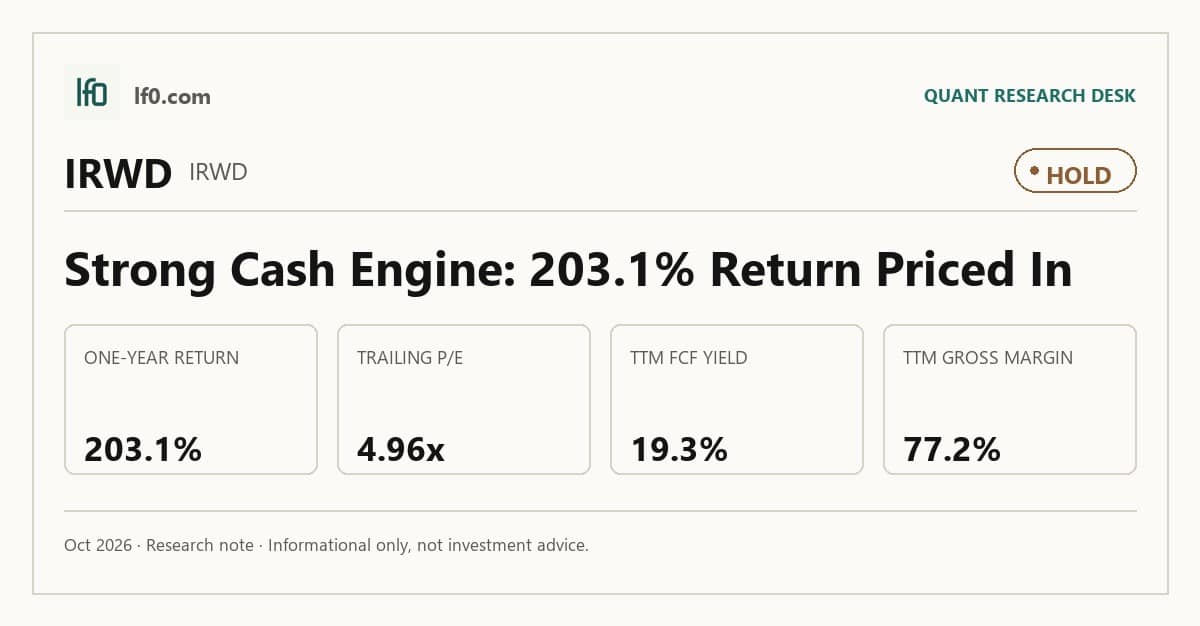
- Rated hold — LINZESS cash flow is real, but apraglutide is delayed and the stock already prices in much of the progress.
- Strongest financial point: TTM FCF yield is 19.3% with $121.8M of levered free cash flow.
- Biggest risk: LINZESS concentration plus the January 1, 2027 Medicare net price reset at $136.
- Valuation is fair to slightly rich versus peers at 2.5x forward P/E and 4x EV/EBITDA.
- I would turn more constructive if STARS-2 starts on schedule in Q2 2026 and revenue stays above $100M per quarter.
Executive Summary
Rating: HOLD | IRWD
Measured from adjusted close on 2026-10-12 to 2026-10-12. Sell ratings are correct when the stock falls; Hold is tracked as a +/-10% range. Daily-close data, not intraday. Calls are tracked for 182 days from publication, then frozen as a final record.
I would put my rating as a Hold because Ironwood already has a profitable LINZESS cash engine, but apraglutide has been pushed into a longer and more uncertain development path. In my view, the key question is not whether the business is profitable — it is — but whether that profitability can keep absorbing the 2027 Medicare price reset and still fund the next leg of growth. TTM levered free cash flow was $121.8M, current ratio was 6.1x, and net debt/EBITDA was 1.3x, so the balance sheet is not the problem. I would move more toward a Buy if STARS-2 site initiations in Q2 2026 stay on schedule and LINZESS cash flow holds through the January 1, 2027 net price reset, because that would show the core franchise can fund the pipeline without losing momentum.
Company Profile
Ironwood Pharmaceuticals is a biotechnology company focused on gastrointestinal and rare diseases. Its main revenue comes from LINZESS, a guanylate cyclase type C agonist sold in the U.S. with AbbVie under a 2007 collaboration and in Canada, Mexico, Europe, China, and Japan through partners that handle local development, manufacturing, and commercialization. The company was incorporated in Delaware in 1998 as Microbia, Inc. and changed its name to Ironwood Pharmaceuticals, Inc. in 2008. It acquired VectivBio in June 2023, adding apraglutide, a once-weekly synthetic glucagon-like peptide-2 candidate for short bowel syndrome with intestinal failure. Ironwood is listed on Nasdaq under IRWD. As of December 31, 2025, it had 100 employees, with 66 in development and 34 in selling, general and administrative functions.
Economic Moat
Business Model
The linaclotide franchise is the core structural advantage, and I do not think a well-funded competitor could rebuild it quickly. Ironwood and its partners already have an FDA-approved product, a global partner network, and a patent stack that protects the commercial formulation through the early 2030s in the U.S. LINZESS is the first U.S. FDA-approved GC-C agonist, while CONSTELLA in Canada and parts of Europe plus partnered commercialization rights with AbbVie, Astellas, and AstraZeneca give the asset a distribution footprint that would take years to recreate. The patent portfolio is not a perfect wall, because the linaclotide composition of matter patent now runs to February 28, 2027 after pediatric exclusivity and some generic settlements allow launches as early as March 2029, but that still leaves a meaningful bridge for cash generation and brand defense.
Apraglutide is the second pillar, but in my view it is still a development asset rather than a moat in its own right. Ironwood acquired VectivBio in June 2023, and that deal brought apraglutide into the pipeline; the company then moved from a rolling new drug application in January 2025 to a required confirmatory Phase III trial after U.S. FDA discussions in April 2025, with STARS-2 site initiations expected in Q2 2026. The business is therefore more focused than it was in 2022 to 2024, but also more concentrated: the linaclotide cash engine now carries the rare-disease program rather than sitting beside a broader pipeline.
Business & Operating Risks
LINZESS concentration is the clearest risk because Ironwood is highly dependent on the commercial success of LINZESS in the U.S. for the foreseeable future, and the 10-K says revenues from the LINZESS collaboration constitute a significant portion of total revenue. Any erosion in U.S. demand, payer access, or AbbVie execution flows directly into the top line, and the filing names coverage and reimbursement levels, prior authorization, and competition from generic prescription drugs and OTC alternatives as specific pressure points. The current-year filing also shows the risk has already started to bite, because the LINZESS list price has been lowered effective January 1, 2026.
Medicare pricing reform is a second pressure point because LINZESS was selected for the second cycle of IRA negotiations on January 17, 2025, and the MFP for a 30-day equivalent supply of LINZESS will become the new Medicare net price as of January 1, 2027 at $136. That is not abstract policy risk; it is a disclosed price reset on the company’s core product, and it should compress net pricing in a channel that already matters enough to be singled out in the filing. Apraglutide adds a different kind of risk because a confirmatory Phase III clinical trial is now needed after pharmacokinetic analysis showed the dose delivered in STARS was lower than planned due to dose preparation and administration. That pushes the program into a longer, more capital-intensive path before it can be re-approached for approval.
Partner dependence and manufacturing execution remain important because Ironwood relies on contract manufacturers, its partners, and other third parties, while AbbVie holds the NDA for LINZESS. If AbbVie, Astellas, AstraZeneca, or a contract manufacturer stumbles, the company can lose timing, supply, or reporting control, and the filing warns that a partner breach could trigger costly litigation or delay commercialization. The disclosed risks do not threaten the moat itself so much as the cash bridge that moat is supposed to provide: the linaclotide franchise still looks durable, but the 2027 price reset and apraglutide delay make that bridge narrower.
Management Discussion & Analysis
Management is responding to the risks by tightening the cost base and preserving cash, but it is not yet solving the concentration issue. The clearest proof is the $20.3M of restructuring expense in 2025, tied to workforce reductions in January and August 2025, which tells me management is using cost cuts to protect operating income rather than to fund a broad expansion. Selling, general and administrative expense fell by $62M in 2025 and research and development expense fell by $16.3M, so the company is defending the existing franchise while keeping the pipeline alive.
That said, apraglutide has moved from a near-term approval path to a longer, more capital-intensive one, and management is now treating STARS-2 as the gating event. At the same time, it is still investing in linaclotide, including pediatric expansion, and the October 15, 2025 pediatric exclusivity plus the November 2025 approval for pediatric patients 7 years of age and older with IBS-C support that franchise. I read that as a sensible response to the disclosed risks, but not as a full offset to them: management is extending the life of the core asset while waiting for the second leg to prove itself.
Recent Events
The most important recent event was Gregory Martini’s resignation as Senior Vice President, Chief Financial Officer, disclosed on May 13, 2026 and effective May 15, 2026. Because the filing says the exit was not tied to any disagreement over financial reporting, I read it as a management transition rather than a control issue, but it still matters at a company where liquidity discipline is central to the thesis.
The more constructive item is that Ronald Silver, the long-time Corporate Controller and Chief Accounting Officer, was named interim chief financial officer and principal financial officer effective May 15, 2026. That internal handoff reduces the risk of a disruptive search and suggests continuity in accounting and reporting. Earlier filings point in the same direction on financing flexibility: on March 11, 2026, Ironwood said it had satisfied the liquidity conditions under its credit agreement, leaving the revolving facility maturity at December 31, 2028. Taken together, the recent 8-Ks leave the investment case materially unchanged, with the CFO change the main execution test.
Financial Analysis
Growth
IRWD — Financial Growth (Quarterly, USD Mil)
| Metric | 2025-06-30 | 2025-09-30 | 2025-12-31 | 2026-03-31 | 2026-06-30 |
|---|---|---|---|---|---|
| REVENUE (USD Mil) | 85.2 | 122.1 | 47.7 | 106.5 | 113 |
| EBIT (USD Mil) | 46.2 | 76.5 | 8.3 | 74.1 | 80.9 |
| EBITDA (USD Mil) | 46.6 | 76.9 | 8.8 | 74.6 | 81.4 |
| NET INCOME (USD Mil) | 23.6 | 40.1 | -2.3 | 40.8 | 51.3 |
| DILUTED EPS | 0.1 | 0.2 | 0 | 0.2 | 0.3 |
Source: Yahoo Finance — Quarterly Financial Statements
Revenue rebounded from $47.7M in Q4 2025 to $106.5M in Q1 2026 and then $113M in Q2 2026, after a sharp drop from $122.1M in Q3 2025 to $47.7M in Q4 2025. I do not read that as a demand problem; it looks more like a swing quarter in a business that still has a concentrated revenue base. EBITDA rose from $74.6M in Q1 2026 to $81.4M in Q2 2026, and net income improved from $40.8M to $51.3M, which tells me the recovery is flowing through to earnings rather than just sales.
Profitability
IRWD — Profitability (TTM)
| Metric | TTM |
|---|---|
| Operating Margin (TTM) | 70.2% |
| Net Margin (TTM) | 33.4% |
| Return on Assets (TTM) | 47.0% |
| Return on Equity (TTM) | — |
| Gross Margin (TTM) | 77.2% |
| EBITDA Margin (TTM) | 61.2% |
Source: Yahoo Finance — Trailing Twelve Months (TTM)
TTM gross margin was 77.2%, EBITDA margin was 61.2%, operating margin was 70.2%, net margin was 33.4%, and ROA was 47.0%. That spread says the core product economics are already strong, and the main drag is below the operating line rather than in cost of goods sold. The gap from 77.2% gross margin to 70.2% operating margin is only 7.1 points, which means overhead is well controlled for a commercial-stage biotech. The larger drop from 70.2% operating margin to 33.4% net margin shows financing and other below-the-line charges still take a meaningful share of profit, so I would focus on cash generation and net income together rather than gross profit alone.
Valuation
IRWD — Valuation Multiples
| Metric | Value |
|---|---|
| Current Share Price (USD) | 3.8 |
| Market Cap (USD Mil) | 631 |
| Enterprise Value (USD Mil) | 957 |
| Trailing P/E | 5 |
| Forward P/E | 2.5 |
| Price/Sales (TTM) | 1.6 |
| Price/Book (mrq) | -3.9 |
| EV/Revenue | 2.5 |
| EV/EBITDA | 4 |
| Beta (5Y Monthly) | 0.22 |
| FCF Yield % (TTM) | 19.3% |
| Forward EPS (USD) | 1.5 |
| Analyst Target Price – Low (USD) | 3.7 |
| Analyst Target Price – Mean (USD) | 6.1 |
| Analyst Target Price – High (USD) | 10 |
| # Analyst Opinions | 4 |
Source: Yahoo Finance
IRWD trades at 2.46x EV/Revenue, 4.02x EV/EBITDA, 4.96x trailing P/E, and 2.55x forward P/E on a current share price of $3.82. That stack says the market is paying for a durable LINZESS cash stream plus optionality on apraglutide, not for near-term earnings acceleration. FCF yield is 19.3% on TTM levered free cash flow of $121.8M, which is the cleanest support for the valuation because the business is already turning profit into cash.
On my read, fair value sits in a range of roughly $4 to $7 per share. That range sits inside the analyst target band of $3.7 to $10, but below the $6.1 mean because I weight the 2027 LINZESS price reset and the delayed apraglutide path more heavily than the consensus appears to. Forward EPS is 1.5, and that looks reasonable against the company’s 2.55x forward P/E, but the more important point is that IRWD’s earnings base is still tied to a single mature franchise. Relative to peers, that makes the stock look fairly valued rather than obviously cheap.
Leverage
IRWD — Leverage & Coverage (Quarterly)
| Metric | Value |
|---|---|
| Total Debt/Equity % (mrq) | — |
| Current Ratio (mrq) | 6.1 |
| Total Debt (mrq, USD Mil) | 396.9 |
| Operating Cash Flow (TTM, USD Mil) | 185.6 |
| Levered Free Cash Flow (TTM, USD Mil) | 121.8 |
| Net Debt/EBITDA (TTM) | 1.3 |
| FCF Margin % (TTM) | 31.3% |
Source: Yahoo Finance — Quarterly Financial Statements
Ironwood’s leverage profile is manageable, but it is not a balance-sheet strength signal. Current ratio was 6.1x, total debt was $396.9M, operating cash flow was $185.6M, levered free cash flow was $121.8M, net debt/EBITDA was 1.3x, and FCF margin was 31.3%. That combination gives the company room to absorb a downturn because liquidity is ample and cash generation is positive, but it is still carrying meaningful debt for a biotech with negative book value. EBITDA is converting into cash reasonably well, so the business is funding itself rather than leaning on external capital.
Insider Activity
The insider transaction record is entirely net selling, with 22 open-market sales and 0 open-market purchases in the 2025-01-17 to 2026-05-19 window. The pattern is concentrated around one very large sale by Alexander Denner on 2026-03-17, but it is also broad because multiple executives sold on 2026-02-23 and 2026-02-24. I do not think that proves the thesis is broken, but it does weaken the case for insider alignment at a time when the stock is already up sharply.
Comparable Analysis
Growth
| Company | Revenue TTM (USD Mil) | Revenue Growth YoY % | EBITDA TTM (USD Mil) | Diluted EPS TTM |
|---|---|---|---|---|
| IRWD | 389.3 | 32.6% | 238.1 | 0.8 |
| LXRX | 41.5 | -97.6% | -54 | -0.2 |
| ARDX | 450.9 | 23.8% | -32.1 | -0.2 |
| BHC | 10,853 | 12.7% | 3,908 | -3 |
| SMMT | — | — | -874.7 | -1.1 |
| XERS | 335.4 | 28.7% | 48.8 | -0.1 |
Source: Yahoo Finance
IRWD’s revenue growth was 32.6% TTM, ahead of ARDX at 23.8%, XERS at 28.7%, BHC at 12.7%, and far above LXRX at -97.6%; SMMT does not report revenue in the table. IRWD also generated $238.1M of EBITDA TTM, which matters because the growth is being backed by earnings rather than by sales alone. That combination is stronger than the group’s average growth profile and is the main reason I think the market can justify a premium to weaker peers.
Valuation
| Company | Current Share Price (USD) | Trailing P/E | Forward P/E | EV/Revenue | EV/EBITDA | Price/Sales (TTM) | Price/Book (mrq) | Market Cap (USD Mil) | Enterprise Value (USD Mil) | Beta (5Y Monthly) | FCF Yield % (TTM) | Forward EPS | Analyst Target Price – Low | Analyst Target Price – Mean | Analyst Target Price – High | # Analyst Opinions |
|---|---|---|---|---|---|---|---|---|---|---|---|---|---|---|---|---|
| IRWD | 3.8 | 5 | 2.5 | 2.5 | 4 | 1.6 | -3.9 | 631 | 957 | 0.22 | 19.3% | 1.5 | 3.7 | 6.1 | 10 | 4 |
| LXRX | 1.7 | — | -8.8 | 15.7 | -12.1 | 18 | 4.3 | 748 | 652 | 1.08 | -6.0% | -0.2 | 2 | 4.5 | 8 | 6 |
| ARDX | 3.3 | — | 11.3 | 1.8 | -25.4 | 1.9 | 5.5 | 847 | 816 | 0.68 | 2.4% | 0.3 | 8 | 12.9 | 18 | 10 |
| BHC | 6 | — | 1.4 | 2 | 5.7 | 0.2 | -1.3 | 2,259 | 22,182 | 0.37 | 63.5% | 4.2 | 6.5 | 7.5 | 9 | 5 |
| SMMT | 17.6 | — | -15.4 | — | -14.9 | — | 22.2 | 14,032 | 13,027 | -1.52 | -1.0% | -1.1 | 11.9 | 29.8 | 43.1 | 13 |
| XERS | 10.5 | — | 28.3 | 6 | 41.5 | 5.7 | -187.1 | 1,911 | 2,026 | 0.84 | 2.8% | 0.4 | 8 | 12.9 | 18 | 7 |
Source: Yahoo Finance
IRWD trades at 2.46x EV/Revenue, 4.96x trailing P/E, 2.55x forward P/E, and a 19.3% FCF yield TTM. By comparison, ARDX is at 1.81x EV/Revenue and 2.42% FCF yield, XERS at 6.04x and 2.75%, BHC at 2.04x and 63.47%, and LXRX at 15.72x and -5.99%. On a peer-multiple basis, applying the 1.81x to 6.04x EV/Revenue range to IRWD’s 389.3M revenue implies an enterprise value of about $705M to $2.4B, or roughly $2.0 to $9.3 per share after netting $396.9M of debt and $79.1M of cash. That range brackets the current $3.82 share price, which tells me the stock is not obviously cheap, but it is also not priced for perfection. The market is paying for IRWD’s stronger profitability and cash conversion, not just for growth.
Profitability
| Company | Operating Margin (TTM) | Net Margin (TTM) | Return on Assets (TTM) | Return on Equity (TTM) | Gross Margin (TTM) | EBITDA Margin (TTM) |
|---|---|---|---|---|---|---|
| IRWD | 70.2% | 33.4% | 47.0% | — | 77.2% | 61.2% |
| LXRX | -3,835.3% | -147.4% | -14.3% | -40.2% | 86.0% | -130.3% |
| ARDX | -10.3% | -12.4% | -4.2% | -38.6% | 75.0% | -7.1% |
| BHC | 27.2% | -10.1% | 6.6% | — | 71.8% | 36.0% |
| SMMT | 0.0% | 0.0% | -101.6% | -192.5% | — | — |
| XERS | 5.6% | -5.1% | 6.1% | — | 86.6% | 14.5% |
Source: Yahoo Finance
IRWD’s 77.2% gross margin, 70.2% operating margin, 61.2% EBITDA margin, and 33.4% net margin all clear ARDX at 75.0%, -10.3%, -7.1%, and -12.4%, LXRX at 86.0%, -3,835.3%, -130.3%, and -147.4%, and XERS at 86.6%, 5.6%, 14.5%, and -5.1%. The gap looks structural, not cyclical, because IRWD is already showing scale leverage while the others are still absorbing development or commercialization costs. That profitability edge is the main reason IRWD deserves a better multiple than the loss-making names.
Leverage
| Company | Total Debt/Equity % (mrq) | Current Ratio (mrq) | Total Debt (mrq, USD Mil) | Operating Cash Flow TTM (USD Mil) | Free Cash Flow TTM (USD Mil) | Net Debt/EBITDA (TTM) | FCF Margin % (TTM) |
|---|---|---|---|---|---|---|---|
| IRWD | — | 6.1 | 396.9 | 185.6 | 121.8 | 1.3 | 31.3% |
| LXRX | 33.9 | 13.4 | 59.2 | -65 | -44.8 | 2.4 | -108.0% |
| ARDX | 189.6 | 3.3 | 282.5 | -17.3 | 20.5 | 0 | 4.5% |
| BHC | — | 1.4 | 20,779 | 1,800 | 1,433.6 | 4.8 | 13.2% |
| SMMT | 3.2 | 7 | 20.4 | -458.4 | -139.7 | 0.8 | — |
| XERS | — | 1.4 | 289.4 | 56.6 | 52.5 | 3.4 | 15.6% |
Source: Yahoo Finance
IRWD’s net debt/EBITDA is 1.3x, below LXRX at 2.4x and XERS at 3.4x, while its 31.3% FCF margin and $121.8M of TTM free cash flow show the balance sheet is being funded by real cash generation rather than dilution. The 6.1x current ratio is also much stronger than XERS at 1.4x and BHC at 1.4x, which means IRWD has more room to fund launches and absorb volatility without leaning on capital markets. Lower leverage also helps explain why IRWD can trade at a better multiple than some peers even though its revenue base is smaller.
Conclusion
I would put my rating as a Hold because the LINZESS cash engine is already visible in the numbers, but the stock also carries a 2027 Medicare price reset and a delayed apraglutide path that keep the upside from looking one-sided. The key tension is that the business is profitable enough to fund itself — TTM levered free cash flow was $121.8M and FCF margin was 31.3% — yet the next leg of growth still has to clear a regulatory and clinical hurdle before it can contribute meaningfully.
The bull case is straightforward: if LINZESS holds its cash generation through the January 1, 2027 net price reset and STARS-2 starts on schedule in Q2 2026, then the company can keep compounding from a position of strength. In that case, I would be more willing to move toward a Buy because the current ratio of 6.1x and net debt/EBITDA of 1.3x give management enough room to fund the pipeline without stressing the balance sheet. The bear case is just as clear: if the price reset and lower list price push FCF margin down from 31.3% toward the low 20s, the cash cushion shrinks quickly, and the stock would be leaning on a mature franchise with less room for error. A weaker-than-expected STARS-2 start would make that problem worse, because it would leave the valuation anchored to LINZESS alone.
For now, I think the cash generation is real enough to support the stock, but not strong enough to justify a more aggressive call. The market is already giving credit for the profitable base, so I want to see the next proof point before I move higher.
What to Watch Next
- STARS-2 site initiations in Q2 2026 — on time would support a move toward Buy.
- LINZESS net pricing after the January 1, 2027 reset — stability would protect free cash flow.
- Quarterly revenue above $100M — would show the cash base is holding.
- FCF margin staying near 31% — would confirm the business is still self-funding.
- Net debt/EBITDA near 1.3x — would keep refinancing risk contained.
What’s your take? I rated Ironwood Pharmaceuticals (IRWD) HOLD above — but the goal here is to get this right, not just to publish an opinion. What would you add to this analysis, or which risk or catalyst do you think I’m under- or over-weighting? Tell me in the comments.
Sources
- SEC 10-K Annual Report — filed 2026-02-26
- SEC 8-K Filing (2026-05-13)
- SEC 8-K Filing (2026-05-07)
- SEC 8-K Filing (2026-03-11)
- SEC 8-K Filing (2026-02-25)
- SEC 8-K Filing (2026-01-02)
- SEC Form 4 Insider Transaction (2026-05-21)
- SEC Form 4 Insider Transaction (2026-03-17)
- SEC Form 4 Insider Transaction (2026-03-12)
- SEC 10-K Annual Report — FY2026
- SEC 10-K Annual Report — FY2025
- SEC 10-K Annual Report — FY2024
- SEC 10-K Annual Report — FY2023
- SEC 10-K Annual Report — FY2022
Data sourced from Yahoo Finance and SEC EDGAR. Not investment advice.
Leave a Comment