
| Company | Jul 25 | Aug 25 | Sep 25 | Oct 25 | Nov 25 | Dec 25 | Jan 26 | Feb 26 | Mar 26 | Apr 26 | May 26 | Jun 26 | 12-Mo |
|---|---|---|---|---|---|---|---|---|---|---|---|---|---|
| CDE | -2% | +51% | +43% | -8% | +1% | +3% | +15% | +33% | -31% | -4% | +8% | -16% | +84% |
| HL | -4% | +48% | +42% | +6% | +31% | +14% | +17% | +11% | -25% | -3% | -1% | -13% | +158% |
| AG | -4% | +15% | +34% | +4% | +19% | +9% | +25% | +54% | -33% | -8% | +7% | -20% | +105% |
| EXK | +3% | +23% | +26% | +5% | +21% | -5% | +16% | +27% | -33% | -1% | +8% | -17% | +68% |
| SVM | +4% | +11% | +31% | +3% | +20% | +7% | +21% | +38% | -23% | +12% | +6% | -20% | +140% |
Source: Yahoo Finance monthly adjusted close.
Executive Summary
Rating: HOLD | CDE
Measured from adjusted close on 2026-10-21 to 2026-10-22. Sell ratings are correct when the stock falls; Hold is tracked as a +/-10% range. Daily-close data, not intraday. Calls are tracked for 182 days from publication, then frozen as a final record.
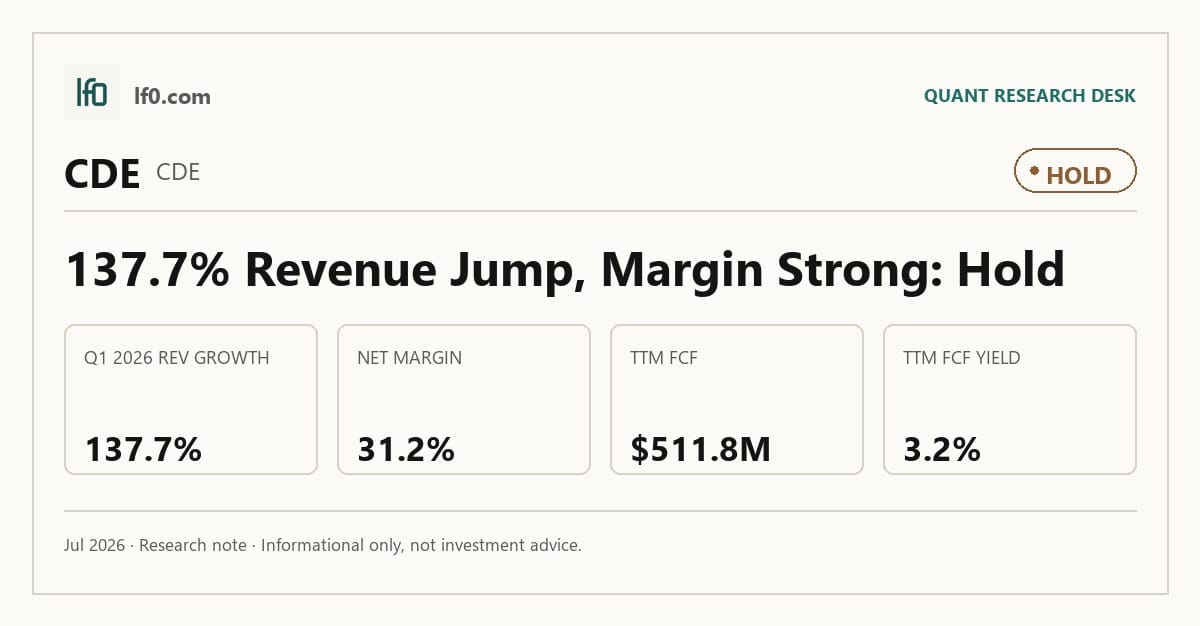
I would put my rating as a Hold because Coeur Mining has already re-rated on the back of stronger production, higher metal prices, and a cleaner balance sheet, so the stock now needs another leg of cash-flow improvement to justify more upside. Revenue reached $856.2M in Q1 2026, EBITDA was $454.1M, and levered free cash flow was $511.8M over the last twelve months, which tells me the operating model is working; the question is whether that strength is already reflected in the share price.
The key tension is valuation versus execution. Coeur is not expensive on a simple earnings screen at 8.0x forward P/E, but I feel the market is already paying for a good part of the 2025 step-up through a 6.1x EV/Revenue multiple and a 3.2% FCF yield. The main risk is that the current run rate depends on supportive metal prices and continued integration progress, especially with New Gold still ahead.
I would become more constructive if quarterly EBITDA stays above $400M, meaning the current margin structure is holding even as the company absorbs New Gold and keeps the Rochester ramp on track.
Company Profile
Coeur Mining, Inc. was founded in 1928 and is a precious metals producer listed on the New York Stock Exchange under CDE. It mines, processes, and sells gold and silver dor, gold concentrate, and silver concentrate from Las Chispas in Sonora, Palmarejo in Chihuahua, Rochester in Nevada, Kensington in Alaska, and Wharf in South Dakota. It also owns the Silvertip silver, zinc, and lead exploration project in British Columbia. Las Chispas began operations in 2022 and was acquired in early 2025, Rochester completed a major expansion in 2024, and Kensington’s permit was extended in 2022 to add 10 years of mine life. Coeur entered into an Arrangement Agreement in November 2025 to acquire New Gold, which would add New Afton and Rainy River in Canada. As of December 31, 2025, it had 2,620 employees and $773.2M of debt.
Economic Moat
Business Model
The moat here is not brand or pricing power; it is the combination of permitted assets, operating mines, and processing capacity that would be hard to assemble quickly. Rochester’s 2024 expansion is the clearest example, because it paired a long-life Nevada orebody with a larger processing footprint that a competitor could not replicate in a short period. I also think the company’s permit base matters: the 2026 10-K shows required permits in hand for Palmarejo, Las Chispas, Rochester, Kensington, Wharf, and Silvertip, which gives Coeur a practical barrier to entry that is more durable than scale alone. Doré and concentrate are sold through multiple refiners, bullion banks, bullion trading houses, and smelters, so no single counterparty appears to control the commercial outlet for production.
Business & Operating Risks
The disclosed risks are real, but they do not look like they are breaking the moat itself; they are testing how much value the moat can still deliver. Metal-price exposure is the biggest one, because all revenue comes from gold and silver sales and the New Gold deal adds copper sensitivity, so a sharp commodity move can still overwhelm the operating advantage. Input inflation is the next pressure point, since fuel, electricity, labor, reagents, explosives, steel, and concrete can all squeeze margins if prices soften. Mine-life, reserve, and project-execution risk also matters because the growth plan depends on expansions and acquisitions rather than a single easy reserve replacement cycle. The risk set does not negate the moat, but it does mean the moat only pays off if management keeps converting permitted assets into cash flow.
Management Discussion & Analysis
Management is responding to those risks by leaning into scale, liquidity, and selective capital deployment rather than stretching the balance sheet. The New Gold transaction was approved by stockholders on January 27, 2026 and is still expected to close in the first half of 2026, so the company is using M&A to broaden the asset base while it still has room to do so. It also kept 2026 guidance centered on 390,000 to 460,000 ounces of gold and 18.2 million to 21.3 million ounces of silver, which tells me the near-term plan still depends on Rochester and Las Chispas doing the heavy lifting. The $75M share repurchase program, of which $9.6M was used in 2025, looks opportunistic rather than aggressive, and that is sensible while sustaining capex is expected to run $207M to $239M and development capex $98M to $125M in 2026.
Management’s credibility has improved. Rochester’s ramp was described as progressing in the prior filing, and 2025 gold production there rose 54% while silver production rose 40%, so that operational promise was delivered. Debt also fell to $773.2M at December 31, 2025 from $590.1M a year earlier, which supports the view that the balance-sheet repair was real. The remaining issue is that the company is still exposed to a heavy tax and capex load, so the growth plan is cash-funded but not cash-light.
Recent Events
The March 20, 2026 acquisition of New Gold is the most important recent event because it expands Coeur’s North American footprint while raising the execution bar. The deal was paired with a new $1B senior secured revolving credit facility, which gives the company more flexibility but also makes covenant discipline more important as the portfolio gets larger. On April 22, 2026, Coeur completed a private exchange for $385.8M of 6.875% Senior Notes due 2032, a constructive refinancing that extends funding but also tightens limits on dividends, debt, liens, and asset sales.
Governance changes in May were more incremental. Kenneth Watkinson announced retirement for early 2027, Anne Beckelheimer was named Chief Accounting Officer, and shareholders approved officer-liability limits and the annual advisory pay vote. Coeur also declared an inaugural $0.02 dividend and continued buybacks, with $680.3M still authorized as of May 15, 2026. Taken together, the recent events support the moat thesis by showing active capital deployment and a cleaner capital structure, but they also make integration discipline more important than before.
Financial Analysis
Growth
CDE — Financial Growth (Quarterly, USD Mil)
| Metric | 2025-03-31 | 2025-06-30 | 2025-09-30 | 2025-12-31 | 2026-03-31 |
|---|---|---|---|---|---|
| REVENUE (USD Mil) | 360.1 | 480.6 | 554.6 | 674.8 | 856.2 |
| EBIT (USD Mil) | 61.6 | 141 | 175.6 | 332.9 | 354.3 |
| EBITDA (USD Mil) | 104.7 | 202.4 | 248.6 | 406.6 | 454.1 |
| NET INCOME (USD Mil) | 33.4 | 70.7 | 266.8 | 215 | 246.8 |
| DILUTED EPS | 0.1 | 0.1 | 0.4 | — | 0.3 |
Source: Yahoo Finance — Quarterly Financial Statements
Revenue accelerated from $360.1M in Q1 2025 to $856.2M in Q1 2026, and that step-up is the clearest evidence that the operating base is scaling. EBITDA rose from $104.7M to $454.1M over the same span, so margin leverage is still working rather than being diluted by growth. The Q4 2025 jump fits the company’s record-quarter narrative and higher realized gold and silver prices, which means the move looks supported by operations and not just by a one-off accounting effect. That matters for the thesis because the growth is now large enough to fund the balance sheet and the acquisition plan at the same time.
Profitability
CDE — Profitability (TTM)
| Metric | TTM |
|---|---|
| Operating Margin (TTM) | 43.0% |
| Net Margin (TTM) | 31.1% |
| Return on Assets (TTM) | 6.7% |
| Return on Equity (TTM) | 12.1% |
| Gross Margin (TTM) | 58.6% |
| EBITDA Margin (TTM) | 53.2% |
Source: Yahoo Finance — Trailing Twelve Months (TTM)
TTM gross margin was 58.6% and EBITDA margin was 53.2%, which shows Coeur is keeping more than half of revenue after direct costs and before depreciation. Operating margin was 43.0% and net margin was 31.1%, so the business is converting a large share of sales into reported profit rather than just EBITDA. Return on assets was 6.7% and return on equity was 12.1%; the gap tells me leverage is helping equity returns, so I would watch cash generation alongside ROE rather than treat it as a standalone quality signal. The margin profile is consistent with the operating leverage described in the moat section, and it is the main reason the stock can support a mid-teens earnings multiple.
Valuation
CDE — Valuation Multiples
| Metric | Value |
|---|---|
| Market Cap (USD Mil) | 15,870 |
| Enterprise Value (USD Mil) | 15,696 |
| Trailing P/E | 12.4 |
| Forward P/E | 8 |
| Price/Sales (TTM) | 6.2 |
| Price/Book (mrq) | 1.5 |
| EV/Revenue | 6.1 |
| EV/EBITDA | 11.5 |
| Beta (5Y Monthly) | 1.30 |
| FCF Yield % (TTM) | 3.2% |
| Forward EPS (USD) | 1.9 |
| Analyst Target Price – Low (USD) | 18.8 |
| Analyst Target Price – Mean (USD) | 24.8 |
| Analyst Target Price – High (USD) | 40 |
| # Analyst Opinions | 11 |
Source: Yahoo Finance
Coeur trades at 6.1x EV/Revenue and 11.5x EV/EBITDA, with a 12.4x trailing P/E and 8.01x forward P/E. On my read, that puts fair value in a range of roughly $19-$25 per share, with the lower end reflecting the current cash-flow yield and the upper end assuming the market keeps credit for the production step-up. That range sits broadly inside the analyst target band of $18.8–$40, but it is closer to the low and middle of the range than to the high, which tells me consensus still leaves room for debate on how much of the growth is durable. Forward EPS is $1.92, and that looks reasonable against peers because the company is not paying a premium multiple for a weak earnings base; it is paying a normal multiple for a stronger cash generator. I would not call the stock cheap, because the 3.2% FCF yield and 1.53x price/book already reflect a good deal of the improvement.
Leverage
CDE — Leverage & Coverage (Quarterly)
| Metric | Value |
|---|---|
| Total Debt/Equity % (mrq) | 7.4 |
| Current Ratio (mrq) | 3.7 |
| Total Debt (mrq, USD Mil) | 773.2 |
| Operating Cash Flow (TTM, USD Mil) | 1,160.1 |
| Levered Free Cash Flow (TTM, USD Mil) | 511.8 |
| Net Debt/EBITDA (TTM) | -0.1 |
| FCF Margin % (TTM) | 20.0% |
Source: Yahoo Finance — Quarterly Financial Statements
Leverage is a clear strength. Total debt/equity was 7.4%, current ratio was 3.7x, and total debt was $773.2M, while total cash was $843.2M, so the company sits in a net cash position. Operating cash flow was $1.2B over the last twelve months, levered free cash flow was $511.8M, net debt/EBITDA was -0.1x, and FCF margin was 20.0%, which means earnings are turning into cash at a healthy rate. That cash conversion matters because it gives Coeur room to absorb the New Gold integration without leaning on the balance sheet. In my view, the leverage profile is one of the strongest parts of the case and is the main reason downside should be more contained than the valuation alone suggests.
Insider Activity
The insider record is net selling. There were 6 open-market sales for $1.4M versus 3 purchases for $61,387 across 81 filings parsed from 2025-02-21 to 2026-06-01, and the latest trade was a 39,000-share sale by Kenneth J. Watkinson on 2026-06-01. I read that as a mild caution flag rather than a thesis breaker, but it does matter because the stock has already rerated and insider buying has not shown up to offset the sales.
Comparable Analysis
Growth
| Company | Revenue TTM (USD Mil) | Revenue Growth YoY % | Diluted EPS TTM |
|---|---|---|---|
| CDE | 2,566.3 | 137.8% | 1.2 |
| HL | 1,629.1 | 100.4% | 0.7 |
| AG | 1,489.9 | 95.4% | 0.6 |
| EXK | 613.7 | 230.2% | -0.1 |
| SVM | 438.1 | 96.2% | -0.1 |
Source: Yahoo Finance
Coeur’s revenue growth was 137.8% TTM, ahead of HL at 100.4%, AG at 95.4%, and SVM at 96.2%, though EXK was faster at 230.2%. The more important point is scale: Coeur generated $2.6B of TTM revenue, versus $1.6B for HL, $1.5B for AG, $613.7M for EXK, and $438.1M for SVM, so its growth is coming from a much larger base. That makes the growth more investable than a smaller peer’s faster percentage alone.
Valuation
| Company | Trailing P/E | Forward P/E | EV/Revenue | EV/EBITDA | Price/Sales (TTM) | Price/Book (mrq) | Market Cap (USD Mil) | Enterprise Value (USD Mil) | Beta (5Y Monthly) | FCF Yield % (TTM) | Forward EPS | Analyst Target Price – Low | Analyst Target Price – Mean | Analyst Target Price – High | # Analyst Opinions |
|---|---|---|---|---|---|---|---|---|---|---|---|---|---|---|---|
| CDE | 12.4 | 8 | 6.1 | 11.5 | 6.2 | 1.5 | 15,870 | 15,696 | 1.30 | 3.2% | 1.9 | 18.8 | 24.8 | 40 | 11 |
| HL | 22.2 | 13.2 | 6.1 | 11.4 | 6.3 | 4 | 10,272 | 9,953 | 1.29 | 2.7% | 1.2 | 17 | 23.5 | 32 | 9 |
| AG | 28.2 | 16.8 | 5.2 | 9.7 | 5.5 | 2.8 | 8,209 | 7,718 | 2.11 | 7.9% | 1 | 22.5 | 24.2 | 26 | 2 |
| EXK | — | 6.1 | 3.8 | 11.5 | 3.8 | 3.7 | 2,361 | 2,350 | 2.37 | 0.6% | 1.3 | 15.5 | 16.2 | 17 | 3 |
| SVM | — | 5.9 | 4.5 | 7.5 | 5 | 2.3 | 2,169 | 1,989 | 1.97 | 4.2% | 1.7 | 13.5 | 14.2 | 15 | 2 |
Source: Yahoo Finance
On valuation, Coeur’s 6.1x EV/Revenue is in line with HL, above AG’s 5.2x, EXK’s 3.8x, and SVM’s 4.5x, so the market is not giving it a clear scarcity premium. The stock’s 3.2% FCF yield is better than HL’s 2.7% and EXK’s 0.6%, but below AG’s 7.9% and SVM’s 4.2%, which is why I think the multiple is fair rather than cheap. Coeur’s 8.0x forward P/E on $1.92 of forward EPS also sits below HL’s 13.2x and AG’s 16.8x, while EXK and SVM are lower at 6.1x and 5.9x; in other words, the market is not paying up for Coeur as if it were the highest-growth name, even though its leverage profile is cleaner than most peers. A $1 investment in CDE one year ago would be worth 1.60 today, versus 2.44 in HL, 1.87 in AG, 1.37 in EXK, and 1.99 in SVM, so the stock has participated in the sector move but has not led it.
Profitability
| Company | Operating Margin (TTM) | Net Margin (TTM) | Return on Assets (TTM) | Return on Equity (TTM) | Gross Margin (TTM) | EBITDA Margin (TTM) |
|---|---|---|---|---|---|---|
| CDE | 43.0% | 31.1% | 6.7% | 12.1% | 58.6% | 53.2% |
| HL | 55.5% | 16.8% | 13.8% | 19.9% | 59.6% | 53.8% |
| AG | 49.5% | 19.5% | 8.0% | 11.5% | 59.7% | 53.6% |
| EXK | 39.9% | -3.5% | 7.4% | -3.9% | 40.4% | 33.3% |
| SVM | 62.6% | -2.3% | 10.9% | 3.4% | 73.3% | 60.3% |
Source: Yahoo Finance
Coeur’s operating margin was 43.0% TTM, below HL at 55.5%, AG at 49.5%, and SVM at 62.6%, but above EXK at 39.9%. EBITDA margin was 53.2%, close to HL’s 53.8% and AG’s 53.6%, which tells me the company is competitive on core operating efficiency even if it does not lead the group. Net margin was 31.1%, well ahead of HL at 16.8%, AG at 19.5%, EXK at -3.5%, and SVM at -2.3%, so Coeur is converting its scale into bottom-line profit better than most peers. Return on equity was 12.1% and return on assets was 6.7%, which is solid, though not best in class.
Leverage
| Company | Total Debt/Equity % (mrq) | Current Ratio (mrq) | Total Debt (mrq, USD Mil) | Free Cash Flow TTM (USD Mil) | Net Debt/EBITDA (TTM) | FCF Margin % (TTM) |
|---|---|---|---|---|---|---|
| CDE | 7.4 | 3.7 | 773.2 | 511.8 | -0.1 | 20.0% |
| HL | 11.1 | 4.9 | 285.1 | 277.1 | -0.4 | 17.0% |
| AG | 9.5 | 2.7 | 314 | 648.2 | -1 | 43.5% |
| EXK | 38.7 | 1.7 | 249.5 | 14.7 | 0 | 2.4% |
| SVM | 10.7 | 3.6 | 118.4 | 90.2 | -1.1 | 20.6% |
Source: Yahoo Finance
Coeur’s debt/equity ratio was 7.4%, versus HL at 11.1%, AG at 9.5%, EXK at 38.7%, and SVM at 10.7%, so the balance sheet is among the cleaner ones in the group. Net debt/EBITDA was -0.1x, compared with HL at -0.4x, AG at -1.0x, EXK at 0.0x, and SVM at -1.1x, and that supports the view that Coeur can fund growth without stretching financing. The 20.0% FCF margin is also strong relative to HL at 17.0% and EXK at 2.4%, which is why the leverage profile and the valuation profile should be read together: the market is not paying a premium for balance-sheet risk, but it is also not pricing the stock as if cash conversion were exceptional.
Conclusion
I would put my rating as a Hold because the stock already discounts a lot of the operating improvement, while the next leg of upside depends on New Gold integration and sustained metal prices rather than on a fresh rerating catalyst. Coeur has done the hard part on the balance sheet and cash flow side, but the market is now asking for proof that the current margin structure can survive a larger, more complex portfolio.
I would raise my rating more towards a Buy if quarterly EBITDA stays above $400M, meaning the company is holding its current operating leverage while absorbing New Gold and keeping Rochester on plan. I would also want to see levered free cash flow remain above $500M over the next four quarters, because that would show the business is still funding growth from internal cash rather than from a stretched capital structure. On the upside, that combination would tell me the current multiple is too low for a cleaner North American producer with a net cash balance sheet.
I would move from Hold to Sell if quarterly EBITDA falls back below $350M, because that would tell me the margin structure is too dependent on favorable commodity prices. I would also turn more cautious if free cash flow slips below $400M for a full year, since that would leave less room to absorb integration risk and would make the current valuation harder to defend.
Weighing both sides, I think the operating case is stronger than the bear case, but the stock is already close enough to fair value that timing matters. My final view is still Hold: the business is improving, yet I do not think the current price leaves enough margin of safety unless the next few quarters confirm that the cash generation is durable.
What’s your take? I rated Coeur Mining (CDE) HOLD above — but the goal here is to get this right, not just to publish an opinion. What would you add to this analysis, or which risk or catalyst do you think I’m under- or over-weighting? Tell me in the comments.
Sources
- SEC 10-K Annual Report — filed 2026-02-18
- SEC 8-K Filing (2026-05-18)
- SEC 8-K Filing (2026-05-13)
- SEC 8-K Filing (2026-05-06)
- SEC 8-K Filing (2026-04-23)
- SEC 8-K Filing (2026-03-23)
- SEC 8-K Filing (2026-02-18)
- SEC Form 4 Insider Transaction (2026-06-02)
- SEC Form 4 Insider Transaction (2026-03-23)
- SEC Form 4 Insider Transaction (2026-03-23)
- SEC 10-K Annual Report — FY2026
- SEC 10-K Annual Report — FY2025
- SEC 10-K Annual Report — FY2024
- SEC 10-K Annual Report — FY2023
- SEC 10-K Annual Report — FY2022
Data sourced from Yahoo Finance and SEC EDGAR. Not investment advice.
Leave a Comment