
| Company | Sep 25 | Oct 25 | Nov 25 | Dec 25 | Jan 26 | Feb 26 | Mar 26 | Apr 26 | May 26 | Jun 26 | Jul 26 | Aug 26 | 12-Mo |
|---|---|---|---|---|---|---|---|---|---|---|---|---|---|
| CUE | -8% | +7% | -18% | -52% | +10% | -16% | -18% | +114% | +49% | +44% | -15% | -5% | +9% |
| CABA | +61% | +54% | -29% | -15% | +17% | +29% | -19% | +11% | +26% | -18% | -14% | +16% | +114% |
| CGEM | -21% | +46% | +31% | -9% | +16% | +30% | -8% | -8% | +26% | +11% | -9% | +34% | +193% |
| EQ | -18% | -1% | -36% | +72% | -8% | +28% | +10% | +2% | +42% | +10% | -31% | +3% | +30% |
| QTTB | +16% | +42% | -22% | +52% | +17% | +18% | +41% | -13% | +97% | +15% | +23% | -5% | +770% |
| CHRS | +41% | +2% | -19% | +4% | +52% | -23% | +1% | +5% | -10% | -12% | +1% | -4% | +16% |
Source: Yahoo Finance monthly adjusted close.
Quick Thesis
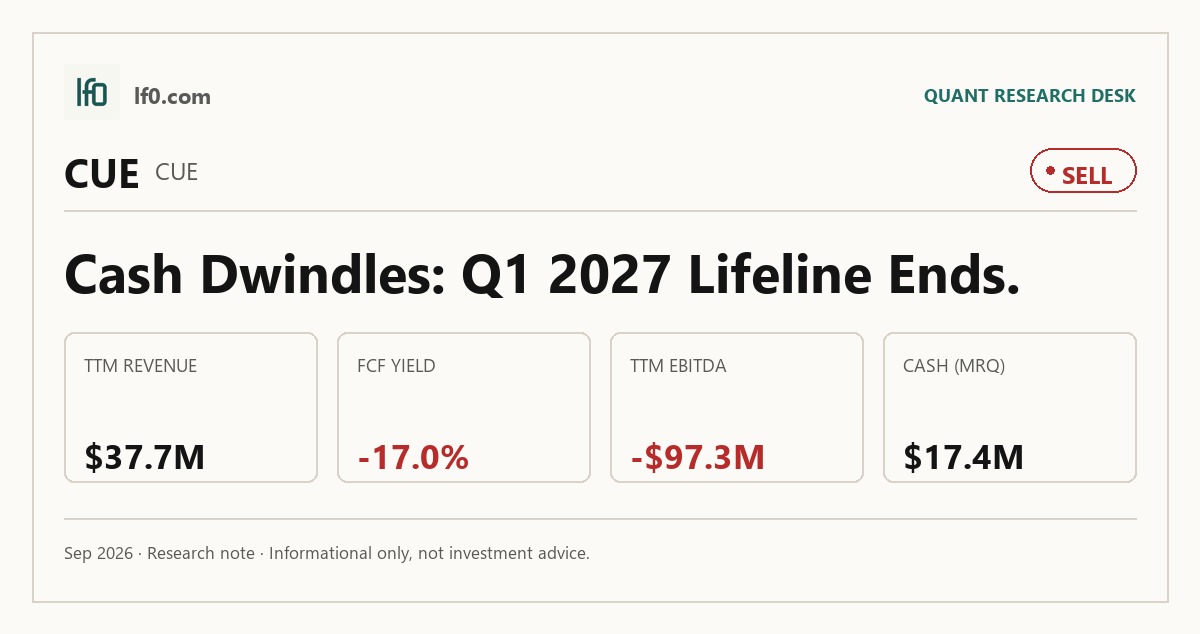
- Rated sell — cash burn and dilution risk arrive before clinical proof.
- Strongest point: the platform’s IP base, with 161 issued patents and 308 pending applications.
- Biggest risk: only $27.1M of cash at year-end 2025, with runway into Q1 2027.
- Valuation is rich at 5.1x EV/revenue despite negative free cash flow.
- I would move more bearish if the Q2 2026 IND slips or burn stays near $50.1M TTM.
Executive Summary
Rating: SELL | CUE
Measured from adjusted close on 2026-09-02 to 2026-10-16. Sell ratings are correct when the stock falls; Hold is tracked as a +/-10% range. Daily-close data, not intraday. Calls are tracked for 182 days from publication, then frozen as a final record.
I would put my rating as a Sell because Cue Biopharma is still a cash-burning, precommercial biotech whose next value inflection depends on clinical execution that has not yet arrived. The company’s core strength is the Immuno-STAT platform and the patent estate behind it, but that advantage is being tested by a balance sheet that leaves little room for delay. In my view, the key issue is not whether the science is interesting; it is whether management can get CUE-401 into the clinic on time without forcing shareholders through another dilutive raise first. I would become more constructive only if the Q2 2026 IND filing lands on schedule and the company shows human safety data in 2H 2026 without a material step-up in cash burn.
Company Profile
Cue Biopharma, Inc. is a clinical-stage biopharmaceutical company developing injectable biologics that selectively engage disease-relevant T cells for autoimmune, inflammatory, and oncology indications through its Immuno-STAT platform. It was incorporated in Delaware on December 31, 2014 as Imagen Biopharma, Inc., changed its name to Cue Biopharma in October 2016, and completed its IPO on December 27, 2017. The company is listed on Nasdaq under CUE and had 29 full-time employees at December 31, 2025, with substantially all staff based in Massachusetts.
Its lead autoimmune program, CUE-401, is in preclinical development and the company expects to file an investigational new drug application in Q2 2026. Cue also has a collaboration and license agreement with Boehringer Ingelheim International GmbH for CUE-501, a B cell depletion program, and an agreement with ImmunoScape Pte. Ltd. for the CUE-100 oncology series. The business is financed primarily through equity and collaboration proceeds, while the Einstein license adds royalty and milestone obligations tied to the core platform.
Economic Moat
Business Model
The exclusive worldwide license to Albert Einstein College of Medicine’s patent estate is the most defensible part of Cue Biopharma’s model because it gives the company control over the core Immuno-STAT platform, the CUE-400 series, and the CUE-500 series through patents that run no earlier than 2033 to 2045, with drug-product patents no earlier than December 2037, subject to extensions. In my view, a competitor would struggle to recreate that position within 3 years, and the license also includes the right to sublicense, make, use, and sell products built on those patents. Secondary support comes from the platform’s modular design, which lets Cue swap targeting domains across autoimmune and oncology programs, and from the 161 issued patents and 308 pending patent applications it held at December 31, 2025.
The business has shifted from an oncology-first posture to a more balanced autoimmune-led portfolio. In 2022, the company was prioritizing the CUE-100 series for oncology and was still seeking third-party support for the rest of the platform; by 2025, it had regained worldwide rights to CUE-401 in March 2025 and entered the Boehringer Ingelheim International GmbH collaboration for CUE-501 in April 2025, while ImmunoScape Pte. Ltd. exercised its option in November 2025 to develop the CUE-100 series. That evolution matters because it shows the platform is no longer just a science project centered on one oncology program, but a set of partnered and internally controlled assets with multiple shots on goal. The footprint also changed materially: today the company is preparing to file an investigational new drug application for CUE-401 in Q2 2026 and expects human safety data in 2H 2026, which means the lead value driver is moving closer to clinical proof.
Business & Operating Risks
The most material disclosed risk is financing. According to their SEC filings, Cue Biopharma had only $27.1M of cash and cash equivalents as of December 31, 2025 and believes that cash lasts only into Q1 2027, which means the company is already inside a near-term funding window and any delay in capital access could force program cuts. The filing is explicit that it will need to raise substantial additional capital, that dilution may be significant, and that failure to do so could force it to delay, reduce or discontinue development programs or pursue dissolution and liquidation with little or no return to investors. The financial data in this article already shows the risk is not hypothetical: the company remains pre-revenue, has an accumulated deficit of $368.5M as of December 31, 2025, and the Nasdaq minimum bid deficiency adds another financing constraint because a delisting would make capital raising harder.
Clinical execution is the second major risk. CUE-401 and CUE-501 are at a preclinical stage, while CUE-101 and CUE-102 still require additional trials before FDA approval. If preclinical or early clinical data do not translate, the company can lose time, spend more cash, and still end up with no approvable product. That risk is already visible in the financial data, since the business has never generated product sales and continues to post negative cash flow, so any delay pushes the financing problem closer. The filing also ties this to third-party dependence, noting reliance on CROs, CMOs, Catalent Pharma Solutions, LLC, and PCI San Diego, Inc.; if any of those supply or trial links fail, development timelines slip and costs rise.
The collaboration structure is now a more prominent risk than it was three years ago. Boehringer Ingelheim International GmbH has an exclusive worldwide license for B cell depletion molecules and ImmunoScape Pte. Ltd. has a co-exclusive development license for the CUE-100 series for five years or longer, while the company is prohibited from developing or commercializing any molecule for applications in B cell depletion during the BI research term. That is a real trade-off: the partnerships bring external support, but they also narrow Cue’s control over its own pipeline and make future economics more dependent on counterparties. The disclosed risks do not directly threaten the moat itself; they threaten the company’s ability to fund and execute on that moat before the patent estate can translate into clinical assets.
Management Discussion & Analysis
Management is responding to the financing and execution risks by leaning harder into partnerships and by narrowing spend to the programs that still matter most. CUE-401 is now the lead program, with an investigational new drug application planned for Q2 2026 and human safety data expected in 2H 2026, so the near-term value driver is clinical de-risking rather than internal commercialization. That shift is reinforced by the April 2025 collaboration and license agreement with Boehringer Ingelheim International GmbH for CUE-501 and the November 2025 collaboration and license agreement with ImmunoScape Pte. Ltd. for the CUE-100 series, because both deals push development expense and downstream execution to partners while bringing in cash and potential milestones.
The cash picture is still the gating item. $27.1M of cash and cash equivalents at December 31, 2025 is projected to fund operations only into Q1 2027, so the current strategy depends on additional equity offerings, collaborations, or other strategic alliances rather than self-funding. That is a meaningful gap between the partnership narrative and the financial reality, since the company also says it will need substantial additional capital and that future equity raises may cause significant dilution. Capital allocation also looks selective rather than broad based: research and development expense rose to $37.7M in 2025 from $36.3M in 2024, with $3.9M of acquired in-process research and development tied to IMSCP and $8.8M of contract manufacturing costs, while CUE-100 clinical trial costs fell to $3.7M from $7.1M as those assets were licensed out.
Prior filings showed a consistent pattern of optimistic platform language, but the outcomes have been mixed. In 2023 and 2024 management emphasized prioritizing CUE-101 and CUE-102 in oncology, yet by 2025 those programs were licensed to IMSCP and the company recognized only $27.5M of collaboration revenue in 2025 versus $9.3M in 2024, which confirms that monetization came from partnering rather than from advancing wholly owned commercial assets. The 2025 filing also said the company would need additional capital and that it had limited cash flows from operations; that proved correct, because the 2026 filing again discloses a going concern warning and a runway only into Q1 2027. Leadership continuity has been weak, with severance paid to the former Chief Executive Officer and the 2026 filing again referencing severance tied to the former Chief Medical Officer, so investors should note that key scientific and corporate leadership has not been stable.
Recent Events
The most significant development I see is the April 30, 2026 license deal with Ascendant Health Sciences for Ascendant-221, Cue’s anti-IgE antibody, because it gives the company exclusive worldwide rights outside Greater China and turns the platform into a broader allergy and immunology asset. That strengthens the thesis by adding a real commercial path, but the structure is expensive: $15M upfront, up to $676.5M of milestones, and tiered royalties, so the upside now depends on execution rather than just owning the asset.
On May 29 and June 1, 2026, the board was reshaped at the same time that the company appointed Sumita Ray as Chief Legal & Compliance Officer and Corporate Secretary, Michael Meluzio as principal accounting officer, and two new directors, Daniel Camardo and Viola Meehan, while shrinking the board from seven to five. In my view, that combination signals tighter governance and more biotech operating experience, which supports the thesis after a licensing transaction that will require clean disclosure and disciplined capital handling.
The June 1, 2026 special meeting also approved the 2026 Stock Incentive Plan and the warrant share issuance tied to the licensing transaction and related private placement. I read that as a financing and dilution step that weakens per-share economics even as it funds the new license, so the recent 8-Ks leave the investment case improved strategically but more levered to successful clinical and commercial follow-through.
Financial Analysis
Growth
CUE — Financial Growth (Quarterly, USD Mil)
| Metric | 2025-03-31 | 2025-06-30 | 2025-09-30 | 2025-12-31 | 2026-03-31 |
|---|---|---|---|---|---|
| REVENUE (USD Mil) | 0.4 | 3 | 2.1 | 21.9 | 5.7 |
| EBIT (USD Mil) | -12.1 | -8.4 | -7.4 | 2.1 | -5.2 |
| EBITDA (USD Mil) | -11.2 | -7.6 | -6.8 | 3.3 | -4.2 |
| NET INCOME (USD Mil) | -12.3 | -8.5 | -7.4 | 1.6 | -5.2 |
| DILUTED EPS | -5 | -2.7 | -2.1 | 0.3 | -1.1 |
Source: Yahoo Finance — Quarterly Financial Statements
Revenue was $5.69M in Q1 2026 versus $0.421M in Q1 2025, up 1,251% year over year, but that jump is distorted by the much larger $21.9M base in Q4 2025, so I would not extrapolate it as a clean run rate. EBITDA improved from $-11.2M in Q1 2025 to $-4.25M in Q1 2026, while net income moved from $-12.3M to $-5.18M, so losses are narrowing faster than revenue is scaling. The quarter-to-quarter swing is still too volatile to underwrite as durable growth, which is why the clinical and financing timeline matters more than the headline growth rate.
Profitability
CUE — Profitability (TTM)
| Metric | TTM |
|---|---|
| Operating Margin (TTM) | -1,113.3% |
| Net Margin (TTM) | 0.0% |
| Return on Assets (TTM) | -172.7% |
| Return on Equity (TTM) | -1,603.5% |
| Gross Margin (TTM) | -99.2% |
| EBITDA Margin (TTM) | -258.4% |
Source: Yahoo Finance — Trailing Twelve Months (TTM)
TTM operating margin was -1,113.3%, gross margin was -99.2%, EBITDA margin was -258.4%, net margin was 0.0%, ROA was -172.7%, and ROE was -1,603.5%. The gross margin and EBITDA margin are deeply negative, which tells me the business is still in the pre-commercial, cash-burning stage where product economics and overhead are both far from scale. The operating margin is far worse than gross margin, so the main drag is not just cost of revenue but a heavy fixed-cost structure that has not been absorbed by sales. Net margin at 0.0% should be read as a breakeven label in the table, not as evidence of durable profitability, because the quarterly income statement still shows losses. ROE and ROA are both sharply negative, and the much larger ROE loss versus ROA suggests returns are being distorted by capital structure rather than genuine earnings power. I would watch for gross margin turning positive and EBITDA margin moving toward breakeven first, because that would show the platform is starting to cover direct costs before overhead.
Valuation
CUE — Valuation Multiples
| Metric | Value |
|---|---|
| Market Cap (USD Mil) | 196 |
| Enterprise Value (USD Mil) | 192 |
| Forward P/E | -56.3 |
| Price/Sales (TTM) | 5.2 |
| Price/Book (mrq) | 61.2 |
| EV/Revenue | 5.1 |
| EV/EBITDA | -2 |
| FCF Yield % (TTM) | -17.0% |
| Forward EPS (USD) | -0.5 |
| Analyst Target Price – Low (USD) | 66 |
| Analyst Target Price – Mean (USD) | 90.5 |
| Analyst Target Price – High (USD) | 115 |
| # Analyst Opinions | 2 |
Source: Yahoo Finance
CUE Biopharma screens as a cash-burning, precommercial biotech, so EV/revenue and price/sales are the right anchors. EV/revenue is 5.1x and price/sales is 5.2x, which implies the market is paying for a pipeline that can convert today’s revenue base into a much larger, durable revenue stream after clinical proof. That is a rich ask for a company with quarterly earnings growth of -37.3% and forward EPS of -$0.5, because the current valuation already assumes future programs will clear development risk and reach monetization. Forward P/E is -56.3x and EV/EBITDA is -2.0x, both of which are not useful cheap-versus-expensive signals here because losses make the denominator negative. FCF yield is -17.0%, which means the business is still consuming cash rather than generating it, so the equity is being valued on clinical optionality rather than current cash generation.
On the analysis here, I would put fair value in a range of about $15.1-$31.1 per share using the peer EV/revenue band and CUE’s current revenue base, after adjusting for cash, debt, and shares outstanding. That sits well below the $90.5 analyst mean target and below the $66-$115 target range, which tells me the sell-side is giving more credit to pipeline optionality than I am. With only 2 analyst opinions, though, that is not a broad consensus; it is a thin sample, so I treat the target range as a reference point rather than a true market anchor. The gap between my range and the targets is also a reminder that the stock is being priced more on future clinical success than on current cash economics.
Leverage
CUE — Leverage & Coverage (Quarterly)
| Metric | Value |
|---|---|
| Total Debt/Equity % (mrq) | 133.2 |
| Current Ratio (mrq) | 1.3 |
| Total Debt (mrq, USD Mil) | 3.1 |
| Operating Cash Flow (TTM, USD Mil) | -50 |
| Levered Free Cash Flow (TTM, USD Mil) | -33.4 |
| Net Debt/EBITDA (TTM) | 0.1 |
| FCF Margin % (TTM) | -88.8% |
Source: Yahoo Finance — Quarterly Financial Statements
Total debt was $3.077M, with total debt/equity at 133.2% and a current ratio of 1.255x, so the balance sheet has some near-term liquidity but not a lot of cushion. Operating cash flow was $-50.05M TTM and levered free cash flow was $-33.43M TTM, which means the business is still consuming cash rather than funding itself. Net debt/EBITDA was 0.1x, but that looks mechanically low because EBITDA is negative, not because cash generation is healthy. FCF margin was -88.8% TTM, and that is the clearest signal here: EBITDA is not converting into cash, so financing needs remain dependent on outside capital. The leverage profile and the valuation profile point in the same direction — the company is not yet earning a premium on balance-sheet strength, so the equity multiple is really a bet that clinical progress arrives before the cash runway tightens further.
Insider Activity
The insider transaction record I see here is clearly net buying, with 5 open-market purchases and 0 open-market sales across 27 Form 4 filings parsed from 2025-12-30 to 2026-05-03. The activity is concentrated in one insider, Sarraf Pasha, so the signal is supportive but not broad based; in aggregate, it still points to alignment between insiders and shareholders. I do not read it as enough to offset the financing overhang, but it does tell me management is willing to buy into the story at current levels.
Comparable Analysis
Growth
| Company | Revenue TTM (USD Mil) | Revenue Growth YoY % | EBITDA TTM (USD Mil) | Diluted EPS TTM |
|---|---|---|---|---|
| CUE | 37.7 | 166.7% | -97.3 | -29.5 |
| CABA | — | — | -184.1 | -1.4 |
| CGEM | — | — | -221.5 | -3.1 |
| EQ | — | — | -19.2 | -0.1 |
| QTTB | 53.7 | — | 21.8 | 3.1 |
| CHRS | 50.9 | 39.5% | -150.4 | -1.2 |
Source: Yahoo Finance
CUE’s revenue growth of 166.7% TTM is the fastest in the set, but it is coming off a tiny $37.7M revenue base and sits alongside negative $97.3M EBITDA TTM and -29.5 diluted EPS TTM, so I read it as scale-up volatility rather than durable operating leverage. CHRS grew revenue 39.5% TTM on $50.9M of sales, while QTTB posted $53.7M of revenue with positive EBITDA of $21.8M and diluted EPS of 3.1, which shows how far CUE still is from converting growth into earnings power.
Valuation
| Company | Trailing P/E | Forward P/E | EV/Revenue | EV/EBITDA | Price/Sales (TTM) | Price/Book (mrq) | Market Cap (USD Mil) | Enterprise Value (USD Mil) | FCF Yield % (TTM) | Forward EPS | Analyst Target Price – Low | Analyst Target Price – Mean | Analyst Target Price – High | # Analyst Opinions |
|---|---|---|---|---|---|---|---|---|---|---|---|---|---|---|
| CUE | — | -56.3 | 5.1 | -2 | 5.2 | 61.2 | 196 | 192 | -17.0% | -0.5 | 66 | 90.5 | 115 | 2 |
| CABA | — | -2.4 | — | -2 | — | 2.8 | 599 | 360 | -16.4% | -1.5 | 3 | 13.2 | 30 | 8 |
| CGEM | — | -8.1 | — | -4.8 | — | 4.4 | 1,350 | 1,070 | -6.6% | -2.7 | 23 | 32.4 | 42 | 11 |
| EQ | — | -9.6 | — | -4.3 | — | 2.6 | 143 | 83 | -10.0% | -0.2 | 4 | 8.6 | 20 | 9 |
| QTTB | 4.3 | -13.3 | 6.1 | 15 | 7.5 | 3 | 404 | 327 | 4.8% | -1 | 34 | 41 | 59 | 5 |
| CHRS | — | -2.2 | 3.2 | -1.1 | 4.3 | 3.6 | 218 | 161 | -73.5% | -0.6 | 4 | 7.8 | 10 | 4 |
Source: Yahoo Finance
CUE trades at 5.1x EV/revenue and 5.2x price/sales, versus CHRS at 3.2x EV/revenue and 4.3x price/sales, while QTTB is richer at 6.1x EV/revenue and 7.5x price/sales. That puts CUE in the middle of the peer range even though its FCF yield is -17.0%, worse than CABA’s -16.4%, CGEM’s -6.6%, and EQ’s -10.0%, and far below QTTB’s 4.8% positive yield. On forward EPS, CUE is -$0.5 versus CHRS at -$0.6, CABA at -$1.5, CGEM at -$2.7, EQ at -$0.2, and QTTB at -$1.0, so the stock is not priced on a superior earnings path. The valuation premium is therefore tied to pipeline optionality, not to current profitability or cash generation.
Profitability
| Company | Operating Margin (TTM) | Net Margin (TTM) | Return on Assets (TTM) | Return on Equity (TTM) | Gross Margin (TTM) | EBITDA Margin (TTM) |
|---|---|---|---|---|---|---|
| CUE | -1,113.3% | 0.0% | -172.7% | -1,603.5% | -99.2% | -258.4% |
| CABA | 0.0% | 0.0% | -48.2% | -93.2% | — | — |
| CGEM | 0.0% | 0.0% | -31.4% | -50.3% | — | — |
| EQ | 0.0% | 0.0% | -34.0% | -59.0% | — | — |
| QTTB | 39.9% | 62.9% | 14.7% | 72.1% | 73.3% | 40.6% |
| CHRS | -226.0% | -259.4% | -30.5% | -178.4% | 69.0% | -295.2% |
Source: Yahoo Finance
CUE’s operating margin of -1,113.3%, gross margin of -99.2%, EBITDA margin of -258.4%, net margin of 0.0%, ROA of -172.7%, and ROE of -1,603.5% are far weaker than CHRS’s -226.0% operating margin, -295.2% EBITDA margin, and 69.0% gross margin, and they are nowhere near QTTB’s 39.9% operating margin, 73.3% gross margin, and 40.6% EBITDA margin. The fact that CUE’s gross margin is negative while its operating margin is also deeply negative points to a cost-of-revenue problem first, not just an opex scaling issue, which is a harder problem for investors because it suggests the business model itself is still not converting revenue into gross profit.
Leverage
| Company | Total Debt/Equity % (mrq) | Current Ratio (mrq) | Total Debt (mrq, USD Mil) | Operating Cash Flow TTM (USD Mil) | Free Cash Flow TTM (USD Mil) | Net Debt/EBITDA (TTM) | FCF Margin % (TTM) |
|---|---|---|---|---|---|---|---|
| CUE | 133.2 | 1.3 | 3.1 | -50 | -33.4 | 0.1 | -88.8% |
| CABA | 12.2 | 5.8 | 25.7 | -153.9 | -98.3 | 1.1 | — |
| CGEM | 0.6 | 8.4 | 2.1 | -159.2 | -89.2 | 1.5 | — |
| EQ | 1 | 23.4 | 0.6 | -20 | -14.3 | 2.9 | — |
| QTTB | 5 | 20.3 | 5.3 | -19.8 | 19.4 | -4.6 | 36.1% |
| CHRS | 89.1 | 1.8 | 54.2 | -186 | -160.2 | 0.3 | -314.4% |
Source: Yahoo Finance
CUE’s total debt/equity is 133.2% versus CHRS at 89.1%, CABA at 12.2%, CGEM at 0.6%, EQ at 1.0%, and QTTB at 5.0%, yet its net debt/EBITDA is only 0.1x because EBITDA is negative and cash is still $17.4M. The real issue is FCF margin of -88.8% and free cash flow of -$33.4M TTM, or about -$4.6 per share, which means the company is funding losses rather than compounding capital like QTTB, whose 36.1% FCF margin and -4.6x net debt/EBITDA show what a cash-generative peer looks like. In other words, the leverage burden would matter less if cash flow were improving faster; instead, the burn rate keeps the financing risk front and center.
Conclusion
I would put my rating as a Sell because Cue Biopharma’s clinical optionality is still outrunning its cash generation, and the balance sheet gives it only a limited window to prove otherwise. The company has a defensible patent-backed platform, but the numbers show that the moat has not yet translated into durable economics: free cash flow is $-33.43M TTM, FCF margin is -88.8% TTM, and cash was only $27.1M at year-end 2025. In my view, that is the key tension in the case — the science may be interesting, but the financing clock is already ticking.
I would raise my rating more towards a Hold if CUE-401 files its IND in Q2 2026 and the company then shows human safety data in 2H 2026 without a material cash burn step-up, because that would move the lead autoimmune program from concept toward proof. If operating cash outflow narrows from $50M TTM to below $35M TTM, meaning the annual burn falls by roughly 30%, the current cash runway would extend meaningfully beyond Q1 2027 and reduce the odds of a near-term dilutive raise. A new partnership that brings in enough upfront cash to cover at least one full year of burn would also help, because it would shift the financing burden away from common shareholders.
I would move from Sell to Strong Sell if the company misses the Q2 2026 IND filing, or if cash burn stays near the current $50M TTM pace while the balance sheet remains at $27.1M of cash, because that would pull the financing window even tighter. A Nasdaq compliance failure would add another layer of pressure because it would make capital access harder just as the company needs it most, and a financing round priced at a meaningful discount before clinical proof would force existing holders to absorb dilution before any value inflection is visible.
Weighing both paths, I think the bear case is more likely to arrive first because the funding clock is already running and the clinical catalysts are still ahead of the data. The stock can work if the IND lands on time and partner capital arrives before the runway gets tight, but until that sequence is visible, I see dilution risk as the nearer event and the stronger force on the shares.
What to Watch Next
- Q2 2026 IND filing for CUE-401 — on time would support a move toward Hold.
- Human safety data in 2H 2026 — clean readout would strengthen the clinical case.
- Operating cash outflow below $35M TTM — would extend runway meaningfully.
- Cash balance versus runway — a faster drawdown would raise dilution risk.
- New upfront partnership cash — enough to fund one year of burn would ease financing pressure.
What’s your take? I rated Cue Biopharma (CUE) SELL above — but the goal here is to get this right, not just to publish an opinion. What would you add to this analysis, or which risk or catalyst do you think I’m under- or over-weighting? Tell me in the comments.
Sources
- SEC 10-K Annual Report — filed 2026-03-16
- SEC 8-K Filing (2026-06-03)
- SEC 8-K Filing (2026-06-02)
- SEC 8-K Filing (2026-05-14)
- SEC 8-K Filing (2026-05-01)
- SEC 8-K Filing (2026-04-22)
- SEC 8-K Filing (2026-04-13)
- SEC Form 4 Insider Transaction (2026-06-08)
- SEC Form 4 Insider Transaction (2026-06-03)
- SEC Form 4 Insider Transaction (2026-06-02)
- SEC 10-K Annual Report — FY2026
- SEC 10-K Annual Report — FY2025
- SEC 10-K Annual Report — FY2024
- SEC 10-K Annual Report — FY2023
- SEC 10-K Annual Report — FY2022
Data sourced from Yahoo Finance and SEC EDGAR. Not investment advice.
Leave a Comment