The Short Version
The Children’s Place is a penny stock in Consumer Cyclical, and the short side is crowded. Short interest, the number of shares investors have borrowed and sold betting the price will fall, is 3.27M shares, or 40.4% of the 8.09M float, which means about 40 shares out of every 100 that can trade have been borrowed and sold.⁽¹⁾
That is far above the market median of 4.5% and above the 95th percentile of 18.3%, so this is not a normal short.⁽¹⁾
A squeeze would need the stock to rise and keep rising on real buying, because days to cover, the number of days it would take shorts to buy back shares using normal trading volume, is 16.27, which is far above the market median of 4.1.⁽¹⁾
The catch is that the company also carries heavy debt and the latest price move was a sharp drop, not a rally.⁽²⁾⁽³⁾
So we see a crowded setup, but no clear trigger yet, and that keeps the squeeze case alive while also making the bear case easy to argue.⁽²⁾
Squeeze Scorecard
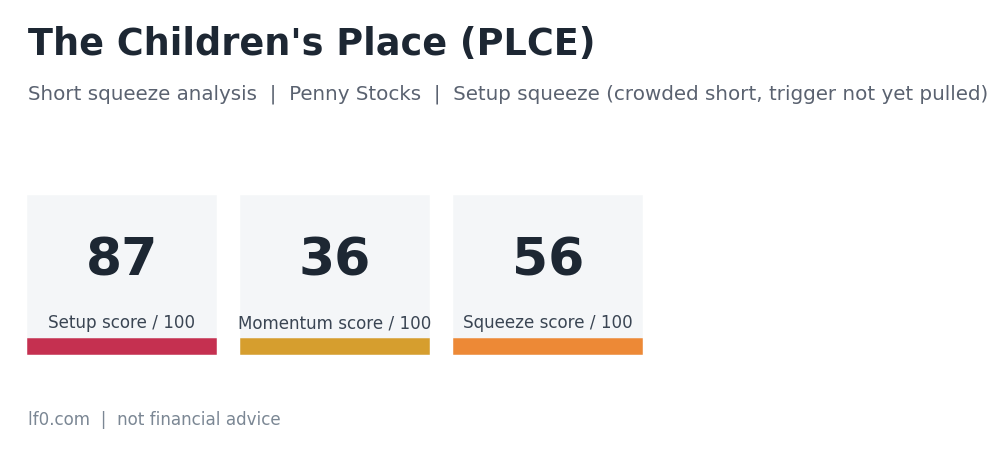
The Children’s Place (PLCE) | Penny Stocks | Setup squeeze (crowded short, trigger not yet pulled)
| Score | Value | Reading | What it measures |
|---|---|---|---|
| Setup Score | 87 / 100 | extreme | How crowded and fragile the bet against the stock is |
| Momentum Score | 36 / 100 | moderate | Whether price and volume are already forcing short sellers to react |
| Squeeze Score | 56 / 100 | strong | Both together, reduced for dilution and cash risks |
Prices as of 2026-10-28; short interest as of the 2026-09-30 report.
How to read the scorecard
We give every stock three scores out of 100. Setup asks: how crowded is the bet against this stock, and how hard would it be for the people betting against it to get out? Momentum asks: is something already happening, with price rising on unusually heavy trading? Squeeze combines the two. It needs both, because a crowded short with nothing happening can sit for months, and a price spike with no crowded short is just a spike.
Rough guide: 0 to 30 weak, 30 to 55 moderate, 55 to 75 strong, 75 and above extreme. Most stocks score under 30 on both.
| Low Momentum | High Momentum | |
|---|---|---|
| High Setup | Loaded spring: crowded short, trigger not yet pulled | Squeeze underway |
| Low Setup | Nothing to see | Price spike without a crowded short: often fades |
This stock: Setup 87 (extreme), Momentum 36 (moderate), Squeeze 56 (strong). Of the 3,186 stocks we scanned, this one ranked #1 on Squeeze Score. In plain terms, the bet against the stock is crowded and fragile (the spring is loaded), but price and volume have not yet forced anyone to react (the spring has not been released).
Key data
| Metric | Value |
|---|---|
| Share price (latest close) | $0.47 |
| Market value of the company | $10.5M |
| Float (shares free to trade) | 8.09M |
| Shares sold short | 3.27M |
| Short interest as % of float | 40.4% |
| Days to cover | 16.27 |
| Cost to borrow the shares (per year) | nan% |
| Shares still available to borrow | nan |
| Latest volume vs usual | 24.9x |
| Price change over 5 trading days | -54.4% |
Executive Summary
The Children’s Place is one of the most crowded short setups in our scan, but it is still a setup, not a confirmed squeeze. Short interest, the number of shares investors have borrowed and sold betting the price will fall, stands at 3.27M shares, or 40.4% of the 8.09M float, which is far above the market median of 4.5% and above the 99th percentile of 26.8%.⁽¹⁾
Days to cover, the number of days it would take shorts to buy back shares using normal trading volume, is 16.27, versus a market median of 4.1 and a 90th percentile of 9.1.⁽¹⁾
That combination tells us the short base is large and the stock is not easy to exit quickly if buyers show up.⁽¹⁾
At the same time, the latest session was a 54.4% drop on 6.70M shares, which is 24.9 times the 60-day average volume of 269,117 shares.⁽²⁾
That kind of volume says traders are active, but the move was down, so we do not yet have the upward price pressure that usually forces shorts to cover.⁽²⁾
Options are listed, but the current mix is more put-heavy than call-heavy, and that does not look like a classic call-driven squeeze ignition.⁽⁴⁾
The company’s balance sheet also matters here because a squeeze story is weaker when the bear case is built on real financial strain.⁽³⁾
Short Interest and Days to Cover
Short interest, the number of shares investors have borrowed and sold betting the price will fall, is 3.27M shares as of the latest short interest report dated 2026-09-30.⁽¹⁾
That is 40.4% of the 8.09M float, meaning about 40 shares out of every 100 that can trade have been borrowed and sold.⁽¹⁾
For context, the market median short interest is 4.5% of shares out, and the 95th percentile is 18.3%, so this stock sits well beyond the usual crowding level.⁽¹⁾
Among the 3,571 stocks in the comparison set, this stock is more heavily shorted than about 91% of names, and in its industry group it ranks 1 of 10 for short interest, where 1 means most shorted.⁽¹⁾
That matters because a crowded short can become fuel if the price starts moving up. Shorts who are already underwater may have to buy shares back, and that buying can push the price higher still.⁽¹⁾
Days to cover, the number of days it would take shorts to buy back shares using normal trading volume, is 16.27, which is far above the market median of 4.1 and above the 90th percentile of 9.1.⁽¹⁾
In the industry group, the median days to cover is 5.0, so this stock is not just shorted more than peers, it is also harder to unwind than peers.⁽¹⁾
We also see that the short position has been building and shifting over time. It was 2.72M on 2026-06-15, 3.07M on 2026-07-15, 3.47M on 2026-07-31, and 3.66M on 2026-08-31 before easing to 3.27M on 2026-09-30.⁽¹⁾
That history tells us shorts have been active for months, but it also shows they have not all rushed for the exit yet.⁽¹⁾
For a trader, the key question is whether a price rise comes with enough volume to make that exit expensive. If the stock starts climbing while volume stays elevated, the cover trade can become self-reinforcing. If price keeps falling or volume dries up, the short thesis gets breathing room instead.⁽²⁾⁽¹⁾
| Short interest (% of all shares) | Days to cover | |
|---|---|---|
| PLCE (this stock) | 14.7% | 16.27 |
| Industry median (9 peers: Retail-Family Clothing Stores) | 7.3% | 5.0 |
| Peer: Abercrombie & Fitch Co. (ANF) | 10.4% | 3.7 |
| Peer: American Eagle Outfitters (AEO) | 10.0% | 2.9 |
| Peer: Urban Outfitters, Inc. Common (URBN) | 8.3% | 6.9 |
| Peer: The Gap (GAP) | 7.3% | 3.8 |
| Peer: The Buckle (BKE) | 7.3% | 7.1 |
| Typical US-listed stock (median) | 4.5% | 4.1 |
| Most-shorted 10% of stocks start at | 13.6% | 9.1 |
| Most-shorted 1% of stocks start at | 26.8% |
Context for the numbers. This table measures short interest as a percent of all shares the company has issued, because that is the one measure we can compare across 3,571 stocks. The stricter percent-of-float figure used elsewhere in this article is always higher than this one. On this measure PLCE is more heavily shorted than about 91% of exchange-listed stocks.
Hover over a bar for the figures. Red bars: shares sold short at each twice-monthly report. Dashed blue line: the float, meaning the shares free to trade. Latest: 3.27M shares short, 40.4% of the float.
Borrow Fee and Availability
Borrow fee, the annualized cost to borrow shares for a short sale, is not available here.⁽⁵⁾
Shares available to borrow are also not available, so we cannot tell whether the lending market is tight or loose right now.⁽⁵⁾
That leaves us with an incomplete picture on the cost side of the short trade. In a true squeeze, a rising borrow fee and scarce shares to borrow can make it harder for shorts to stay in place, but we do not have those figures.⁽⁵⁾
We do know that the stock is not on the regulatory threshold list for persistent delivery failures, which means it is not currently flagged for that specific issue.⁽⁵⁾
At the same time, there were 215,615 failed deliveries in the latest half month, which tells us settlement friction has existed even if the stock is not on that list.⁽⁵⁾
For a trader, the missing borrow data matters because a crowded short is more dangerous when borrowing gets expensive or scarce. Without that evidence, we can say the short base is large, but we cannot say the borrow market is actively squeezing it yet.⁽⁵⁾⁽¹⁾
Price and Volume Trigger
The latest session closed at $0.47, and the stock fell 54.4% in that session and over the last 5 sessions.⁽²⁾
That is not the kind of move that usually starts a squeeze. A squeeze normally needs the stock to rise first, because rising prices force shorts to mark losses and may push them to buy back shares.⁽²⁾⁽¹⁾
Volume was 6.70M shares, which is 24.9 times the 60-day average volume of 269,117 shares.⁽²⁾
That is a huge burst of trading for a stock with a 22.24M share count and a $10.5M market cap, so the tape is active enough to matter.⁽²⁾
But the direction matters just as much as the size. Heavy volume on a down day can mean panic selling, forced liquidation, or short sellers pressing the trade, not necessarily the start of a squeeze.⁽²⁾
The stock is also sitting far below its 5-month high of $4.43, so there is room for a rebound if buyers step in, but there is also a long way to go before the chart looks repaired.⁽²⁾
A trader watching this setup would look for a reversal day, then follow-through on above-average volume. If the stock can reclaim ground and hold it, shorts may start to feel pressure. If it keeps making lower lows, the squeeze case weakens fast.⁽²⁾⁽¹⁾
Hover over any day for its price and volume. Blue line: daily closing price. Bars: shares traded each day; dashed line: the usual (60-day average) volume. The latest price of $0.47 is 89% below the six-month high of $4.43 (Jun 01). Orange bars mark days with at least three times the usual trading volume; the most recent was Oct 28.
Options and Gamma
Options are available, which means traders can express a bullish or bearish view without buying the stock itself. A call option is a contract that gives the right to buy shares at a set price, while a put option is a contract that gives the right to sell shares at a set price.⁽⁴⁾
The current options mix is heavily tilted toward puts, with 15,864 put open interest contracts versus 1,511 call open interest contracts.⁽⁴⁾
That is not the usual shape of a call-led squeeze setup. Call volume was 175 contracts, while put volume was 10,612 contracts, so the day’s flow was also put-heavy.⁽⁴⁾
Call open interest, the number of call contracts already open, equals 1.87% of the float in share terms, and there were no out-of-the-money call contracts 10% to 30% above spot.⁽⁴⁾
That matters because a gamma squeeze, a move where call buying forces market makers to buy stock to hedge, usually needs a meaningful pile of call demand near and above the current price. We do not see that here.⁽⁴⁾
Implied volatility, the options market’s estimate of future price swings, is not available near the money, so we cannot judge whether option pricing is already stretched.⁽⁴⁾
For a trader, the options market here looks more like a hedge or bearish expression than a fuel source for a squeeze. If call buying suddenly appears and the stock starts rising, that could change the picture quickly. If put demand stays dominant, options are more likely to reinforce caution than to ignite a rally.⁽⁴⁾⁽²⁾
Catalysts and Filings
No clear catalyst was identified in the recent headlines field.⁽²⁾
That matters because a squeeze usually needs a spark, such as a surprise earnings beat, a financing update, a turnaround headline, or a sudden change in trading behavior. Without a catalyst, the stock can still move, but the move is more likely to be noisy and unstable.⁽²⁾
There were 3 Form 8-K filings in the last 60 days, covering the creation of a direct financial obligation, the departure or appointment of directors or officers, and the entry into a material agreement.⁽⁶⁾
An 8-K is a filing companies use to report important events, and those topics tell us the company has had meaningful corporate activity recently.⁽⁶⁾
We also see no dilution filings in the last 12 months. Dilution means issuing new shares that can reduce each existing share’s claim on the business, and the usual warning signs would be registration statements or prospectus supplements that allow new share sales.⁽⁶⁾
That is helpful for the bull case because it means we do not have a recent filing signal that new shares are about to hit the market.⁽⁶⁾
Still, the absence of a dilution filing is not the same as a clean bill of health. The company can still face pressure from debt, operations, or future financing needs, and those risks can matter more than a filing count.⁽⁶⁾⁽³⁾
Solvency and Dilution Risk: The Bear Case
The bear case starts with the balance sheet. Cash is $7.2M, total debt is $622.5M, and net debt is $615.4M.⁽³⁾
That is a heavy debt load for a company with a $10.5M market cap.⁽³⁾
Revenue over the trailing 12 months was $1.13B, but net income was negative $133.0M, so the business is still losing money overall.⁽³⁾
Gross margin was 29.4%, which means the company keeps about 29 cents of gross profit for every dollar of sales before overhead and other costs.⁽³⁾
Operating cash flow over the trailing 12 months was $49.3M and free cash flow was $62.6M, which shows the business is generating cash on a trailing basis, but that does not erase the debt burden or the net loss.⁽³⁾
This is why short sellers may still be comfortable here. A stock can be heavily shorted for a reason, and a weak balance sheet can keep the bear case alive even when the float is tight.⁽³⁾⁽¹⁾
We also note that insiders hold 4.8% and institutions hold 75.7%, which means the float is not dominated by insiders.⁽¹⁾
For a squeeze to overpower this bear case, buyers would need to show up with enough force to change the tape, not just the story. If that does not happen, the debt and losses can keep weighing on the stock.⁽³⁾⁽²⁾
How I Would Play This
As an illustration only, not advice: I would treat this as a high-risk squeeze watch, not a clean momentum trade. I would only consider a very small share position if I wanted direct exposure, because the stock is already extremely volatile and the latest move was down hard. I would want to see a reversal day first, then follow-through on strong volume, before I added anything. If the stock cannot hold a bounce, I would assume the squeeze thesis is not working. I would not size this like a normal stock because the downside can be fast and severe. If I wanted optionality instead of shares, I would only use call options if I had a clear trigger and a short time frame, because options can expire worthless. If I were bearish, I would still be cautious about shorting into a crowded name, because a crowded short can move against you quickly. The thesis breaks if price keeps falling, volume fades, or the market stops rewarding the setup.
A small share position means buying a limited number of shares so the loss is capped by the amount invested, but the stock can still go to zero or near zero. Call options are contracts that can multiply gains if the stock rises, but the most you can lose is the premium paid, and they fit only if the move happens fast enough. Staying out is always a valid choice, especially when the catalyst is unclear and the tape is weak. Shorting a crowded stock can lose more than you put in because a rising stock has no built-in ceiling, so the loss can keep growing if the squeeze starts.⁽⁴⁾⁽¹⁾⁽²⁾
What Would Invalidate the Thesis
The squeeze thesis weakens if the stock keeps falling or cannot reclaim lost ground on strong volume.⁽²⁾
It also weakens if short interest falls materially in the next report, because the fuel for a squeeze would be smaller.⁽¹⁾
A lack of call demand would be another warning sign, since a squeeze often needs bullish options flow to add pressure.⁽⁴⁾
If the company were to announce a new dilution filing, that would be a major negative because new shares can expand supply and dilute existing holders.⁽⁶⁾
A fresh financing stress signal, a worsening balance sheet, or another negative corporate filing would also support the bear case rather than the squeeze case.⁽³⁾⁽⁶⁾
Conclusion
The Children’s Place is one of the most crowded shorts in our scan, with short interest far above the market and industry norms and days to cover that are also unusually high.⁽¹⁾
That said, we do not yet see the clean trigger that usually turns a crowded short into a squeeze, because the latest move was a sharp drop and the options market is not showing a call-led ignition.⁽²⁾⁽⁴⁾
The main risk for bulls is that the company’s debt load and losses keep the bear case intact, while the main risk for bears is that a sudden reversal on heavy volume could force covering.⁽³⁾⁽²⁾⁽¹⁾
Our overall read is simple: this is a real squeeze setup, but it is still waiting for the spark.
Sources
Where the figures in this article come from, so you can check them yourself:
- FINRA equity short interest report, settlement date 2026-09-30
- Daily price and volume history for PLCE
- Financial statements and balance sheet for PLCE
- Listed options chain for PLCE
- Borrow fee and shares available from Interactive Brokers’ public stock loan file; failed deliveries and threshold list from SEC and exchange data
- SEC filings for PLCE
How We Score This (Methodology v1)
Every stock in our daily scan gets two scores from 0 to 100. Each ingredient is scaled between a level that earns no points and a level that earns full points, then weighted by how much it matters. A score is the points earned divided by the weight of the ingredients we could measure, so a stock without listed options is not penalised for it.
Setup Score: how crowded and fragile is the bet against the stock?
| Ingredient | Weight | Points earned | How it scales |
|---|---|---|---|
| Short interest as % of float | 30 | 30.0 | 5% = 0 pts, 40% = full |
| Days to cover | 10 | 10.0 | 1 day = 0, 8 days = full |
| Borrow fee (annualised) | 15 | n/a | 5% = 0, 100% = full (log scale) |
| Shares available to borrow vs shares short | 10 | n/a | 50% of short = 0, 1% = full |
| Change in short interest since the prior report | 10 | 0.0 | 0% = 0, +30% = full |
| Float size | 10 | 10.0 | 500M shares = 0, 50M = full |
| Fails-to-deliver / Reg SHO threshold list | 5 | 5.0 | On threshold list = full |
| Listing pressure (low share price) | 10 | 10.0 | $3 = 0, $1 or below = full |
Momentum Score: is the squeeze already starting?
| Ingredient | Weight | Points earned | How it scales |
|---|---|---|---|
| Volume vs 60-day average | 30 | 30.0 | 1.5x = 0, 8x = full (log scale) |
| 5-day price change | 20 | 0.0 | +5% = 0, +100% = full |
| Gain from the 20-day low | 15 | 0.0 | +15% = 0, +150% = full |
| Call open interest (in shares) vs float | 15 | 0.5 | 1% = 0, 25% = full |
| Call/put volume ratio | 5 | 0.0 | 1.0 = 0, 5.0 = full |
| Implied volatility (nearest expiry, near the money) | 5 | n/a | 60% = 0, 300% = full |
| Social attention (StockTwits / Reddit) | 10 | n/a | Not scored in v1 (needs a browser session) |
Squeeze Score. The geometric mean of Setup and Momentum, so a stock needs both a crowded short and price pressure to rank highly. It is reduced by 20% if the company has recently filed paperwork that lets it sell new shares into a rally (which gives short sellers an exit), and by 15% if it has less than 12 months of cash at its current burn.
Size categories. Large Caps: market value of $10B or more. Penny Stocks: share price under $5 and market value under $300M. Small Caps: everything else.
A caution on timing. Short interest is only reported twice a month, so the true position today may be higher or lower than the figure shown.
This article is for educational and informational purposes only. It is not financial advice or a recommendation to buy or sell any security. Short squeeze stocks are extremely volatile and you can lose all of your investment. We may hold positions in securities we discuss. Do your own research.
Join the LF0 Equity Research community on Discord
Get each new research article as it is published and talk it through with other readers.
Leave a Comment